|

 Now that Wimbledon is done, it's time to look back at the past two weeks and see who were the winners and losers.
The obvious winner was Roger Federer. With this title, he won his 6th Wimbledon title, one short of Pete Sampras's record. He also broke Sampras's record of 14 Slams. He also accomplished the rare French-Wimbledon double, something that only Rafael Nadal (last year) and Bjorn Borg have done in recent memory.
Two other folks, seen as heading into their twilight years, also had wonderful Wimbledons. Obviously, finalist Andy Roddick, with the help of Larry Stefanki, made great strides in his game over the last 6 months, including beefing up his backhand, his volley, and the variety in his serve. A year ago, Roddick wondered aloud if he would ever be able to reach the top of the game again. One caveat. Roddick is 26. Still, players like James Blake and Mardy Fish played better as they got older, and Roddick could still have 4-5 good years before he hangs it up.
The other guy is older. Tommy Haas, long troubled by injuries, had a marvelous Wimbledon, beating Novak Djokovic, before tamely bowing out to Roger Federer in the semifinals. This should push Haas into the top 20. Can he continue to move his game up?
Lleyton Hewitt also had a bit of a comeback making it to the quarterfinals, where he lost to Andy Roddick. For that matter, Juan Carlos Ferrero also made it to the quarters and lost to Andy Murray.
How about Andy Murray? Well, he got one step further than last year. He made the quarters last year, and the semis this year. Even though he didn't serve well, he played a resurgent Andy Roddick very close. However, the Brits will have to wait another year. Andy Murray, meanwhile, gets ready for the hardcourt season, the surface he likes best.
Juan Martin del Potro showed that grass is still not his friend. Lucky for him, there's only a month's worth of grass events. He too should thrive on hardcourts where he first started to make a name for himself about a year ago.
The French generally didn't do so well. Monfils didn't play, injured again. Tsonga lost to hard serving Ivo Karlovic, but was playing pretty good. Gilles Simon lost to Juan Carlos Ferrero, but hopes to do better once the hardcourt season starts.
Robin Soderling, French Open finalist, had a pretty good Wimbledon. He went out tamely to Roger Federer, but otherwise, did pretty well, making the fourth round.
Two American juniors did well. Devin Britton and Jordan Cox, doubles partners, fought each other in the semifinals, with Cox winning 16-14 in the third set. Cox failed to win the title, losing in three sets to Andrey Kuznetsov. Neither player was seeded, which goes to show you how little seeding matters in the juniors.
The losers? Well, in a sense, Nadal was the big loser, though not from playing poorly, but of course, from not playing at all. An afterthought once the tournament got started, his absence made a lot of people's Wimbledons including Lleyton Hewitt, Andy Roddick, and Andy Murray (and Roger Federer for that matter). Since he failed to defend the title, and Roger won it, Roger becomes number 1.
And, although Djokovic did pretty well, reaching the quarterfinals where he lost to Tommy Haas, a better result than in 2008 where he lost to Safin in the second round, his results have become less stellar. He retired in the quarters of the Australian Open to Roddick, then lost in the 3rd round of the French to Philipp Kohlschreiber, then to Tommy Haas in the quarterfinals of Wimbledon, 2009 has not been that friendly to Djokovic. Can he recover for the hardcourt season, or will 2007 and 2008 be seen as a bit of a fluke? And how much can be attributed to a change in racquet?
Overall, there weren't really much in the way of losers. However many players of Federer's generation, including Federer himself, had a pretty good Wimbledon. The question is whether these successes will lead to future successes especially for Andy Roddick.Labels: wimbledon

posted by Charlzz at

 With a host of former Wimbledon champs sitting and observing the proceedings, Roger Federer broke Pete Sampras's record of 14 titles. Prior to the US Open, few thought Roger would be able to break his record. He had started losing to players other than Nadal, and then, there was Nadal too.
When the Australian Open rolled around in 2009, there were still questions whether Roger could still beat Rafa or not, and when he lost, many thought Rafa would roll. He'd win the French. He'd win Wimbledon. The major record would take much longer to accomplish.
And then something of a miracle happened. Or not. Critics had said the physical style that Rafael Nadal played would cause him to have a shortened career. Nadal had faded shortly after Wimbledon in both 2007 and 2008. He often played poorer in the hardcourt season after a long clay season and fighting at Wimbledon. He'd often recover at the beginning of the year, but Nadal's body seemed only built for 7 months.
No one expected Roddick to play this well. Roddick decided to up the level of aggressiveness and try to hit with Federer. Late in the first set, Roddick needed to stave off break points before he held, a sign of his newfound confidence. He then played well against Federer's serve and had a break, finally taking the first set.
In the second set, Roddick again had chances. He took a 6-2 lead, only to lose one mini-break, then watching Federer hold both serves, and then to let Roger get to 6-all, and eventually letting the opportunity slip, letting Roger win 8-6. Roger then took the third set tiebreak, and it looked like Andy's chances might have slipped.
But Andy continued to serve well and hit well, and earn a critical break in the fourth set and ride that to a 6-3 fourth set.
And that fifth set. Both guys served so well, and there were few opportunities, and it went on and on, until Roddick had a few second serves and a few mishits, and lost his only serve of the entire tournament, to give Roger his 6th Wimbledon and his 15th Slam, 16-14 in the final.
Was it as well played as the 2008 final? Maybe not. But it showed the new mental resolve of Andy Roddick, who continued to play well game after game. If anything hurt Roddick, it was his inability to really pressure Roger. Roger was, for the most part, better off the ground, and Roddick needed his serve to win enough points. Not to say Roddick didn't have some great groundstrokes, and try to play power shots, because he did that, but Roddick also struggled a bit hitting against Federer. With hard hitting shots, Roddick surprised Federer, and didn't give him rhythm.
There were shots missed that Rafa or Murray or Djokovic might not have missed, aggressive shots where Andy took a chance and would hit wide, or clip the net. Were he a bit more steady on those shots, he might have taken Roger down.
In the end, Andy's game was a combination of big serving and big hitting, and even as he lost this, it is a far cry from last year when he wondered if he would ever reach a Slam final or even contend. It probably hurts when he realized that he could have had the second set and really put Roger in a pinch.
So discussions of Roger being the best ever will occur again. At the very least, people can point to having a better record than Sampras and being very close to his Wimbledon record.
Congratulations Roger on the 15th!Labels: wimbledon
posted by Charlzz at
 Less than 12 hours from now, Andy Roddick will have to put a plan into effect to deal with one of the toughest players in the business.
He and his braintrust have to figure out something he hasn't had a solution to so far. Beat Roger Federer.
It's not that Andy Roddick hasn't tried, but he can only change his game so much.
How do you beat Roger Federer, and in particular, how do you beat him on grass, his favorite surface?
Let's think about how Federer has lost recently. In general, Federer likes fairly short points. There have been players like Gilles Simon who have outsteadied Federer. If you can run down enough balls, then Federer will sometimes miss. In a sense, Nadal does this with Federer.
Nadal also likes to pick on Roger's backhand. Roger has a pretty good one-handed backhand. It's steady, it's versatile. He can hit topspin. He can hit slice. However, it's not the most aggressive backhand in the game. James Blake takes more chances. Tommy Haas has a pretty hard backhand. So does Richard Gasquet and Stanislas Wawrinka. Roger can occasionally get really nice angles, but he's not going to overwhelm you with winners from his backhand.
This is one reason Roger likes to run around his backhand. While his backhand is solid, his forehand is a weapon.
The other way to beat Roger Federer, which is tough, is to play like James Blake or Stanislas Wawrinka. These guys play a bit like Roger Federer, and take their chances. They hope to make a lot of tough shots trying to hit the big shot before Roger hits them. This is tough because Roger plays this way, and he's the best at it.
Few people try to serve and volley against Roger. This is mostly because few people serve and volley. Mardy Fish does it. Tommy Haas does it. That's about it. Roger makes this tough because he likes to return serve very close in. Against Ivo Karlovic, he tries to block the shot up the line. He doesn't have to take a full swing to deal with Karlovic. This may be one reason he has success against Roddick. Roddick has practiced more volleying, but he is not great at it. He did use it judiciously against Murray however.
Murray did do one thing that gave Roddick some trouble. Murray would take Roddick's sharp crosscourt angles and hit it up the line. Murray won plenty of points doing this.
So what will Roddick do? Roddick has tried being aggressive against Federer and it hasn't worked. More than likely, he will try to duplicate what he did against Murray and hope it works again.
The one big key for Roddick is handling Roger's serve. Roger spent time getting his serve back to where he wanted it to be, that is, enough of a weapon that he would get a few free points off it. Roddick needs to at least be able to get a few second serves back into play. One thing he did against Murray was to attack his second serve. Roddick may try to do that again.
Ultimately, Roddick can't change his game plan too much. He's not likely to come with an Ashe strategy where he tried to feed Connors junk to attack his weakness. Top players play so well. Federer has developed his game to remove weaknesses. In the past, weaknesses were weaknesses and players lived with them. Occasionally, you get someone like, say, Martina Navratilova that worked hard on her topspin backhand so that Evert, even when she attacked Martina's backhand, found it came back time and again.
Roddick has to also hold serve. Roddick lost serve two times in the match against Murray, but on grass, even three times is a lot. He lost serve once in the second and once in the third. Haas gave Federer trouble because Federer had a really difficult time with Roddick's serve.
Ultimately, any strategy has to be tempered with what Roddick can do. Roddick has worked on a drop shot but it worked well against Murray because Murray, when he feels nervous, stands way back. He leaves the forecourt open up. Federer, on the other hand, is more like Agassi. He prefers to stand much closer to the baseline. Roddick will likely use the drop shot much less.
If Roddick wins, it's likely to be very close. One can hardly expect Federer to easily fall, short of (one hopes not) an injury. Federer generally doesn't have many bad days and usually plays better and better. One reason Federer does so well against Roddick is not so much his technical skill, but that Roger is a rhythm player. When he's confident, he hits a lot more shots effectively. Against Roddick, Federer just feels confident. Not only has he beaten Roddick a ton of times, but he's also been in the finals so many times, even against Roddick. If he gets a little nervous, he knows he can play well, and that settles him down.
So it may not come down to X's and O's, but come down to how good Roger feels. When Roger feels good, his shots simply flows. He is so talented, that he just goes for his shots and makes them. It's a rare player, like Rafa, that can go toe to toe with Roger while Roger is playing well. And he is less vulnerable on grass than on clay where the high kicking shots bother him more than the lower shots on grass.
Roddick is competitive. He'll want to win. But he knows his chances aren't great. He'll hope that all the training he has done so far will play out, and maybe he can win a set, or maybe even two. Perhaps he has a trick up his sleeve, but probably not. He will try to play smart, and hope that he plays as good as he can possibly play.
On a day where the US celebrates its indepedence from the tyranny of British rule, maybe Andy Roddick can find a way to break free of the mastery of Roger Federer. It's the smallest kind of freedom, but one that Roddick will be more than happy to celebrate.Labels: wimbledon
posted by Charlzz at
 On the surface, everything is stacked against Andy Roddick. Head-to-head, Federer leads 18 matches to 2. Roddick has reached 4 Grand Slam finals, winning 1, losing 3. All 3 losses have come to Roger Federer. In a Wimbledon that is without one big rival, Rafael Nadal, Andy Roddick again faces Roger Federer.
To Andy Roddick, Roger Federer must be like Pete Sampras is to his Andre Agassi, except arguably, Agassi was at the very top of the game, and even then, found it near impossible to beat his longtime rival. Roddick, on the other hand, while challenging for the top spots up to about 2005 seems to have faded some. Not out of the top 10, to be sure, but enough for a new crop of young players to make his life difficult. He and Lleyton Hewitt, two old married guys, can relate to this situation, trying to stay relevant in a changing tennis world, and still unable to find ways to beat Roger Federer.
Roddick came up with a group of young guns, the ones that eventually supplanted Pete Sampras. The US Open was the proving grounds for the Fed generation, except it was Marat Safin first in 2000, then Lleyton Hewitt in 2001 that beat Sampras in consecutive years. Roddick might have been that next guy, but he fell meekly to Pete Sampras in 2002, a straight set dismissal in 2002, the year Sampras won his 14th and final Grand Slam major. Roddick would finally complete his quest in 2003, beating yet another of the Fed generation players, Juan Carlos Ferrero.
Roddick seemed like the kind of guy that might replace a Pete Sampras. More photogenic than Sampras, Roddick had a huge serve, a big forehand, the two requisite weapons of a modern player. What he seemed to lack was imagination. He wanted to win with power alone. He was a bit lucky that Roger Federer was fighting his own demons wondering what it would take to become number 1, but once Federer broke the physical and mental barrier, he engineered a kind of stranglehold on the game that was near absolute, only tainted by the fearless game of Rafael Nadal.
What happens when you are talented enough to hit the biggest serves in the game, but lack the variety of shot, the mental tenacity, to win big points? Roddick must have felt much like Agassi did, often staring as Sampras would trade long rallies and win them. Agassi must have despaired when he could not return enough Sampras serves and had to rely on his ground game to work hard to win his own serves.
How does it feel to be so talented, and look across the net at someone at another level? What kept Roddick in the game was a desire to do the best he could, and that meant admitting that he lacked the skills to be the best, but that he had enough skills, if the stars align, to perhaps make an impression. He was Salieri to Federer's Mozart, wondering what secrets Federer knew that he did not.
Give credit to Roddick for trying something--anything--to beat Roger Federer. Come to net, play patient, serve and volley. Surely, Roger had some weakness which he could exploit. But Roddick can only change his game so much. He can't hit the unnatural topspin of Rafael Nadal. He doesn't have Nadal's bullish strength, nor his blazing speed. Roddick didn't even have a part of a game that he should have had, a volley. Roddick volleyed as well as a pro does, but he couldn't rely on a serve and volley game. He wasn't Pete Sampras. Heck, he wasn't even Mardy Fish.
Roddick has often sought advice with coaches, and each coach always seemed to give him a boost. When he worked with Brad Gilbert, he won his only Grand Slam major. He worked with Jimmy Connors, and his brother, and Patrick McEnroe, and now, Larry Stefanki. By the time he hooked up with Stefanki, Roddick had already evolved his game, to a patient baseline style, a far cry from how he used to hit. He still had power if he needed it, but this patient style actually won him a fair number of matches. He still had his serve. Not only was it among the best serves in the game in terms of speed, it was also one of the most consistent. Roddick often serves at 70% or better. It's a consistency that he shares with Ivo Karlovic. Strange how the best servers hit hard and consistent.
Stefanki looked to make a few changes. Fitness was the first change. Roddick should never tire from playing a long five set match. He should be fit enough to chase down shots. Roddick needed to add some finesse to his game. He learned a drop shot, a drop volley. It may be hard to teach an old dog new tricks, but the game was moving in this direction, and Roddick needed a few more tricks to use.
Meanwhile, there's Federer. Ah, Roger Federer. Federer had come off a very successful two years, indeed, perhaps the most successful two years of any tennis players career. That was 2006 and 2007 where he won the small Slam, winning 3 of 4 Slams, both years losing the elusive French to his Spanish rival. He must have thought that 2008 would continue his awesome streak, but one thing stopped Federer, and it wasn't human.
It was mono.
Due to a lack of serious practice, Federer started losing matches that he used to never lose. Federer has always had errors in his game, but they were now inexplicably creeping in. He would shank forehands and backhands. This would be enough to lose a game a set, and enough to lose to a variety of players.
Credit Federer for always being ready to play the majors, for despite his illness, he made the semifinals of the Australian Open. He reached the finals of the French. But, for the first time, he gave up his hold on Wimbledon. He would struggle on the hardcourt season. He would lose to James Blake at the Olympics. This level of perfection seemed to be fading. What was wrong with Roger Federer?
But at the Olympics, he seemed to find some solace. Teaming up with Stanislas Wawrinka, he unexpectedly won a doubles gold medal. That put a smile on his face, and he felt really good going into the US Open. He lucked out a bit. Andy Murray had been playing fantastic hard court tennis. He had beaten Djokovic twice. Murray also found a way to beat Rafael Nadal. Although Nadal had traditionally faded by the US Open (as he would once the indoor season rolled around), Nadal had still made the semifinals. When a rain delay caused his semifinals to be delayed a day, everyone thought for sure that Nadal would come back and win in five sets.
And he came back to win the third set, but Murray found a way to win.
Meanwhile Federer was feeling a resurgence. He had just dominated Djokovic in the semifinals, and he would do the same to Andy Murray in the finals to reach his 13th major, one that seemed so elusive after Wimbledon and after his hardcourt results.
But Federer would again fade. He trained hard in the offseason to try and get better, to make up for lost time. It was said he worked on his serve, and he worked on his volley. However, his back had bothered him at the end of 2008, and he needed time to recover from that.
Federer again made the Australian Open final, but he failed to make Nadal work hard. Nadal had played a marathon match against Fernando Verdasco. It was thought Federer might exploit Nadal's fatigue, but Federer stubbornly played Nadal as if Nadal were fine. Still, who could blame him. Federer went five sets before wilting badly in the fifth set, the pressure seemingly too much to bear.
Federer then decided to take time off. He needed to work on his game. He skipped his Davis Cup commitment, and worked on his serve and worked on his fitness. His results were a bit patchy. He was losing early in Indian Wells and Miami. He lost to Wawrinka and Djokovic. But finally, at Madrid, Federer put it together. He managed to beat Rafael Nadal. Little did anyone know that Nadal, looking a bit peeved in the semis against Djokovic, was not 100%. No matter, it gave Federer confidence.
And when Nadal fell to Robin Soderling, in the biggest upset in recent memory, Federer worked very hard to get through the French, fighting his way through two four setters, and two five setters, to finally capture his first French crown.
And when that happened, the tears of sadness that befell Roger in Melbourne changed to tears of joy. The quest that had lasted years was finally over. And Roger could go into Wimbledon relaxed.
And so here he is again, feeling as he has so many times before. Without Rafa in the final, Roger feels he has as good a chance to beat the rest of the field. Even as Roddick has played sublime tennis in the semifinals to reach his first Wimbledon final since 2005, Federer has to feel good, has to feel relaxed.
So Roddick will hope that Stefanki can think of something that will hold Roger at bay. Something that might take him to several tiebreaks. Maybe Andy will have a Goran moment. Goran Ivanisevic had labored for so long to win Wimbledon. He lost to Agassi, then to Sampras twice. He was seriously beginning to wonder if he'd ever win Wimbledon. Then, he met Patrick Rafter in the final, and Rafter gave it everything he had, but when the match was over, Goran wept. He had tried so hard, and finally, he got his reward. It was very reminiscent of Jana Novotna choking away a third set lead to Graf, but finally winning it in 1998 over Nathalie Tauziat.
Roddick's task is daunting. Federer seems to have gotten his fire back, and he's looked good against all comers. Even the blip of a set he lost to Kohlschreiber was beaten back with a 6-1 final set.
Roddick wondered if he would ever reach this stage again. Wondered if he had the game to compete in a finals again. Now the question finally is, does he have the game to finally break through and beat the rival that has vexed him so?Labels: wimbledon
posted by Charlzz at
 Andy Murray, critics will say, lost because his serve percentage was 52% while Andy Roddick's serve percentage was 75%. But that doesn't tell the entire story.
Roddick, for as big as he serves, is remarkably consistent. He has average a little over 70% for the entire tournament. He has not served lower than 70% in any of his matches.
Murray generally serves between 55% and 65%.
One odd statistic was the number of aces by Murray. He served 25 aces, which was more than Andy Roddick. This isn't so unusual because Murray had, save an odd match here or there, served just under 20 aces a match.
Murray had a few problems. One was his passing shots. Because Andy Roddick attacked more than usual, Murray had to pass more than usual. Roddick approached primarily to the Murray backhand. Murray primarily passed crosscourt, sometimes netting the shot. Roddick seemed to know that Murray prefers the crosscourt pass and closed into net even tighter than usual. One would imagine Murray might have tried passing down the line, but he didn't do this.
Murray also had a few groundstrokes that went awry. This happens to everyone, but it was very Federer-like (at least back when he was struggling). Murray inexplicably missed a few shots in a neutral rally. Indeed, were Murray a bit steadier off the ground, his poor serving percentage wouldn't have mattered so much.
Much of Murray's problems occurred in the third set. Murray had broken Roddick early in the second set, and took the set with a break. Murray went up 0-40 on Roddick's serve, and Roddick managed to scrape out a victory in that game. Had Murray broken there, Murray's confidence would likely have soared, and Roddick would have struggled to win. Instead, Roddick broke, and appeared to be cruising to a third set victory.
But again, Murray broke Roddick. Thus, despite Murray's poor first serve percentage and Roddick's excellent first serve percentage, it boiled down to a few points here and there. In particular, look at the third set tiebreak. This was a close tiebreak that went Roddick's way. Indeed, statistically, Roddick has had a great tiebreak record.
The fourth set also came down to a tiebreak, and that set was also close. Now, perhaps if Murray had been serving well, Roddick would not have had looks to break his serve and Murray might have won by breaking Roddick's serve. That is a possibility. But in the end, the serve percentage doesn't tell the entire story mostly because Murray was able to take games off Roddick.
Roddick, for his part, played a smart match. Already he was serving very consistently, but Murray didn't expect Roddick to mix it up so much. In particular, Roddick came to the net 75 times. Meanwhile, Murray retreated far behind the baseline as he does when he feels tight. Although Murray didn't pass particularly well, he was hitting his down the line forehand and backhand well. Both Murray and Roddick like to hit these short down the line shots where the ball barely clears the service line. I think the idea is, by the time the ball reaches the baseline, it becomes really hard to hit a passing shot. One must hit up.
Ultimately, the match turned on a few key points, and was pretty tightly played. Was it a good match? Well, there weren't so many exciting points, and so the crowd had a hard time getting into it. They were perhaps more tense than usual hoping Murray would get fired up.
The common criticism is that Murray gets a bit passive. If Murray dominates someone, it's typically someone that can't hurt him, like Juan Carlos Ferrero. Because Murray doesn't go out trying to hit a ton, and often mixes his slices with his drives, he allows opponents who hit hard to occasionally dictate to him. Roddick, for his part, doesn't try to blast a player off the court.
Against, Murray, Roddick also mixed up his shots, coming in sometimes, hitting softer sometimes, hitting harder sometimes. This variety kept Murray off-balance, and seemed to bother him as much as Murray seems to bother others.
At times, Murray was hitting well, especially his down-the-line backhand. But when he plays more aggressively, he also misses more. He was bothered by a code warning when umpire Pascal Maria heard what he thought was an obscenity. Murray said "Andy, hit the pass" and Maria apparently interpreted it as something else. This irritated Murray and generally, when Murray is unhappy, he doesn't play his best tennis. And when he's struggling a bit, like he did today, he doesn't usually get out of it easily. Give credit to Roddick for playing the big points better and for not making errors at bad times.
OK, so does Roddick stand a chance? Recall he served extremely well, and still barely won two tiebreaks to beat Murray.
Federer, on the other hand, just beat Haas in three sets. Like Roddick, he served at 75%. He won a gaudy 89% of points on first serve and 81% on second serves. Meanwhile, Roddick won 77% of his first serves, but only a shade over 50% on his second serves. Indeed, Federer has been getting tougher and tougher on his first and second serve win percentage as the tournamen has proceeded. If Roddick is going to win, he needs to get a bead on Federer's second serve and hope Federer serves around 60%. If Federer serves anything like today, Roddick won't have a chance.
Roddick's best chance is to win in tiebreaks. Roddick has a great tiebreak record this year. He's unlikely to beat Federer by simply outhitting him. Roddick is likely to apply similar tactics as he did with Murray, that is, mixing stuff up. Roddick simply lacks enough weapons to hurt Federer. He is, however, steady enough to play long rallies with Federer. Federer, however, will clearly look to shorten the points and apply pressure.
One can hope that Roddick will play as sharply as he did today so the match can be interesting. The crowd will likely back Roger Federer who has become their adopted son, as they hope to witness history, the breaking of Pete Sampras's record.
The key for Roddick is how well Federer sees his serve. Federer struggled a bit with Haas's serve through the match, but did just well enough in two games to make the difference. Federer feels very confident that when the opportunities present themselves, he can take advantage. So far, though, Roddick has managed to win some tight matches, including his last two. This should give him some confidence. But in the end, will it be enough?Labels: wimbledon
posted by Charlzz at
 Between the two of them, they served 46 aces. Ivo Karlovic serves that many on a good day. Andy Murray with 25. Andy Roddick with 21.
It was billed as the battle of the two Andy's. On the one side was Andy Roddick. His career had been a merry-go-round of coaches. He had worked with Brad Gilbert, Jimmy Connors, Patrick McEnroe, and even his own brother, before working with Larry Stefanki who had worked with the likes of Fernando Gonzalez and Marcelo Rios.
Andy Roddick has been the tour's pretty boy. His huge serves lead to big sales for Babolat when they needed a big name to propel the racquet. Back then, Roddick was the big serve and the big forehand. He won the US Open back in 2003 in straight sets over Spaniard, Juan Carlos Ferrero. He spent 13 weeks as number 1. He was one of several that took the mantle during the tumultuous period between the fading days of Sampras and the ascendancy of Roger Federer.
His big game lead him to three more finals. Once in 2004 Wimbledon, then once again in 2005 Wimbledon, and finally once again in 2006 US Open. Yet each time he was thwarted by the same man. If Federer's nemesis was one Rafael Nadal, then Andy Roddick's was one Roger Federer. The Swiss maestro with his dizzying array of shots.
Even has his star faded, Roddick fought. In 2008, things started off well. He had beaten Nadal and Djokovic to win in Dubai. Later in the summer, he reached the semifinals at Rome, but had to retire against Wawrinka due to back injuries. He would skip the French. He would lose to Tipsarevic in the 2nd round at Wimbledon, then he skipped the Olympics, and lost to del Potro and lost to Troicki, all under the tutelage of his brother. His game was floundering, and he sought help from Patrick McEnroe. Under his guidance, he got to the quarterfinals of the US Open where he would lose to Novak Djokovic, where Djokovic would infamously criticize Roddick for claiming Djokovic had faked his injuries. This would lead to boos and a falling out of Djokovic's popularity.
Roddick would seek help from Larry Stefanki who immediately told him he needed to lose 15 lbs and work on his fitness.
On the other side was Andy Murray. Murray's 2008 was as bright as Roddick's had dimmed. Murray had started the year at number 6. He had separated from his coach, Brad Gilbert. He felt he argued too much with Gilbert and needed a team around him that he would feel comfortable with. That team included several people, most notably his coach, Miles Maclagan.
Key to the new Murray was a year-round effort for fitness. A fitness coach would travel with him year round. Although Murray started off 2008 strong, it soon faded some, as he adjusted to his new routine. He had a poor clay court season. Wimbledon marked a turnaround. In the 4th round, down two sets to love to Frenchman, Richard Gasquet, Murray came back to win in five sets. He would go out in straights to the ever-improving Rafael Nadal who would go on to claim his first Wimbledon title.
Murray used this victory to buoy him to a successful hardcourt season which resulted in two victories over then number 3 Novak Djokovic. Though he would be eliminated early in the Olympics, he came back strong in the US Open beating Rafael Nadal for the first time in four sets, though he faded to the Swiss superstar in straight sets in a Monday final that was delayed due to rain.
Murray would continue on to have a very solid beginning of the year. He would lose in the finals of Indian Wells on a blustery day to Rafael Nadal, but turn it around to beat Novak Djokovic in Miami, his home away from home.
When his ranked moved from 4 to 3, displacing Serbian, Novak Djokovic, Murray would be proclaimed as the heir apparent to Fred Perry, the next great British hope to win Wimbledon.
When he handily dismissed Juan Carlos Ferrero in the quarterfinals, the British public felt sure he could beat Andy Roddick. Murray had a 6-2 head-to-head, including a straight set drubbing back in 2006 at Wimbledon. He knew how to beat this guy.
But where Murray was basically an unknown in 2006, he was quite a well-known commodity in 2009.
When Roddick first worked with Stefanki, it was early on in 2009 and Roddick was facing Murray. Stefanki asked what Roddick planned to do, and he said he would try to out hit Murray. This failed miserably and Murray won in straight sets in Doha.
Roddick took a new approach. He would play patient. He would wait for his spots. He would come to net. This patience plus one of Murray's poorer serving days lead to Roddick getting a break in the first set and winning it. Early in the second set, Murray would get a triple break point on Roddick's serve. He would proceed to break and hold that one break lead and win the set.
Murray then opened the third set with another triple break point opportunity. This time, Roddick came back and won this early game. Not only that, he broke Murray and eventually raced to a 5-2 lead in the third set. Murray would hold, then, break, then hold again. Would Murray come back? The two went into a tiebreaker. Roddick had some insane tiebreak record in 2009 of 24-4. He would win the tiebreak 8-6, and try to close it out on the fourth set. This match would again go to a tiebreak, and this time, Andy Roddick would pull it out, and British hopes would be dashed for another year.
Roddick's success came from a variety of strategies. One was an excellent service day. Roddick would serve at 75%, and at earlier points be closer to 80%. Murray, on the other hand, normally a better server than today, served a measly 52%. This, more than anything, made it tough for Murray. Roddick was eager to pounce on second serves. He also judiciously came to net, serving and volleying at times.
Roddick noted, after the match ended, that few had picked him to beat Murray given their recent record. Even Roddick seemed a bit surprised. He knows his record against Federer makes him a decided underdog. Beating Murray with a 6-2 losing record is one thing. Beating Federer, when he has a 18-2 record is another. Roddick may despair trying to beat Federer, but reaching the finals is something he thought was already passed him.
So another Wimbledon is drawing to a close, and Federer has to be thinking what unusual luck he has had. His biggest rivals, the ones that have given him the most trouble have faded. Nadal was in no shape to defend his title. Djokovic had too tough a time with Tommy Haas. Andy Murray bowed out to Andy Roddick.
Can Roddick finally turn it around? Maybe not. But few thought he was ready to take out Andy Murray. Few thought Andy Murray would wilt under the pressure of a demanding British public. In the end, though, one can say that Roger Federer is Roger Federer and not Andy Murray. This final may not match the one from last year, but Federer doesn't particularly mind how he get his titles.
Andy Roddick may go as the least successful Grand Slam finalist ever. And he has one person to blame for it. In the meanwhile, he can savor the fact that the tournament started with 128 people, and for a day or so, he's one of 2 remaining.Labels: wimbledon
posted by Charlzz at
 On match point, Roger Federer elevated and tomahawk-chopped and overhead on his way to a 7-6(3), 7-5, 6-3. The scores appear like he "routined" his way to a victory, and that was partly true. Federer seemed on the verge of winning easily, but the only one of the remaining semifinalists that have actually beaten Federer in a major, namely Tommy Haas, found ways to win his serve.
Much as he did in the French Open, Haas's serve continue to befuddle Federer. Roger almost had a harder time with Haas's serve than he did with Karlovic's serve. Haas continued to use the serve and volley to trouble Federer, but needed to use his groundstrokes to mix things up.
Although Federer had few opportunities to break Haas, Federer also never had any break points against him. If Haas was going to win, it had to be in tiebreaks.
Haas managed to keep himself in most sets, despite Federer threatening to break several times. Haas was arguing with himself with his actress girlfriend egging him on, even imitating a backhand and trying to tell him not to miss those shots.
Prior to the match, Tour News said Federer would probably win in four sets. However, Federer had another record ongoing. He had never dropped a set if he reached the semifinals. Since he's reached the semifinals 7 times, that's 12 sets of semifinal play.
The statistics keep building up for Federer. He has reached 16 of the last 17 Grand Slam finals, the only blip was against Djokovic in the 2008 Australian Open. This is his 7th straight Wimbledon final, having won 5 Wimbledons already and narrowly losing last year's final.
Wimbledon is usually the surface that gives him the least trouble. He hasn't looked shaky like he did back in the French Open where he had to play two four setters and two five setters. He's only dropped one set, that to Philipp Kohlschreiber in a third set tiebreak, and then rolled to a 6-1 fourth set. The one player that might have given him trouble, Novak Djokovic, lost to Haas, the second time in the last few weeks.
It felt like the match was closer than it was, despite Roger not being threatened on his own serve, mostly because Federer had a tough time making a dent in the Haas game.
But at 5-3, he played a long game where he kept getting break point after break point, and finally got through.
As he closes in on breaking Pete Sampras's 14 Grand Slam titles, perhaps the last point of the match was a fitting tribute. And Federer is closing in on Sampras's Wimbledon record too. Federer hoped Sampras would show up for the finals, but he understood if Sampras didn't want to come. After all, the records Sampras expected to stand up for a generation, might only last a tennis generation, which is maybe 5 years.
And Roger Federer does what he does best. Make it to major finals.Labels: wimbledon
posted by Charlzz at
 Roger Federer was once asked whether he thought that Rafael Nadal pushed him to be the player he is today. Federer gave something of a surprising answer. He said, only a little. He felt he was already putting pressure on himself.
Early in his career, when he won his first Slam, he asked himself whether he was content winning one or two Slams or did he want to push himself to win multiple Slams. Obviously, he picked the second.
Most people first noticed Roger Federer when he beat Pete Sampras in the fourth round of the 2001 Wimbledon in five sets. Anyone who has seen that match knows that Federer won it by serving and volleying. He points out that early in his rivalry with Lleyton Hewitt, he would try to get to net as soon as possible, so unsure of his ability to hang in a groundstroke battle with Hewitt. But as he developed his ground game, he no longer worried about having to come to net, and now only does it as a change of pace.
Think of that. Lendl was not a serve and volleyer, but he convinced himself he needed to be one to win at Wimbledon, and over years of intense focus, made himself into a reasonable volleyer. If you look at his results at Wimbledon, you could argue that he was in the top 5 players on grass in his era behind McEnroe, Becker, and Edberg. Few players have made the singular commitment that Lendl made in his unsuccessful quest to win Wimbledon.
Roger Federer did more than work on his ground game until it was as powerful as it is today. He worked on his fitness, and more important, he worked on his mental game.
Look at Federer's results in 2002 and 2003. Three times, Roger Federer lost in the first round. He put so much pressure on himself to be successful that he prevented himself from winning the matches he needed to. He knew he was plenty talented, but he lacked mental toughness. There have been plenty of players that haven't had enough mental toughness to make it to that next step. Indeed, many tennis players have this problem. It takes a special brand of toughness to be like Rafael Nadal.
Some of that comes with simply playing better, being more fit, so you don't have your body rebel against you late in a fifth set. Vince Lombardi, famous American football coach, once said "fatigue makes cowards of us all", and those that point to early occasions where Murray "quit" may have been witnessing this level of fatigue and the inability to push through discomfort leading to losses.
Mardy Fish said, in a Wimbledon interview, that he would love to ask Roger Federer, in a private moment, how he did it. How he stayed to mentally focused. Federer has often said that this is one of his strengths and has pointed out his opponents having lapses in concentration. Federer's likely answer would probably be to smile and not really answer the question. Federer likes to keep his secrets.
Sometimes people say that champions are born, not made, but perhaps with Roger Federer, it was at least partly made. He needed to develop his skills to become a formidable groundstroker, and he needed to avoid injury by good physio work, and most importantly, he needed to be mentally tough, to hang in matches even when things don't look good, realizing that his opponent is likely to crack sooner than he will.
If he wins a 15th title, it will be in no small part to the amazing work Federer put in to make himself as good as he possibly could be. This is an effort that continues. When he wanted to recover from his spotty play at the beginning of 2009, he worked on two things: his fitness and his serve. He needed to rely more on his serve to win him easier points. He didn't work on the forehand that was giving him issues. Of course, he also added the drop shot to his repetoire, a shot that he disdained in the past.
As effortless as Federer make his game, he is likely to say that it only came from a lot of hard work, hard work that the public doesn't get to see.Labels: wimbledon
posted by Charlzz at
 Wimbledon, of all the Grand Slams, holds to traditions so dearly that they make their schedules with the players in mind rather than maximize television coverage.
Unlike the French, they do not start competition on a Sunday. Unlike the other Grand Slams, Wimbledon does not play the middle Sunday, which would yield plenty of viewers who can't take a day off in the middle of the week.
All players play in the round of 16 on Monday, then the women play their quarters on Tuesday (with 1 day rest), then the men play the quarters on Wednesday, the women play semis on Thursday, the men play semis on Friday, the women's final on Saturday, and the men's final on Sunday. From Tuesday on, the women don't get a day extra rest nor do the men, which can happen in other majors.
Indeed, other majors are probably fearful that women won't sell as many tickets as men, so they always have men playing every day. Wimbledon doesn't do that. In the second week, women have their days, and men have theirs.
Today (Thursday) is the women's semifinals, and much like last year, it offers the opportunity for two Williams sisters to make the final. Although Serena has lost to Dementieva 4 of the last 5 times, Serena is also better at the big events. Dementieva, though, fought really well and didn't yield. She had a match point, plus a chance to avoid getting broken late in the second set. But Serena is Serena, and she fought tough for her win. Final score: 6-7(4), 7-5, 8-6.
Venus playing Dinara and crushed her 6-1, 6-0. An all-Williams final for the second year in a row.
Let's move to the previews of the men's semifinals.
Tommy Haas plays Roger Federer. Federer has a fairly big head-to-head lead, 9-2. Haas hasn't beaten Federer since 2002 when he beat Roger in 5 sets. Haas has been playing pretty well in the twilight of his career. He pushed Federer to 5 sets at Wimbledon and twice beat Novak Djokovic on grass. He's modified his game from clay to grass to play serve and volley and this may again give Roger troubles.
However, once must remember that Roger used to exclusively serve and volley back in the early days. Recall his match against Pete Sampras in 2001. Roger came in on first and second serves. And Roger just played Karlovic who often comes to net, so it's not as if he hasn't seen any volleyers. Much will hinge on the first set. If Roger can win that, I can see him winning in straight sets. I expect maybe a four setter, but Haas has been playing well, and I can envision a 5 setter too. Still, expect Roger to be too tough for Haas, but expect close sets too.
In the other semifinals which is "featured" because of Andy Murray, expect Murray to win. Again, I look to four sets. Murray beat Roddick at Wimbledon in 2006 in straight sets. Murray does so many things well, in particular, he serves well and he returns well. His variety should be too much for Roddick, but I can see Roddick winning a set. Roddick knows he's running out of chances and that Wimbledon offers him his best shot at a Grand Slam title, but the crowd will be solidly in Murray's favor. Honestly, I can also see this one going 5 sets too.
Although it's boring prediction (though hopefully an exciting match), look for a Federer-Murray final.Labels: wimbledon
posted by Charlzz at
 No, no, Roger, give yourself a hand. Some people point to Roger Federer as the Cal Ripken of tennis. Cal Ripken, a baseball player for the Baltimore Orioles, played in 2,632 games in a row. Many have said that Ripken did the equivalent of showing up to work, which, in a sense, he did. But given the athletic nature of sports, it really speaks to both Ripken's health and to his value for the team.
This record's different. You see, Roger has to win matches to make it to the Grand Slam semifinal. He has to win on all surfaces, against all sorts of opponents, whether he's feeling good or not.
Ivo Karlovic is one of those danger opponents. On any given day, Roger Federer should beat Ivo Karlovic. But to do so, Federer must serve consistently well, not miss too many first serves, and take advantage of the few opportunities that Karlovic presents him. Karlovic has been accused of being all serve, an argument one might make of Pete Sampras except Sampras had a few other nice shots to back up his tremendous serve. Indeed, if Karlovic had a serious ground game, he'd be like a modern day Sampras.
Karlovic isn't an idiot savant, hitting his serve with genius while the rest of his game is total mediocrity. He was world class groundstrokes and volleys. But, world class goes several hundred deep. Karlovic can hit a hard forehand. He volleys reasonably well. His backhand and return are liabilities. But because his forehand and volleys are generally good, if he can play well, he can knock players out, as he did with Tsonga and Verdasco.
Federer's ability to handle Karlovic lies in his remarkable ability to see his serve better than almost anyone on the planet, and even then, Federer whiffs a lot at Karlovic's serve. Federer doesn't stand 12 feet back to receive. He is maybe 2-3 feet behind the baseline, looking for 2nd serve opportunties, or to block back a big serve.
Now realize that Karlovic is not only a huge server, but he is a consistent server. Karlovic has averaged 70% first serves coming into this quarterfinal matchup. 70% with bombs like his. He'd lose more often if he served, say, 55%. Indeed, nerves must have played a little part since his serve percentage dropped to 60%. One serve out of ten is enough to give Roger a few more looks.
Even so, Roger only managed one break in the first, early on, one break in the second, late on, and had to play a tiebreak in the third. Roger's concentration on his own serve is so complete that his serve looked positively Karlovic-esque. To be fair, Karlovic is not a brilliant returner, and so Roger gets so many more free points on his serve against Karlovic, who can't solve Fed's kick to his backhand.
Final score: 6-3, 7-5, 7-6(3).
Roger makes yet another Grand Slam semifinals.
And his opponent?
If you had to look at the top four players and point to the one that seems the most fragile mentally, lately, this would be Novak Djokovic. Andy Murray, for his part, generally doesn't have bad losses. His opponents have had to beat him. Djokovic, however, retired in the Australian Open, lost in the 3rd round of the French Open, after being heavily favored to make it to the semifinals of the French, and lost to Tommy Haas at Halle, 6-1 in the third set.
Djokovic knows he's plenty talented, but can he win the tight matches? How's his mental tenacity? He plays well against the big players, like Federer and Nadal, but what about everyone else.
Djokovic had to face Haas again, and you would think he would be ready to beat him at this bigger stage. For his part, Haas, at 31, is having a mini-resurgence in his career. Haas has had numerous injuries that have kept him out of the game, but has stayed relatively healthy as of late. Along with Juan Martin del Potro, Haas gave Federer the most trouble in Paris. He had a break point on Federer's serve, which Federer erased with an inside out forehand, and eventually fell to the mighty Swiss in five sets.
But Haas is also a crafty veteran. He was once ranked as high as number 2 in the world with expectations that he would be the new Boris Becker. While injuries prevented him from reaching that lofty goal, he has become a recent threat.
Haas wins in four sets over Djokovic: 7-5, 7-6(6), 4-6, 6-3.
This means Roger Federer will have a rematch of his French Open fourth round match, but this time, it's the semifinals.
Andy Murray was expected to have the easiest of the four quarterfinal matches. Although Ferrero was former number 1, his ranking had slipped, he had lost to Murray easily in Queen's, and so no one felt Ferrero could challenge Murray. So far, they are right. Murray has won the first two sets, 7-5 and 6-3, and is up a break in the third, leading 4-2.
In the other Andy match, Andy Roddick has taken the first set 6-3, but he is down 4-1 in the second against Lleyton Hewitt. Will this be another upset?Labels: wimbledon
posted by Charlzz at
 Yesterday, the entire round of 16 was played for both men and women. Today, it was only the women playing their quarterfinal matches.
Most had predicted the Williams sisters would be plowing their way to the final. The only other names that were generally given (other than, say, Azarenka) were Dinara Safina, the number 1 seed, and Elena Dementieva. In that respect, the semifinals are mostly as many had predicted.
Despite numerous double faults, Safina won in three sets over the hard-hitting German, Sabine Lisicki. This is as far as Lisicki has ever gone in a major, so she was naturally thrilled with her progress, despite her loss. Safina felt she fought hard despite giving away so many points on double faults.
Venus Williams, not surprisingly, overpowered Poland's Agnieszka Radwanska, 6-1, 6-2. She had tape on her legs, and is apparently somewhat injured but fighting through it because it's Wimbledon. Serena has a similarly easy time against a player that has given her trouble, namely, Belarus's Victoria Azarenka. Score: 6-2, 6-3.
Elena Dementieva had an easy time beating Italy's Francesca Schiavone, 6-2, 6-2. Dementieva feels confident that she can give Serena a difficult time. She said she had been improving her game overall.
Tomorrow, all four men's quarterfinals are played. Roger Federer plays Ivo Karlovic on Centre Court, followed by Andy Murray vs. Juan Carlos Ferrero. On Court 1, Tommy Haas plays Novak Djokovic, followed by Lleyton Hewitt vs. Andy Roddick.
A preview.
Karlovic has never reached the quarterfinals of a Grand Slam before. You would think he would have had success on grass, up to now, but just as he beats players by getting them to tiebreaks, he can also lose to them. At age 30, he's actually the second oldest player remaining in the draw (Fabrice Santoro is in his mid 30s, and would be the oldest player left) behind Tommy Haas. Federer has to be very careful. Karlovic will likely give Federer few opportunities to break. Federer has, at least, played a hard server in Ivo Karlovic, and had success against players like Andy Roddick, but Karlovic is in a league of his own. Still, it's hard to deny Federer. He must play the tiebreaks well when they come and not play loose games on his own serve.
Andy Murray has only met Juan Carlos Ferrero once. Alas, it was only two weeks ago at Queen's where he dismissed him handily. The one advantage Ferrero has is the ease of his win in the round of 16. While Murray was pushed to five sets by hitting partner Stan Wawrinka, and appearing to suffer from fatigue, Murray has apparently been recovering, eating food, getting hydrated, and back to his routine. We'll see how quick Murray recovers. Still, given his general level of fitness, expect Murray to advance.
Djokovic has only lost one set so far, and that was the very first set he played against Frenchman, Julien Benneteau, and that, in a tiebreak, 10-8. Since then, he has won 12 consecutive sets. His toughest opponent so far has been Mardy Fish. He now faces Tommy Haas. The two just met a little over a week before Wimbledon in the finals of Halle. Haas won in three sets taking the third set, 6-1. Haas and Djokovic have always played close matches, and if there's an upset, this is probably the most likely one. However, Djokovic feels he has a lot to prove, given his poor French performance. I expect him to pull through in four sets.
Finally, Lleyton Hewitt plays Andy Roddick. These two also played recently. Roddick beat Hewitt at Queen's in two close tiebreak sets. This means Hewitt can keep even with Roddick. Like Murray, Hewitt was also pushed to five sets against Radek Stepanek. Unlike Murray, his final three sets were pretty easy. If there's an upset possible, Hewitt might be the guy to do it. Roddick should be favored slightly.Labels: wimbledon
posted by Charlzz at
 Today was the first day the roof has been used. Wimbledon, so famous for its rains, has been remarkably dry this fortnight.
After the traditional day off, everyone was on tap to play their round of 16.
While tennis is often perceived as a game for the young, especially, with players like Murray, Djokovic, Nadal, Cilic, and del Potro storming their way up the ranks, there are times when age and experience find a way.
Hewitt, now back in full force, since his recovery from hip surgery some nine months ago, looked to be on his way out. If there was one reason to favor Hewitt, it's that he's always such a dogged competitor. Intensity is his middle name. Even so, Radek Stepanek took a two sets to love lead and it looked like Hewitt might bow out. Suddenly a light clicked on, and Hewitt took the next three sets easily. Final score: 4-6, 2-6, 6-1, 6-2, 6-2.
Three other players from Hewitt's generation had easier victories. Roddick beat Berdych in straight sets. Federer also beat Soderling in straight sets. Juan Carlos Ferrero beat Gilles Simon in straight sets. What do all four winners have in common? Each has won a Grand Slam major. Each has been number 1.
Haas, who barely squeaked to this round with late fifth set heroics over Cilic, had a comfortable straight set win over Russian, Igor Andreev, 7-6, 6-4, 6-4. At 31, Haas is the oldest of the winners today. He credits his injuries, ironically enough, for his longevity, since it forced him off the tour and therefore, he hasn't had the wear and tear of other players his age.
And although you wouldn't think it, Ivo Karlovic is 30 years old. He beat the resurgent Fernando Verdasco and shows that his serve hasn't slowed down one bit as he hits his third decade around the Sun.
The other two matches (Wawrinka vs Murray, Sela vs Djokovic) involve players under 25.
Sometimes the old dog has a couple of tricks after all. This is a partial celebration of tennis champions from 6-7 years ago making their stand before the new generation takes over.Labels: wimbledon
posted by Charlzz at
 Every player that borders on greatness probably imagines this. If a certain player hadn't been playing at the same time, maybe they could have done so much more.
For Andy Roddick, his nemesis was Roger Federer who stood in his way in two Wimbledon finals. To be fair, Andy winning Wimbledon might be like Goran winning Wimbledon. Andy might not have the game of a dominant number 1, but getting to two Grand Slam titles offers a bit more legitimacy to near-greatness than one title. He's in the realm of Michael Chang who won one major, and reached the finals of 3 more.
For Ivan Lendl, he had many nemesis. Early in his career, it was the triumvirate of Borg, Connors, and McEnroe. Soon, Borg retired, and Lendl figured out how to play Connors (junkball him and hit a few winners), and eventually, he found ways to beat McEnroe. But by then, Wilander, Becker, and Edberg were on the rise. As strong a player as he was, these other players played well too, and the final legacy is that Lendl has one of the worst won-loss record of any player, putting him in the tier of nearly great players. Had he won a few more titles, he might have been like Jack Nicklaus, the golfer, who was runner up nearly as often as he was winner (of course, that being a hugely more significant accomplishment in golf).
For Federer, who is already being talked of as the best ever, that nemesis is Rafael Nadal. Without Nadal, Federer may have won the French Open 3-4 times in a row. He may have secured a double Grand Slam in 2005 and 2006. Then, there would be no question at all. No comparisions to Laver, no comparisons to Sampras. He would stand alone.
This Wimbledon, Roger gets to live that dream world for a tournament. There's no Nadal in the draw, in particular, no healthy Nadal. In 2007 and 2008, Federer struggled mightily to break Nadal and had huge problems doing so.
If you look at the draw, Federer's section looks to be the toughest. To win Wimbledon for a sixth time, he may have to go through Soderling (done), Karlovic or Verdasco, Djokovic, and Murray. That's a lot of heavy lifting.
But Federer is Federer. He has done what few men of his talent have done. No, not win a boatload of major titles. He has made himself into a mental giant. This is no small feat. Federer was considered something of an underachiever. Admittedly, Federer had to work on his fitness, his balance, his health, but just as important was his work on his mental strength.
These days, Federer's mental toughness is nearly unrivalled. He did have a mental hiccup from 2008 and parts of 2009, but it may have had to do with his physical form, i.e., his mono and his back.
Against players he should beat, Federer typically beats them. And even when he loses, it's usually a very tight match where he's in it to the end, much like his rival, Nadal. Federer said that he hasn't despaired because he rarely has lopsided losses. The only one in recent memory was against Nadal in the 2008 French Open, and he came back at Wimbledon to play a hugely entertaining five setter. Against Murray and Djokovic, two players that have had success against him lately, he almost never loses to them in straight sets, and when he loses, it's usually because his game goes awry for a few points.
Today, Federer played Robin Soderling for an 11th time. Whether Soderling won or lost, this fourth round appearance validates the progress he made in the French. So often, a player (like Fernando Verdasco) does well in a major, but it is a bit of a fluke, and they struggle to match their lofty play. To lose in the fourth round to Roger Federer, well, that ain't so bad.
Soderling for his part, played a typical match for him early on. That is, Federer made him play worse than he normally does. Soderling made a few too many errors. He tightened his play in the second and third set and forced a tiebreak in both cases. Indeed, playing Soderling is probably good practice for whoever he faces next (currently, Verdasco and Karlovic have split, surprise, surprise, two tiebreak sets). Soderling has a big serve and a big game.
If Federer gets past his next opponent, he'll face the winner of Djokovic-Haas. Djokovic has been flying so under the radar, he's practically subterranean. How rare is it for the fourth ranked player to receive less attention than Andy Roddick? And yet, Djokovic has two wins against Federer. He is not lacking for confidence to play Federer, and this could be one of the more exciting matches of the fortnight. Or it could be Tommy Haas, the guy that pushed Federer to five sets. Haas has a recent victory over Djokovic, as Djokovic has mental lapses and loses to players he shouldn't. Haas has always given Djokovic trouble, even as Djokovic has a narrow 2-1 head-to-head.
Haas had a pretty straightforward win over Russian, Igor Andreev, 7-6(8), 6-4, 6-4.
By the way, although this is the 8th day since the start of Wimbledon, it is considered Day 7 because there was no play on Sunday.
EARLY RESULTS
Today was the first day the roof has been used. Tour News is doing pretty good in the prediciotn department, but Hewitt was a scare. Hewitt went down two sets to love against Stepanek, but has roared back to win the last three sets easily. Federer won as expected. Haas had an easy win.
Tour News also rolled the dice with Karlovic, who has beaten Verdasco in four sets. Again, not surprisingly, Karlovic has played three tiebreak sets, and won two. He took the fourth set 11-9 in the tiebreak. Up next for Karlovic is Roger Federer. Expect more tiebreak sets or close sets with the big serving Croat.Labels: wimbledon
posted by Charlzz at
 What a difference a few weeks make. Going into the French Open, there were many guesses who would win. Due to Nadal's dominance at Roland Garros, and his hot streak entering Paris (winning 3 of 4 clay events), it was hard to pick against Nadal.
The guy who had been giving Nadal the toughest time had seen his ranking slip from 3 to 4. In Madrid, Djokovic played outstandingly well and still lost.
Finally, Federer played well enough to get to the final and for once, beat his longtime nemesis, Rafael Nadal. People were thinking that maybe, this year, he could find a way to beat Rafael in the finals.
Everyone knew, as number 1 and 2 seeds, that Federer and Nadal couldn't meet each other until the finals. That meant, it would come down to which side of the draw Djokovic would fall on. Djokovic had beaten Federer in their last 2 meetings, one on clay, one on hard courts. He had been playing so well against Nadal that some felt he would give Federer trouble too.
Except things didn't go according to script. Djokovic lost in the 3rd round to Philipp Kohlscreiber of Germany, and Nadal lost in the following round to Robin Soderling.
Due to this early loss and to a loss in the finals at Halle to Tommy Haas, people began ignoring Novak Djokovic. Djokovic, for his part, has been happy to be ignored. But realize this was the number 3 player in the world, and still the number 4 player. When he is playing well, he is still tough to beat.
Indeed, almost no one is discussing a possibility of Djokovic winning the whole thing. Djokovic has played Federer twice this year and won twice. Admittedly, the last time they played in a Slam, namely, last year's US Open, Federer looked very solid against Djokovic. Although Federer still looked shaky playing Djokovic, which may have been Federer, or the booing Djokovic received for saying how he didn't care for Andy Roddick's comments that he was faking an injury.
In other circumstances, people may have been sympathetic to a player who felt his integrity was being questioned, but whether it was because everyone felt Roddick was just joking, or that Novak was being critical of an American, the boos rained down, and it seemed to unsettle Djokovic for many months afterwards. Indeed, he's cut back on his impersonations, only trotting it out in Italy after being begged to do one for the crowd.
Now Djokovic has to actually reach Federer (and for that matter, Federer's road to the semis isn't so easy either). However, he has a favorable record against the remaining folks in his section which include Sela, Haas, and Andreev. Haas has given him the most trouble historically, and Djokovic has owned Andreev. His section should be pretty reasonable.
Federer, meanwhile, has to face the hard hitting Swede, Robin Soderling. Admittedly, Soderling has never beaten Federer, and it's hard to imagine that he's figured anything new to try against Federer in a few weeks. However, his big game ought to be better suited to grass. The bad news? Federer's game is also better suited to grass.
After that, Federer plays the winner of Verdasco and Karlovic. Karlovic actually has a winning record against Verdasco, and if he serves big, it can be hard to beat him. Even Federer has lost to the big serving Croat. Karlovic has just enough of a game that he can occasionally get a break here or there, and that can be enough for him to win.
Djokovic had a tough opening round, but both Federer and Murray have each dropped a set. And Djokovic played a tough Mardy Fish and beat him in straight sets.
Everyone is pointing to Murray-Federer, but there's still one top notch player left that may have a lot to say about who wins this year's Wimbledon.Labels: wimbledon
posted by Charlzz at
 Who is Robin Soderling? Sometimes you see a player that plays pretty well, and you know that it was something of a fluke, and the likelihood that is he'll not be able to repeat such an accomplishment again. That might be someone like Malivai Washington who worked his way to a finals of Wimbledon only to lose to Richard Krajicek (neither ever made it to a finals of a major afterwards).
For some reason, Robin Soderling is being given a second look. But it's not hard to see why.
Soderling beat Nadal a few weeks ago in Paris in what has to be the biggest upset at Roland Garros since, well, maybe ever. Nadal had never lost at Roland Garros. He had won 3 of 4 clay events coming into Paris. He had been winning his early rounds handily. And no one had ever heard of Robin Soderling. No one except possibly his Davis Cup teammates.
Mats Wilander, himself a former number 1, would tell folks that Soderling was a stalwart Davis Cup player, a guy who came through in the clutch. Still, Soderling doesn't fit the profile of an up-and-coming player. New players are supposed to catch fire when they are 17, make the world take notice. They aren't supposed to wait until 24 to do this.
It wasn't Nadal's victory that made people sit and take notice, although certainly, they took notice. It was his next two victories. In 2001, Federer had an auspicious start, knocking off the 7 time Wimbledon champ in the fourth round. He lost in the quarterfinals to Tim Henman, although in all honesty, that match was pretty close. But it follows the typical pattern of a big upset. You get the big upset, you're happy, you lose in the next round.
Soderling followed up his victory with a crushing of Nikolay Davydenko who had easily dispatched Fernando Verdasco. Many felt Davydenko, former world number 4, would be favored to reach his first French Open final. Who knew that, of all the players left in the draw, Soderling had a winning record against Davydenko?
More importantly, he followed up that match with a completely improbable victory over Fernando Gonzalez. Down 4-1 and a break and having lost the previous two sets after being up two sets to love, Soderling won the next 5 games, to prevent an embarassing loss and take him to his first major final.
That was a key victory for Soderling, because he played a tough opponent, and showed the steely reserve to come back. Although Soderling would go out somewhat tamely against Roger Federer, he did tighten the match forcing the second set to a tiebreak and playing the final set 6-4.
Lately, players who have had big games but have struggled on the mental part have begun to bloom at a later age. Before Soderling, Fernando Verdasco was that player. At age 25, he was a a hard-hitting player that was generally ranked between 10 and 20, perhaps much like another Fernando, Fernando Gonzalez. Verdasco's jump came during the Australian Open where he beat an ailing Andy Murray, then pushed Nadal to five gruelling sets. His work with Gil Reyes, famous for being Agassi's strength trainer, spiritual advisor, and part time mentor, lead to a better frame of mind.
Soderling has been working with former Swedish French Open finalist, Magnus Norman, to improve his game. He's always had a big serve, nice flattish groundstrokes. When he has time to set up, he can hit as hard as anyone in the game. And with the mental coolness he showed at the French, many felt he could make trouble at Wimbledon, especially considering clay isn't Soderling's best surface. It may indeed be grass.
Soderling has followed up his performance at the French by getting to the fourth round of Wimbledon. He beat Spain's Nicolas Almagro in straight sets: 7-6(7), 6-4, 6-4. He nearly gave away the first set tiebreak after going up 5-0, then watching Almagro tie it at 5-all. Soderling held tough enough to win that first set, which was key because he took the next two sets.
Remember the finals of the French Open. McEnroe had said that Soderling was not well-liked amongst players, but few others knew much about Soderling. He not only seemed like an easy-going guy, but he was very gracious to Roger Federer, calling him the best ever. He said that he had joked ("yoked" in Swedish English) that no one beats Robin Soderling 10 times in a row (popularized by Vitas Gerulaitis who said no one beats Gerulaitis 17 times in a row, when he finally won a match against Connors, who had beaten him 16 times in a row (records seem to show Connors never beat Gerulaitis 16 times in a row--13 was more like it, but perhaps Vitas wasn't keeping count).
Soderling went on to say that he and his coach were wrong then declared no one beats Soderling 11 times in a row.
Well, Soderling is about to put this theory to the test. Federer had been cruising against Philipp Kohlschreiber, who had never taken a set of Roger. He was up 6-3, 6-2. In the third set, Federer fell and appeared to twist his knee in a game where he had a chance to break Kohlschreiber. Although Federer looked fine, it seemed to rattle his game. Kohlschreiber, who had been playing better in the third, eventually took the third set in a tiebreak. Federer, seemingly disgusted with losing a set, rolled in the fourth, taking it easily, 6-1.
It's unlucky that Soderling has to play Federer in the next round. He might have made it further in the tournament. But then, Soderling was a giant killer once, beating the king of clay on clay. Does he have it in him to beat Federer? Soderling says Federer is a bad matchup for him, and makes him play suboptimal tennis. But grass is also one of Soderling's better surfaces.
Currently, Karlovic and Tsonga are in a fourth set. Karlovic took sets 1 and 3. Tsonga took the second set. Brad Gilbert predicted Dr. Ivo (a riff on Austin Powers, Dr Evil) woudl upset Tsonga. And honestly, it could happen. Karlovic has a huge serve. Grass ought to be his best surface. At some point, he has to capability to string together a few good games.
Verdasco and Montanes also in the fourth set. Montanes took the opening set. Verdasco took sets 2 and 3. Robredo and Sela have just started.
Up later, Djokovic against Fish. Fish is playing well and could upset Novak. However, Djokovic has a lot to prove to keep himself in the elite. Haas will play Cilic. Can the wily veteran defeat the up-and-comer?Labels: wimbledon
posted by Charlzz at
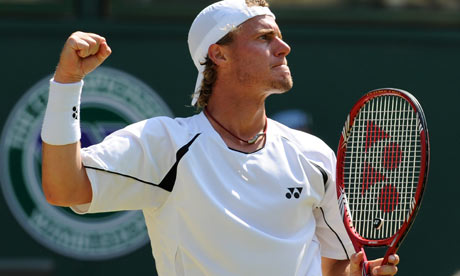 Last week, Rafael Nadal put his hopes on defending his Wimbledon title on two exhibitions. He had arranged to play two exhibitions at Hurlingham Club in London. The first exhibition was against Lleyton Hewitt.
About nine months ago, Hewitt had hip surgery. It took several months of recovery including playing a small tournament in Houston, an ATP 250 event (this is a tier below ATP 500), something he would not have to do if his ranking hadn't dropped. He wanted to move it high enough to avoid qualifying for bigger tournaments down the road.
Hewitt says he hasn't been playing solid until about the French Open where he had the misfortune of meeting Rafael Nadal. While Nadal would go on to lose for the first time in the Paris clay to Robin Sodering, he had no problems disposing of the Australian. While Hewitt plays a solid baseline game, he's always been more of a hard court and grass court player. Witness his two Grand Slam titles at Wimbledon and at the US Open.
Last year, Novak Djokovic entered the second round of Wimbledon to face Marat Safin. Safin had beaten Djokovic some years earlier back when Djokovic had yet to rise in the rankings and back when Safin's game was still formidable. Since then, Safin had come back from injury and he had had spotty results. Most people lamented the underachieving Safin, feeling that this Wimbledon, a tournament Safin had historically performed poorly at, was not going to be anything different from the tournaments he had played recently.
But for two weeks, Safin managed to muster enough of his old self and play well on the surface he likes least, starting with the startling upset of Novak Djokovic.
Fast forward to this year. Safin exited tamely in the first round to Jesse Levine. Levine is known for having practiced with Roger Federer, owing to his lefty demeanor. But Levine's ranking is a lowly 133 that puts him behind a great number of other Americans including, say, John Isner.
And back up one week. There was Hewitt playing Nadal, knowing the results of this exhibition and the next might very well push Nadal out of the tournament. There was a huge incentive for Hewitt to win the match and not play it like a conventional match. If his win could convince Nadal not to play Wimbledon, that would be one less headache for Hewitt to deal with. Combined with his loss to Hewitt and Wawrinka, Nadal elected to return back to Mallorca and heal up, hopefully in time for the US Open.
When the draw came out, Hewitt would, surprisingly, be scheduled to meet Nadal early, but due to Nadal's withdrawal, the Wimbledon committee juggled the seeds to prevent a hole from where Nadal was located, a hole that might benefit his quarter of the draw. Rather than insert a lucky loser, which they would have had to do if Nadal had withdrawn after the tournament had started, they moved a few players around.
del Potro, the 5th seed, took Nadal's spot. He had been in Djokovic's quarter. This probably made both Djokovic and Federer happy. James Blake took del Potro's spot. Nicholas Kiefer took James Blake's spot and was promoted to 33rd seed. All of these players that were moved have consequently lost. Blake lost in the first round Andreas Seppi. Kiefer lost in the first round to Fabrice Santoro.
del Potro, on the other hand, the guy whose star seemed most on the rise, had an easy first round. But he had to face Hewitt.
Everyone says Hewitt is an intense guy. He's also the kind of player who doesn't want to play average all his life. Commentators speculated that if he really got clocked by del Potro, he might retire.
del Potro, for his part, had yet to prove his prowess on grass. In the past two years, he had fallen to the Olympic gold medalist in doubles. Last year, he lost in the 2nd round in straight sets to Stan Wawrinka. The year before, Roger Federer also rolled over him in straight sets in the 2nd round. However, since last year, del Potro has gone on a tear.
His ranking is firmly in the top 10. He beat Nadal back in Miami. He beat Murray in Madrid. He pushed Federer to five sets at Roland Garros. He had an easy straight set win in the first round of Wimbledon.
And unlike Safin, who many felt was as talented as Federer, most people believe Hewitt to be a workmanlike winner, perhaps in the mold of Jimmy Connors. Inspired not by the Aussies, but by Mats Wilander, Hewitt plays a baseline game, not the chip and charge that characterized many an Aussie including Patrick Rafter and Pat Cash. (Coincidentally enough, Wilander was inspired not by fellow countryman, Bjorn Borg, but by brash American, Jimmy Connors).
Hewitt's game seemed like a holdover from the 1990s. He was like Chang or Wilander. Quick player. Unlike Chang, he hit deep, and he had a visible intensity to win. But Hewitt's best results were pre-Federer.
So when del Potro was to face Hewitt, it wasn't exactly like Djokovic facing Safin. Djokovic was considered the overwhelming favorite, but only because Safin's game was a shell of its old lustrous self. On the other hand, del Potro, while a formidable player, had yet to prove he could win on grass, and Hewitt, while lacking the wild talent of Safin, had still done well to beat Nadal, and claimed he was feeling great.
And if there were those paying attention, del Potro was actually ill the week after the French. He recovered in Argentina, and then trained on the few grass courts available in Argentina. McEnroe thought this might not be enough. With all the players in London, who could del Potro play against?
The match itself was a bit surprising. Hewitt served well, moved well, and del Potro looked irritated throughout. Hewitt played a lot of shots up the middle and del Potro responded mostly in kind. Hewitt was playing so well that he only dropped serve once, and that was serving for the match. He had had 8 break points against him, but del Potro only converted once. When del Potro broke, Hewitt immediately broke back and held for the match.
This is a good time to look at players like Safin and Hewitt.
In tennis, one can point to certain "generations" of players. There is the Sampras generation which might be better titled the Agassi generation. These were perhaps the most successful group of Americans in the Open Era. When reporters wondered who would replace McEnroe and Connors, few expected the replacement to include Sampras, Agassi, Chang, Martin, Washington, and Courier.
When Sampras was on the decline, basically after 2000, he left a bit of a vacuum. Already, players from the next generation were asserting themselves. Sampras himself had lost to both Hewitt and Safin at the US Open.
Roger Federer, for his part, was a late bloomer. Although he had a huge win against Sampras in 2001, he would not begin to play his best until later in 2003. In the meanwhile, players who bloomed earlier were jockeying for number 1.
In this period, there were a plethora of number 1's: Safin, Kuerten, Hewitt, Ferrero, and Roddick. Indeed, Federer seems to have an affinity for this group of players, each of whom has won at least one Grand Slam title. When Federer looks at the new generation: Nadal, Murray, Djokovic, del Potro, he sees a group of people he doesn't yet relate to.
The Fed generation may have been dominated by Federer, but Roger is always quick to defend these players, in particular, Andy Roddick. Federer believes in consistency, and with Roddick, he sees a guy that's worked really hard to stay in the top 10.
So Federer perhaps has to smile when Lleyton Hewitt scores a victory over Juan Martin del Potro. The group of guys he played with when he came up the ranks were not a pushover bunch. They played good tennis and still have a few surprises left in them.Labels: wimbledon
posted by Charlzz at
 Sam Querrey has won one title in his career, the Tennis Channel Open. Here he is pictured accepting his trophy over runner-up Kevin Anderson (supporting the Illini, his alma mater).
Querrey is the fourth ranked American player behind Andy Roddick, James Blake, and Mardy Fish. Ranked 47th in the world, he is only one spot behind Israeli, Dudi Sela.
Querrey has occasionally pushed top players, taking the occasional set from Rafael Nadal, but not yet beating a few of the really big players.
Today was an opportunity for Sam. He faced 11th seeded, Marin Cilic. It's probably rare for the 6'6" Querrey to meet players his height, though the number of tall players are quite numerous. They include Ivo Karlovic, John Isner, Kevin Anderson, Marin Cilic, Juan Martin del Potro. Once upon a time, it was rare to see a tall player that played the baseline. If you were tall, you were considered lumbering, and needed to come to net to prevent jackrabbit players from beating you.
Perhaps Todd Martin was the first to really break that mold. Here was a guy also 6'6" that played from the baseline. Sure, he also served and volleyed, as did fellow American Pete Sampras, but he had enough game to slug it from the baseline too. Prior to that, 6'4", Yannick Noah would mix it up, coming to net as well as playing from the baseline.
On a day like today, when Querrey pushed Cilic to a fifth set, you begin to realize a lot of tennis is mental. When people look at a player like Roger Federer, they marvel at the grace of his movement, the ferocity of his forehand, the squash shots he hits to save points, the deftness of his drop shots. There's no doubt Federer has a lot of physical attributes that lead to a successful game.
But time and again, Federer has shown a mental tenacity to win points even when he is struggling. Some of that has to do with adjustments he makes in his game as he reacts to what his opponent is doing well. These are tactical changes. But sometimes, it's a matter of going for shots even when they aren't all dropping in. In the French Open, there was a key point, 30-40 in the third set. If Federer loses that point, he goes a break down, and he's already down two sets to love.
Nadal shows an incredible mental tenacity. He hits big shots when he needs to. In one of the best played matches of the year, Nadal was fighting Djokovic in the Madrid semifinals. Even match point down, he was able to dig deep and hit huge shots when it mattered.
These mental struggles don't only occur at the very top of the game. They occur in many matches. If you ever look at the age of the lesser known players playing in the Grand Slam, they are generally much older than you'd imagine. The ATP Tour is not filled with 19 year old wunderkinds. Despite the proliferation of players like Murray, Nadal, Cilic, and del Potro, more likely, you'll find players that are closer in age to Federer.
These older players, which in any real life job would be considered young, have been on the tour for many years, and they've dealt with many situations. They know how to cope. Younger players haven't had as much experience. So a player like Querrey may struggle against players that are veterans that he should beat if he expects to take the next step up.
He might take solace in players like James Blake and Mardy Fish who were late bloomers, players that didn't have fantastic junior careers, but honed their games over many years, filling holes in their games.
Even so, here was an opportunity for Querrey to make a breakthough. While Cilic isn't top ten, he's close enough, and with Mario Ancic not playing Wimbledon, Cilic has been pegged as a dark horse favorite. In the end, Querrey didn't have enough, and lost 4-6, 7-6(3), 6-3, 6-7(4), 6-4. Marat Safin, another tall player, has pointed out that winning begets winning. Safin says he feels as physically fit now as he's ever been, but the victories aren't coming.
Occasionally, however, two players meet, and for some reason, one player's strengths are overwhelming, even though the two players are similar in ranking. So it was today with Dudi Sela and last year's semifinalist, Rainer Scheuttler. On paper, you might give the edge to Scheuttler. He's experienced. He's reached the Australian Open final before. But in the only two meetings they've had, Sela has won both, and often with lopsided set scores.
Last year in Beijing, Sela won 6-3, 6-3. This year at the Australian Open, he won 1-6, 6-2, 6-4, 6-4.
Some quick updates. Roger Federer had little problems beating Garcia-Lopez who made the semis of Eastbourne last week. He won in straight sets. Tommy Haas had an easier time when Michael Llodra retired. Djokovic, who has been flying under the radar, a place he happens to enjoy, also won in straight sets.
Djokovic will now face Mardy Fish in the third round. Fish beat a Serbian in Janko Tipsarevic, in four sets. They've only met twice, but Djokovic has prevailed both times. By the way, it's worth reading Mardy Fish's inteviews (see here). He has more interesting things to say then, say, Roger Federer, who always seems a bit catty with the press, as if he's vaguely annoyed with their questions.
A quintet of Spaniards had tough wins. Verdasco played three tiebreak sets, plus a 6-4 to win over unheralded Vliegen of Belgium. Robredo needed five sets to win over Koubek of Austria. Almagro needed five sets to beat Karol Beck, a lucky loser who beat Feliciano Lopez in the first round. The fifth set went 7-5. Gimeno-Traver also took five sets to beat American, Taylor Dent. Montanes had a four set win over Canas.
Not ever Spaniard won today (and there are many of them playing). French Open finalist, Robin Soderling, struggled a bit to a four set win over Granollers.
Kohlschreiber (who beat Djokovic at the French) needed five sets and 8-6 in the fifth to beat Czech, Ivo Minar. Andreev however won in straight sets over Spadea. Karlovic also won in straight sets; his victory was over Darcis. Tsonga got a gift. He won in a walkover over Italian Simone Bolleli.
A couple of very interesting matches on slate for tomorrow. del Potro plays Hewitt. Hewitt says he's feeling pretty good after having to deal with surgery from last year. He's been feeling good since about the French Open. Murray plays Gulbis. Gulbis, much like Murray, had been on a fitness/training regime. He felt the work he had put in to become stronger had affected the consistency of his game, but that his game is coming around, and improving a lot. In Americans sports, this is considered a "trap" match, because Gulbis hasn't been playing well but is capable of hitting very well. Murray has beaten Gulbis twice.
Is Leonardo Mayer for real? He plays fellow South American, Fernando Gonzalez.
Finally, is there more magic for the magic man? Fabrice Santoro plays former number 1, Juan Carlos Ferrero.Labels: wimbledon
posted by Charlzz at
 People look at Wimbledon and marvel at the predictability of the finals. Rarely does an unseeded player win the tournament. In recent memory, there have been two examples: Boris Becker, who won Wimbledon in his second tournament ever (he won Queen's), and Goran Ivanisevic who won as a wildcard, but clearly was capable of producing a big game on the grass.
Even if the finals have produced three consecutive meetings between the game's best two players, the others who make it far are often a bit surprising.
Let's wind the clock back a year and revisit last year's quarterfinalist. The two that were expected to be there, Federer and Nadal, were there. Andy Murray was just starting to take that next step forward having won a five setter against a solid grass court player in Richard Gasquet. The other five quarterfinalists were: Feliciano Lopez, Marat Safin, Arnaud Clement, Rainer Scheuttler, and Mario Ancic.
Mario Ancic got injured, so he didn't even make Wimbledon this year. Feliciano Lopez fell in five sets to Karol Beck, a lucky loser, in the first round. Marat Safin, given a 14th seed primarily on the basis of his semifinal appearance last year, went out tamely to Federer practice partner, Jesse Levine in four sets, in the first round. Arnaud Clement lost in the first round to Juan Martin del Potro in three easy sets. Indeed, both Clement and Lopez suffered due to Nadal's withdrawal (though Clement would have faced Nadal otherwise, so he'd probably take his chances with del Potro). Rainer Scheuttler was the only one to make it to the second round, and he lost in straight sets to Dudi Sela of Israel.
What this means is a much different looking quarterfinals. Some familiar faces are hoping to make it that far including Andy Roddick and Novak Djokovic.Labels: wimbledon
posted by Charlzz at
 2007 was the year of Djokovic. As the epic battle of Federer vs Nadal raged on at the French and at Wimbledon, few noticed that a Serb, one Novak Djokovic, had made the semifinals of both events. He made a breakthrough of sorts by making the finals of the US Open, then winning the Australian Open in 2008.
2008 did not have one particular standout player. You could say it was the year of Murray, or the year of Tsonga, or the year of Simon, but as time passes, it may be the year of del Potro. del Potro came into the US Open in 2008 having won four titles in row, albeit nothing major.
Since then, he has continued to improve. Despite a weak start to his clay court season, he powered his way to the semifinals against Roger Federer, and despite never having taken a set of Federer, proceeded to push Federer to five sets, one of several matches that Federer felt was like a finals.
There were doubts whether the tall Argentine could play well on grass. The low bounce might not suit the lanky player from Tandil. However, he has two requisite weapons that every top male pro seems to have: a big serve and a big forehand.
del Potro inherited Nadal's position in the draw when Nadal (who del Potro beat for the first time earlier in the year) withdrew. Nadal's draw was expected to be tough. He would meet veteran player and last year's quarterfinalist, Arnaud Clement. In the second round, Nadal would have faced the man who beat him in an exhibition only a few days earlier, former world number 1, Lleyton Hewitt. But Nadal's problems have become del Potro's problems.
del Potro continued at Wimbledon where he left off at Paris: pummeling early round opponents. del Potro won 6-3, 6-1, 6-2. Up next is Hewitt, who is always a tough competitor, and will be a better measure of where del Potro's game is on grass.
If you look at who del Potro has lost to this year: Federer, Djokovic, Ljubicic, Murray, Nadal, Stepanek, and Fish, you see that, for the most part, del Potro loses only to better players. He's made a breakthrough of sorts, beating Andy Murray in Madrid and beating Nadal in Miami. He's yet to beat Roger Federer, however.
Other winners today. Roddick in 4 sets over Chardy. Probably means his ankle his fine. Ferrero in straight sets over Youzhny, which is normally a tough first round. Ferrero has been playing better as of late. Hewitt with a crushing win over Ginepri. Hewitt is up for del Potro next.
Santoro beat Kiefer the 33rd seed (added when Nadal withdrew) easily in straight sets. The magician still has a few tricks up his sleeve. Haas, the number 24 seed (also courtesy of Nadal's withdrawal), won in four sets. Stepanek, a player whose flatter style is better suited to the grass, won in straight sets. The new talent, Grigor Dmitrov, however retired to Russian, Kunitsyn.
Benjamin Becker, who won a grass event just before Wimbledon (and last guy to beat Agassi before he retired, won in straight sets. Alves, the lucky loser, who benefitted from the Nadal withdrawal, beat Andrei Pavel in straight sets. The other surprising Argentine, Leonardo Mayer, had an easy 6-0, 6-0, 6-3 win over Oscar Hernandez. Mayer may be one to look out for.
Wawrinka had a straight set win over Schwank. Mathieu needed four sets to beat Gil. Tursunov, who won a grass event last week but like Roddick, a victim of twisted ankles, had to retire against Zverev.
Late results: Simon in straight sets over American Bobby Reynolds. Safin looks like he may bow out in the first round against American Jesse Levine. Finally, Britain's hope, Andy Murray, needed four sets to beat big-serving American Robert Kendrick.
Djokovic and Federer are the top players playing tomorrow.Labels: wimbledon
posted by Charlzz at
|
 |

|