|

 Last year, Juan Martin del Potro arose from obscurity on the strength of four consecutive tournament wins. He won two clay events in Stuttgart and Kitzbuhel, then came to the US to win Los Angeles (beating Roddick) and Washington DC. Last year, Juan Martin del Potro arose from obscurity on the strength of four consecutive tournament wins. He won two clay events in Stuttgart and Kitzbuhel, then came to the US to win Los Angeles (beating Roddick) and Washington DC.
Once a player gets to a certain level, they start to avoid the ATP 250 events. ATP 250 events like Indianapolis last week and Los Angeles this week generally attract players ranked 20 and lower. It's rare for a top 10 player to play unless it's out of patriotism like Roddick and Blake in the US, and even they sometimes avoid these smaller tournaments.
Last year, del Potro was an unknown, and playing Los Angeles and DC was appropriate. This year, he has chosen not to defend his title in Los Angeles. He is, however, scheduled to play DC which is an ATP 500 tournament, and therefore is attracting a better class of player with Tsonga, Roddick, and del Potro in the draw. However, even DC is not enough to bring out the top 4: Federer, Nadal, Murray, Djokovic, even though Murray has played the tournament a few times and has even been a finalist.
This week, there are two clay court tournaments being played: Gstaad and Umag. Wawrinka is the top seed in Gstaad, Davydenko the top seed in Umag (Croatia), and Tommy Haas is the number 1 seed in Los Angeles. Next week, Washington DC, then the week after is a Masters 1000 event in Montreal, where all the big names will appear, especially the highly anticipated return of Rafael Nadal.

posted by Charlzz at

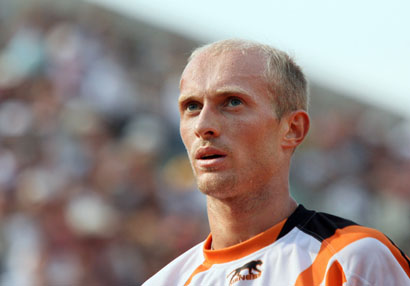 Although the French Open has long since concluded and the US Open is looming, the clay court season continues rolling. Although the French Open has long since concluded and the US Open is looming, the clay court season continues rolling.
Two events were concluded on Sunday, July 26. The International German Open held in Hamburg was won by Nikolay Davydenko. Davydenko's ranking had slipped out of the top 10 due to an injury he sustained in Chennai earlier in the year which caused him to miss the Australian Open and the early hard court season (Indian Wells and Miami).
With his straight set victory of France's Paul-Henri Mathieu, 6-4, 6-2, he re-enters the top 10 ranked 9th in the world.
Hamburg has suffered a demotion. Last year, it was a ATP Masters 1000 event. Due to some shuffling around, it got replaced by Madrid, which was formerly an ATP Master 1000 indoors event. Hamburg complained about its demotion, to no avail.
The good news, for Germans anyway, is that Davydenko speaks fluent German. He was interviewed by Michael Stich who returned to play some doubles, despite being pretty much retired. Hamburg wooed away Gilles Simon who was defending champ at Indianapolis. Simon continues his slide having played a poor first half of the year. However, most of his ranking points occurred in the hard court season. The question is whether Simon will play better on the hard courts or whether he will continue to lose early and see his rankings slip outside the top 10.
The Indianapolis Tennis Championships is an ATP 250 event, and suffered a setback of its own when the injury that caused Andy Roddick to drop out of the Davis Cup tie with Croatia the week after Wimbledon continued to plague him in Indianapolis. Roddick tweeted that he would return back to action in Washington DC's Legg Mason Tennis Classic to be held next week.
Although attempts were made to get James Blake to play, rumor was he wanted more appearance money than the tournament was willing to shell out. This made Dmitry Tursunov the highest seed with a ranking of 27 last week.
Sam Querrey continued to be impressive making his second straight final. However, much like his loss to Rajeev Ram in the finals of the International Hall of Fame Championships (played on grass), Querrey again was unable to beat a lower ranked player in fellow American, Robby Ginepri. Ginepri won his third ever ATP title. He last won a title back in 2005 when he won Indianapolis. Ginepri had an easy win over Querrey, 6-2, 6-4, preventing Querrey from winning his second title ever.
On the positive side, Querrey continues to play well in somewhat weaker fields. On the negative side, he still hasn't broken through to win titles. That has to be the next step if he expects to entrench himself in the top 20.
This week, three event are on tap. Two are on clay (Gstaad and Umag) and one is on hard courts (Los Angeles). Los Angeles was the event that raised the profile of Juan Martin del Potro who beat Andy Roddick en route to the title. del Potro continued his win streak by winning in Washington DC the following week. Los Angeles, like Indianapolis, is an ATP 250 event. Washington DC is an ATP 500 event and is expected to garner a decent draw (no one in the top 4 will play, however). Last year's DC and LA draw were partly decimated by the Olympics.
posted by Charlzz at
 Some have speculated whether Mirka Vavrinec's pregnancy was planned or not. Regardless, the birth of twin daughters couldn't have been better planned. Falling two weeks after Wimbledon, and two weeks before a Masters 1000, Federer had a break that he could use to witness the birth of two daughters. Some have speculated whether Mirka Vavrinec's pregnancy was planned or not. Regardless, the birth of twin daughters couldn't have been better planned. Falling two weeks after Wimbledon, and two weeks before a Masters 1000, Federer had a break that he could use to witness the birth of two daughters.
The daughters are named Myla Rose and Charlene Riva.
The modern athlete now has their own webpage, and Federer has a Facebook page where he announced the birth roughly midnight East Coast time.
Congratulations to the happy parents!
posted by Charlzz at
 Tennis fans can be pretty avid, but many of them would be hard-pressed to recognize players that don't show up on TV much. The ATP Tour has more than a thousand participants, many who are far from household names. Tennis fans can be pretty avid, but many of them would be hard-pressed to recognize players that don't show up on TV much. The ATP Tour has more than a thousand participants, many who are far from household names.
India has produced its share of very good players: the Amritraj brothers, Ramesh Krishnan, his father, Ramanathan Krishnan. It's fair to say that as American tennis is struggling, Indian tennis is likewise struggling. In recent years, Mahesh Bhupathi and Leander Paes have been the two notable players, winning Grand Slam titles in doubles.
Who is the highest ranked male Indian player? The answer is, it depends. If you want to know the highest ranked Indian player that represents India, it is currently Somdev Devvarman, ranked 127 in the world. You may not know about him, unless you were an avid University of Virginia tennis fan. Devvarman won the NCAA Division 1 Men's Tournament 2 years in a row, and was in the finals one additional year. He recently turned pro and has been trying, like most players, to get his ranking higher. He reached the finals in Chennai (in India) earlier this year losing to Marin Cilic on clay.
But if you ask who the highest ranked male Indian player of Indian descent, then that man is Rajeev Ram. Ram (pronounced more like "Rom" or "Rohm") is American. Born in Denver, he know lives in Indiana. Much like the Chinese migration that eventually lead to players like Michael Chang (or Kevin Kim), the Indian migration to the US (and other parts of the world) has increased dramatically, especially since the 1980s, so it was only a matter of time when someone of Indian origin would become a ranked tennis player.
Ram is currently ranked 108, which is his highest ranking ever. His ranking was based mostly on the strength of winning the International Hall of Fame Championships held in Newport, Rhode Island, which was concluded last week. He beat Sam Querrey in the final in what amounts to an upset. Ram is entered this week in Indianapolis.
Indianapolis is an ATP 250 event. To give you an idea of what that means. There's the Grand Slams. There are the Masters 1000 beneath that. Then the ATP 500. Then the ATP 250. These events rarely draw the top pros. You're unlikely to see Federer, Nadal, Murray, or Djokovic play these events. But they are just strong enough to get players just outside the top 10 (Andy Roddick decided he wasn't well enough to play this week, so he dropped out).
Rajeev Ram's rankings were low enough at the time the players had to get their names in that he couldn't qualify for the main draw. But due to his recent win, and that he's an American, he got a wildcard.
With that wildcard, he beat Devin Britton in the first round, 6-3, 7-5. Who is Devin Britton? Britton has something in common with Somdev Devvarman. He won the NCAA Division 1 Men's Championship in tennis. Unlike Somdev, he won it as a freshman. Britton reached the semifinals of Wimbledon juniors where he lost 16-14 in the third set (the same set score Fed beat Roddick) to his doubles partner, Jordan Cox. Britton promptly turned pro and was invited to hang out with the Davis Cup team in their tie against Croatia, the week after Wimbledon.
And what does Rajeev Ram get as a reward for this victory? In the "what goes around, comes around", he gets to face Sam Querrey once again.
Oh yes, in the "it's a small small world" category. Somdev Devvarman wasn't the only guy who did well at Chennai. Rajeev Ram won the doubles title in Chennai this year.
So keep an eye out for Rajeev Ram.
And if you a Twitter kind of person, he was given a shout out by Andy Roddick. He's listed as @RajeevRam. Give him some love.
posted by Charlzz at
 The US Open Series starts next week. This series was meant to bring increased focus to the hardcourt tournaments in the US leading to the US Open. The series consists of both men and women's events. The US Open Series starts next week. This series was meant to bring increased focus to the hardcourt tournaments in the US leading to the US Open. The series consists of both men and women's events.
On the men's side, there are the following tournaments: Indianapolis (Simon), Los Angeles (del Potro), Washington DC (del Potro), Montreal (Nadal), Cincinnati (Murray), New Haven (Cilic), US Open (Federer).
Last year, the US Open series fields were partly decimated by the Olympics. Indeed, tennis was considered so important that the Olympics, held in China, changed its start to a week earlier because of its proximity to the US Open. It worked out well because the start of the Olympics fell on August 8, 2008 or 08.08.08, which the Chinese considered auspicious (i.e., brings good luck).
Andy Roddick is one of the few players that plays the majority of the US Open series (he's seen in this picture that he uploaded to TwitPic). In particular, he chose not to attend the Olympics, and attended Los Angeles and Washington DC. The other beneficiary of everyone being at the Olympics was Juan Martin del Potro, who won both these tournaments, beating Roddick in LA. Indeed, Roddick finished the US Open Series more desperate than before. He had been coached by his older brother John, and it wasn't leading anywhere. He asked Davis Cup captain, Patrick McEnroe to coach him, and did respectably well at the US Open, losing to Novak Djokovic in four sets in the quarterfinals.
The US Open Series has a point system where players accumulate points based on their results. Points winners earn a bonus pool at the end of the series.
Most of the very top pros, e.g., Federer, Nadal, Murray choose to play only in the Masters 1000 level tournaments, which are Montreal and Cincinnati. Montreal, which is formally called the Rogers Cup, used to be called the Canadian Open. Due to the French and English parts of Canada often at odds with one another, the site of the tournament alternates each year. Last year, it was in Toronto. This year, in Montreal. Cincinnati, more formally called Western & Southern Financial Group Masters, used to be called the ATP Championships.
Next week is the Indy Championships. The following is a list of accepted players:
Baghdatis, Marcos CYP
Kim, Kevin USA ,
Becker, Benjamin GER
Kunitsyn, Igor RUS ,
Berrer, Michael GER
Lu, Yen-Hsun TPE,
Clement, Arnaud FRA
Mayer, Leonardo ARG,
Dabul, Brian ARG
Muller, Gilles LUX,
Daniel, Marcos BRA,
Querrey, Sam USA
Ferrero, Juan Carlos ESP,
Reynolds, Bobby USA,
Gicquel, Marc FRA ,
Roddick, Andy USA,
Gulbis, Ernests LAT ,
Sela, Dudi ISR ,
Isner, John USA,
Spadea, Vincent USA ,
Istomin, Denis UZB,
Tursunov, Dmitry RUS
Karlovic, Ivo CRO.
Robby Ginepri was given a wildcard. It does not appear like Gilles Simon will defend his title here. Andy Roddick is the only player in the top 20 in the field so far. Tursunov, ranked 23, is the second highest ranked player in this field.Labels: us open series
posted by Charlzz at
 There's a lull now between the end of Wimbledon and the start of the hardcourt season proper. In this interim, attention has focused to another sport--cycling, and the start of the Tour de France. There's a lull now between the end of Wimbledon and the start of the hardcourt season proper. In this interim, attention has focused to another sport--cycling, and the start of the Tour de France.
Cycling has always brought with it charges of doping. Performance enhancing drugs that allow the top cyclists in the world to bike over two thousand miles (3500 km) in three weeks. Lance Armstrong, seven time winner of the Tour, was frequently dogged by claims that he had used such drugs, and he always denied them vigorously. However, the notion of drugs and sport is closely intertwined when it comes to cycling.
Tennis, on the other hand, seems eager to avoid controversy, sweeping various penalties under the rug. Players like Nikolay Davydenko were accused of match fixing for money, throwing in losses. They ruled Davydenko was not guilty. Guillermo Canas was accused of doping in 2005 and spent 8 months trying to clear his name which he eventually did.
More recently, Mathieu Montcourt of France was recently accused of gambling on tennis. While the rest of the world mourned Michael Jackson, Montcourt also died at the age of 24 of an apparent cardiac arrest.
And Richard Gasquet was recently accused of using cocaine. He was suspended and hasn't played since Miami, prior to the clay court season.
Today, he was found not guilty of cocaine use. His explanation? He had gone to a club and kissed a woman who had used cocaine. The ITF bought this story and has reinstated Gasquet to play as of this morning.
posted by Charlzz at
 It's true. Tennis fans are generally obsessed about the best. People care about Federer and Nadal, and then maybe Djokovic and Murray. Andy Roddick and James Blake are considered failures for failing to contend for Slams. This is unfair, we all know. Roddick and Blake's careers are really just outside of stardom, especially Roddick, who has made four Grand Slam finals, winning one, and managed a top ten ranking for most of his career. It's true. Tennis fans are generally obsessed about the best. People care about Federer and Nadal, and then maybe Djokovic and Murray. Andy Roddick and James Blake are considered failures for failing to contend for Slams. This is unfair, we all know. Roddick and Blake's careers are really just outside of stardom, especially Roddick, who has made four Grand Slam finals, winning one, and managed a top ten ranking for most of his career.
Consider a player like Fabrice Santoro. Few tennis fans know who he is. Yet, here's a player that stayed in the top 100 for most of his 20 year career. Santoro's career has to be considered something of a success based on longevity, much like Arnaud Clement, Jonas Bjorkman, and others who have stayed on the tour for numerous years, yet have often failed to break through at the very top.
By all accounts, Sam Querrey ought to be considered a success. He's won a tournament already. He's made two finals. He's in the top 100. It's certainly better than Donald Young who has neither won a title, nor ever been in the final.
If you think that's insignificant, think about the last great British hope, Tim Henman. How many titles do you think he's won? 20? 30? He's won 11. And he made 17 additional finals beyond that. This is a very solid career. Certainly, he did quite well at Wimbledon, making the semifinals several times, and even one semifinal at the French Open. Henman is in the category of players hovering right around 10, who win an odd title here or there. Two titles in a year would be a great year for Henman.
The players you hear about, the ones that are ranked at the top. Those players often make a huge splash, a big upset that takes the tennis world by surprise. Whether it's Boris Becker's win at Wimbledon in 1985, or Mats Wilander winning the French in 1982 over Guillermo Vilas, or Andy Murray beating Roger Federer in 2006 while still not ranked in the top 10. Roger Federer himself upset Pete Sampras at Wimbledon in 2001. The best players often make their presence known early, and beat big-name players.
To that end, Sam Querrey has come up short. This week, he played in the finals of the International Hall of Fame Championships in Newport, Rhode Island. He was able to play in this tournament when Patrick McEnroe decided to pick Mardy Fish to play Davis Cup when Andy Roddick decided an injury would prevent him from participating in a tie against Croatia. Newport is a pretty small tournament. The big name players don't play this tournament. This is why Fabrice Santoro, whose ranking has usually floated in the 40s, was two time defending champion.
Querrey had one solid win in this tournament, namely, his semifinal victory over Santoro who is ranked 46 and was 34 when the tournament started (since he was defending champ, he lost points and his ranking went down). Against Rajeev Ram who was ranked 181 prior to the tournament, Querrey came up short and lost in three sets. These are the kinds of tournaments Querrey should win, especially against a player ranked over 100.
Querrey gives good players a tough time, but he doesn't win. He pushed Marin Cilic, a top 20 player to five sets at this year's Wimbledon. But Cilic showed why he's in the top 20, and Querrey isn't, by winning that fifth set. Although Cilic isn't a big name, he's big enough. A victory over him would have been a sign of progress for Querrey.
Again, his success is more than most tennis players ever achieve. It's certainly possible that he could improve more slowly, like Mardy Fish or James Blake. But given his results so far, it's certainly looking like he won't be the next Pete Sampras or even the next Todd Martin.
posted by Charlzz at
 The Davis Cup held quarterfinals a week after the conclusion of Wimbledon. Due to its timing and due to Andy Roddick's loss in the final, the team replaced Roddick with Mardy Fish. The Davis Cup held quarterfinals a week after the conclusion of Wimbledon. Due to its timing and due to Andy Roddick's loss in the final, the team replaced Roddick with Mardy Fish.
Croatia fielded Marin Cilic, their highest ranked singles player, and the huge serving, Ivo Karlovic. They decided to host the match in Croatia.
There was a decision to be made, namely, how good was James Blake playing. The problem, really, is who to replace Blake with. Even if Blake hasn't been playing that well lately, the next highest ranked player, after Mardy Fish, is Sam Querrey. Normally, Querrey does attend Davis Cup ties, but he had a rather unique opportunity. A big server like Querrey is likely to play well in the Hall of Fame Championships, held in Newport, Rhode Island on grass.
This tournament is generally very weak, as evidenced by Fabrice Santoro being two-time defending champion. You won't find Federer or Roddick playing at Newport. It's way too small, especially off the heels of the end of Wimbledon.
Croatia, naturally, picked the surface that would hurt Americans the worst, indoor clay. One could argue that grass might be pretty good for Croatia, too, but given the history of Americans playing awful at the French, it made some sense to play on clay.
That decision made some sense after Day 1, when Blake lost a five setter to Ivo Karlovic, followed by Fish losing a five setter to Marin Cilic. With the US down in a hole, 2-0, it was up to the Bryan brothers to win the doubles. The Croatian coach decided not to have Ivo Karlovic play doubles, probably predicting a loss regardless of whether Karlovic played or not, and opting to rest the big guy in case he was needed.
That left James Blake playing Marin Cilic. This was not a good matchup for Blake. Although Blake has a good head-to-head record against Cilic, they've never played on clay. Cilic won the match easily in four sets and with the win, Croatia had a 3-1 lead, and was off to the semifinals.
Croatia had won the previous two encounters with the US. Prior to that, Croatia wasn't a separate country and was considered part of Yugolslavia, which shows how infrequently Croatia makes it this far.
The fifth rubber (as it is called in Davis Cup) was meaningless, with Croatia having an insurmountable lead, so the teams decided to put in backups. In particular, US decided to put in lefty, Bob Bryan, while Croatia put in 112th ranked, Roko Karanusic, who played doubles for Croatia. The Bryan brothers focus almost exclusively on doubles. Indeed, this year, Bob Bryan has not played any singles, and has no ranking.
So what are the limitations of Bob Bryan's singles game? Recall he's 31 years old, and mostly plays doubles. He has three problems. His backhand is adequate to keep in a rally, but it's no weapon. His footspeed is adequate to move around, but Bryan is a bit on the heavier side, although he is pretty tall at 6'4". His big weapon is his forehand. It says something about the modern game that a doubles player like Bryan has to play singles from the baseline. You would think, against a player ranked below 100, he could sneak in on a few serve-volley points. Nope. OK, just saw a serve and volley point. Needless to say, he doesn't use it much.
To his credit, Bryan took a set off of Karanusic and broke to stayed in the third set. Bryan just saved match point by serve and volleying, and approached the net to get to game point.
Oddly enough, Bryan has played Karanusic before in singles, quite the surprise given how rarely Bryan plays singles. They met, not suprisingly, in Davis Cup, in a first round match against Croatia. Bryan won that match in three sets, in a meaningless rubber. Croatia, perhaps much like now, had already won the tie.
This begs the question. Where is Davis Cup lately? At one point, all the Australians were faithful players of Davis Cup. The Americans were too. Jimmy Connors was the noted exception, who avoided it most years, focusing on singles, but John McEnroe, for all his antics, was a Davis Cup stalwart. Since then, players have occasionally played Davis Cup, but not been so committed to it. Blake and Roddick have been pretty good about playing Davis Cup.
Roger Federer is noted for not playing Davis Cup that much. If it means interfering with his quest for history, Davis Cup gets the boot. Earlier this year, Switzerland was slated to play the US. With Federer's record against both Roddick and Blake, there was a strong likelihood that Federer himself could put a 2-0 score. Wawrinka could probably win one more match, or Fed could team with Wawrinka in doubles, a team that beat the Bryan brothers at the Olympics. But Federer begged out of it, and the US won rather handily.
There has been some suggestion that the Davis Cup be played in two weeks with every round played at the same time. This might be interesting if a site would be willing have four different surfaces, say, clay, grass, indoors, and hard courts. But what you'd lose, big time, is the crowd. You could play it in a month, if you like, where the matches are played each week, or if you only permit, say, 3 days off between rounds, it could be done in 3 weeks or so. The likelihood that the tennis calendar could be cleared long enough for this to work out is probably low, and the format is likely to remain unchanged.
Well, you know, even in a dead rubber match against players that generally don't get to see singles play, it was kinda fun watching. This isn't the epitome of quality play, but there is a rooting interest. Bryan managed to get a break back, push into a tie-break, and win the tie-break over Karanusic. Devin Britton came to help the team practice. He won the NCAA finals last year, and was a semifinalist at Wimbledon juniors, and has decided to go pro.
A few other results. Israel completed their improbably upset over Russia, 4-1. Russia decided to go with Andreev and Youzhny and not play Marat Safin who only played doubles.
The Czech Republic won a tight one over Argentina, impressive given del Potro generally gives you two wins. Juan Monaco is also an up-and-coming player, but the Czechs were hosting the tie on indoors, and Monaco lost to Stepanek and Berdych. The Czechs also won doubles.
Spain won despite Kohlschreiber winning both his singles. They played Ferrero in the fifth rubber instead of Robredo. I don't know the rules about swapping in a different player. Spain has such a huge stable of players, that they field a strong team even without Nadal.
Well, now a few weeks off before the next Masters 1000 tournament, as we all wonder if Nadal will be healthy enough to play by the US Open. He's already had three weeks off (Wimbledon plus one more week). The next Masters 1000 tournament is in Montreal (the Rogers Cup, formerly the Canadian Open) on August 8, so there's still three weeks before that.
Until then, enjoy!Labels: davis cup
posted by Charlzz at
 Perhaps no other sport has experienced the kinds of changes that tennis has in the last 30-40 years. If someone were to have taken a time machine from the 1970s and modern day, they'd see a sport that follows the same rules as the one they knew, but the play would be completely foreign. Perhaps no other sport has experienced the kinds of changes that tennis has in the last 30-40 years. If someone were to have taken a time machine from the 1970s and modern day, they'd see a sport that follows the same rules as the one they knew, but the play would be completely foreign.
Let's take time to reflect on those changes by first looking back at how tennis was played in the 1970s and earlier.
Because grass dominated the Grand Slams--three of four majors were played on the surface, and because grass courts would get torn up after use, leading to bad bounces, the solution many players opted for was serve and volley. Avoid bad bounces by avoiding bounces.
There were two major styles of play/grips: the Australian style and the American style. The Aussies preferred a "one grip fits all" philosophy. They stripped tennis to its bare essentials. If you had to use one grip for everything, it pretty much had to be a continental grip. Continental grips are used for serves and volleys, and are reasonably good for backhands. The one weak area is the forehand. It's not surprising that Australians did not have consistent forehands.
Part of this philosophy of getting to net was the slice approached shot. Indeed, forehands were generally hit flat or with a little underspin or sidespin for safety. Since it's hard to hit dipping passing shots this way, the lob was an extremely common tool, therefore, a good overhead was a necessity to play serve-and-volley.
Americans, by contrast, used three grips: Eastern forehand for the forehand grip, Continental for serve and volley, and Eastern backhand for the backhand grip. Again, much like the Australians, Americans also preferred serve and volley tennis.
Harry Hopman provided one of the earliest "innovations" of tennis. He believed in rigorous practice, and wanted practice to be harder than real play. He preached fitness. Given the gentlemanly nature of the sport, this injection of athleticism lead to players who could play as well in the fifth set as they did in the first.
Although grass dominated the game, Europeans still played on clay, and there were still clay court specialists, many who hit with topspin, although topspin was considered something of a novelty. Topspin was one of the few innovations adopted by Rod Laver and may explain why he was so successful.
Topspin's popularity grew with two top players in the 1970s, even though many players were already using topspin. Bjorn Borg showed that you could hit heavy topspin and still win on the fast lawns at Wimbledon. Ivan Lendl then took this another step showing that you could hit the ball much harder than players dared hit it, and the ball would still go in consistently. Lendl was the father of modern power tennis.
The 1970s was a pivotal decade for tennis in a wide number of ways.
Two-handed backhand. Although players like Cliff Drysdale used a two-handed backhand before it was popular, the real success of two-handed backhands came in the 1970s with three number 1 players: Bjorn Borg, Jimmy Connors, and Chris Evert. Although one-handed backhands were commonly taught, their success lead to a huge transformation of the game.
Indeed, experts at the time would be flabbergasted to realize that one-handed backhands would be a novelty, and two-handed backhands would dominate the game.
The two-handed backhand would lead to players that hit as well off the backhand as they did off the forehand. Indeed, classic players like Connors and Evert generally had much better backhands than forehands.
Oversized racquets. Perhaps the biggest splash came from Pam Shriver, long time doubles partner of Martina Navratilova. She made the finals as a 16 year old amateur in 1978 US Open using an oversized Prince racquet. In those days, racquets were not even 70 square inches. The Prince racquet was nearly twice the area, at 110 square inches.
Oversized racquets combined with another technology that forever changed the way the game was played.
Non-wood racquets. By the 1960s, racquets were starting to be created from material other than wood. Wood had several disadvantages. For one, it was pretty heavy. For another, being wood, it warped if the humidity was too high. Wood presses were made to prevent warping.
Although steel racquets existed before the late 1960s, the inventive mind of Rene Lacoste, the founding member of the French Four Musketeers, created the T-2000. Its unique design, perhaps the most innovative looking racquet ever, used a steel wire wrapped around another steel wire. It was Jimmy Connors racquet of choice throughout the 1970s.
1975 turned out not only to be a pivotal year at Wimbledon where Arthur Ashe upset the brash Jimmy Connors (and beat Bjorn Borg en route), it was also a final between two players that used non-wood racquets. Connors played with steel. Ashe with a composite. Composite racquets were often a mix of graphite and fiberglass. Head created many of these alternate material racquets from aluminum to composite.
The huge revolution in racquets occurred sometime between 1982 and 1983 when pros began abandoning wood racquets in droves. Graphite racquets were not only stronger than wood, they were lighter than wood, and they didn't warp. This meant you could create racquets much larger than wood and much lighter too. In the old days, a racquet might be 12 ounces or heavier. Today, there are racquets that weigh in at 9 ounces or even less.
This lead to an increase in size of racquets. Most pros in the 1980s learned to play on wood. The change to an oversized racquet would have meant too much power to control. So most players only took modest increases in racquets sizes, typically in the low 80 sq. in range. McEnroe switched to graphite. Lendl was already using graphite. Wilander used graphite. Vilas mostly stayed with wood and was on the verge of retiring. Borg quit before the graphite revolution was complete.
The early 80s produced a mix of players. There were players like Wilander and Lendl that lead the topspin brigade. There were more classic players like McEnroe, Connors, Tim Mayotte, etc. that hit with little topspin or that still served and volleyed. But as time passed, the power tennis game was becoming more important. Boris "Boom Boom" Becker was the next step in power tennis. He competed with perhaps the last classicist of the day, Stefan Edberg, showing both styles were still effective.
Then, the Bollettieri academy kids surged forward. The first of these actually showed up in the early 1980s with Jimmy Arias, then Aaron Krickstein. They had several Bollettieri qualities. Huge forehands, deficient net games. But the Bollettieri academy finally lead to its ultimate player in Andre Agassi. When Agassi burst on the tour, even Lendl, the hardest (or second hardest, if you add Becker to the mix) hitter on the tour was amazed at Agassi's power.
With Agassi came a bunch of similar players: Jim Courier, Michael Chang, Todd Martin, and Pete Sampras. All had big forehands. Many had two-handed backhands.
Inside out forehand. If you were to show an inside-out forehand to a player that played in the 1960s, they might laugh at the idea. Why would you give up so much space to hit a forehand? In that day, groundstrokes were merely a means to an end. Get to net. Thus, most forehands were not being used to hit punishing winners. No one thought that was possible, and so it wasn't done.
But once the power forehand became in vogue, why not use it more? Lendl was perhaps the player that used the inside-out forehand and brought it to popularity. Again, this was made possible by hitting with power and topspin. Players like Agassi and Sampras would favor their forehands by cheating to their left.
Reverse forehand. Pete Sampras pushed the game forward as well. Although he is noted for his huge serve, the serve that won him 7 Wimbledons, Sampras is less renowned for a stroke that has become hugely important today: the reverse forehand, formerly known as the buggy-whip forehand.
One reason Agassi had so much trouble beating Sampras, other than his huge serve, was that Sampras was a decent enough baseliner. Agassi would try to hit Sampras off the court. A typical strategy was to hit a hard crosscourt shot. Sampras would track this down, and use his reverse forehand to create an even sharper angle, with pace, and Agassi would be flummoxed. How did Sampras do that?
Rafael Nadal has taken the idea of a reverse forehand to an extreme where he hits a large number of his forehands in this style. It allows him to barely get to a shot, and still hit a powerful accurate shot.
Modern passing shot. The reverse forehand also became a staple of the modern passing shot. In the old days, hitting a flat passing shots was fraught with risk. How do you control the ball accurately? A passing shot was either hit sharp crosscourt, or hit deep up the line. With the advent of topspin and the reverse forehand, you could hit a short down the line passing shot with tons of power, or a sharp crosscourt as before, dipping wildly.
A volleyer as talented as Federer will come to net and not even be able to touch a passing shot. This is how good passing shots have become. Indeed, it's so good, that you rarely see lobs, though that has made a small comeback. Look at players from the 1970s or earlier and you'll see the lob is a staple of the passing game.
Standing back. Professional courts have always had a lot of space behind the baseline. Most players generally stood close to the baseline. However, Borg did something unusual. He would often play many feet behind the baseline, and receive serve way, way back. Lendl would do the same. In the old days, if you stood that far back, you would have to hit an extra 10 feet, and that would weaken your return.
Players, especially defensive players, learned to play 6-8 feet or more behind the baseline, but because they hit so hard, they could still hit winners that far back. Andy Murray has been criticized for being too passive. Part of his passive nature is standing 8-10 feet behind the baseline.
Fitness and movement. Lendl not only pushed the game forward by hitting power forehands, inside out forehands, etc. He also took training and diet to a new level. Both he and Martina Navratilova worked hard at off-court practice, building strength, endurance, etc. to find any additional edge they could. Lendl routinely invited young players, like Pete Sampras, to hit with him so he could play upcoming talent, a practice that Roger Federer also uses today.
Once the game got faster with sharper angles afforded by reverse forehands, players realized they needed to chase these shots down if they were going to win. This meant an emphasis on movement and recovery and balance. This also meant a commitment to weight training so the body wouldn't break down due to these fast changes in direction.
Watch a match on clay from the 1970s. When winners are rare, and no one serves and volleys, conservative play is king. This means a lot of hitting, but not a tremendous amount of running. With today's power game, a shot can be hit anywhere on the court, and players have to run really fast and hard, and still hit a huge shot when they get there. In the past, any such running meant a defensive lob would be tossed up.
Windshield-wiper forehand. In the good old days, a forehand was hit with a high follow-through. Even Pete Sampras did this. Agassi may have been the first to follow through to the left of his body and use a 180 degree core rotation. What was a novelty in the 1990s became staple in the 2000s. Now every player rotates 180 degrees, from Federer, to Murray, to Djokovic. Nadal is something of an exception mostly because he hits so many reverse forehands.
This style of hitting leads to power and topspin.
Squash shot forehand. The defensive lob was huge in its day. You were in trouble, you hit a defensive lob. A lob typically lead to an overhead, and usually, point over. Today, the squash shot forehand is the solution to a huge shot hit to the forehand. It's an emergency slice that every modern player needs to know how to hit, and even in an emergency, it must land deep, so players can have time to recover, and not put themselves in danger of a huge shot afterwards.
Recovery slice backhand. Once upon a time, the slice backhand was used to approach the net, and was more of an offensive shot. Ken Rosewall used this as a staple of his game. These days, the slice backhand is used more to recover. It is not meant to hit winners, but to float very deep and provide recovery time as well as a change of pace. The technique is even different. There is a sharp chop downwards, partly to address the high topspin shots that are frequently being hit.
Swinging volley. Lendl's innovations continue here as well. Given his huge topspin forehand and his so-so volley, Lendl often takes floating forehand volleys as in-the-air swinging forehand volleys. Players like Agassi and Federer have used this as well.
Serving percentage. This is one of those things that's crept up on people. If you check the statistics of the 1980s, it was pretty common for servers to serve under 60%. Lendl routinely served around 50% first serves. These days, the best servers are averaging 70%. Andy Roddick, with one of the biggest serves in the game, average a little above 70% first serves. Ivo Karlovic also averages this high. Roger Federer typically serves around 65%.
Despite the serving percentage increase, players are returning better than ever, so free points aren't that much easier to come by.
Kick serve. Kick serves have been around for a while, but it has now become the staple second serve. The slice serve is seen far less, though it is still used. The top pros all kick it extremely high.
Drop shots and drop volleys. Now that players stand way back behind the baseline, they have suddenly become vulnerable to the drop shot and drop volley. In the 1980s, this shot was rarely seen and often poorly hit. These days, the top players have all added these two shots to their arsenal. Touch players haven't made a resurgence, but these touch plays have come back to deal with the problems that power tennis poses to modern players.
Conclusion. With the change in equipment and racquet material, players have changed their hitting style, and with each change has come responses to deal with those changes. It will be interesting to see where things go in the next decade.
posted by Charlzz at
 It's the dream of many players to reach number one in the world, to be the best at something. Tennis, fortunately, has a system in place that allows players to achieve this goal (say, unlike being the best cook in the world). It's the dream of many players to reach number one in the world, to be the best at something. Tennis, fortunately, has a system in place that allows players to achieve this goal (say, unlike being the best cook in the world).
But what does it take to be the best in the world? If you consider some of the words used to describe the top players--confident, brash, arrogant--they don't sound like virtues, at least, to a non-competitive world that values cooperation and friendliness. Everyone believes that Federer, Nadal, Murray, and Djokovic are as certain of their abilities as Serena was when she said she felt like number 1. They understand the public doesn't want to here that kind of bragging, so they go into damage control.
This is a real challenge. Players often need to believe in themselves strongly, possibly even arrogantly. Go watch some junior tournaments, and you'll see that seething smugness of some players that know they are the best, even if they aren't. Occasionally, you might see a few folks that break the mold, the nice guys of the tour like Sam Querrey, who are certainly competitive, but aren't outwardly smug.
Players that are barely out of their teens are expected to show civility and class. Some are naturally gracious. Others require a bit more advice from their agents, from their friends. Thus, Andy Murray, the patriotic Scot, didn't have the traditional British grace of Tim Henman who said all the right things. Murray, by contrast, seemed angrier, more brusque, more American. It's perhaps not surprising that Murray's tennis hero was Andre Agassi, that his favorite TV shows and comedians are American. His accent is often a bit more American. Americans probably like Andy Murray better than the Brits do, but when it's been more than 70 years since you had a Wimbledon champ, the Brits will take him as a champion. In any case, the Brits have always thought that they were too nice a culture to win in tennis, and Murray certainly portrays the dogged determination needed to win.
Of course, Murray has had to do spin control. He tweets, as so many athletes do now. He has a website where he details his training, where he hones an image of a guy that makes bets with "Team Murray" and losers must pay in "forfeits", usually a bit of cross-dressing or some mild form of humiliation, like schoolboy pranks. He's been more gracious with the press. He's cut his hair. Remember when his hair was huge and wild? Now that he's a legitimate contender, he needs to look the part.
Sometimes all the spin in the world doesn't protect you from an indiscriminate act. Remember when Novak Djokovic was that new guy, that funny guy? He impersonated Nadal. He impersonated Sharapova. Never mind that Andy Roddick also does hilarious impressions, Djokovic was the one that got noticed. With a haircut that seemed more sculpted than grown, Djokovic was seen as an easy-going guy.
Then came a bit of fateful indiscretion. Djokovic had heard that Roddick "accused" him of faking his injury during the 2008 US Open. Timeouts are supposed to be taken for pre-existing injuries rather than for a loss of conditioning. These days, timeouts are even used to disrupt a player that is playing well, as most athletes have some nagging injury. Djokovic had squeaked out of a long five setter over Tommy Robredo, taking numerous breaks to recover from the heat. Robredo complained bitterly, claiming these injury timeouts were just hiding his lack of fitness.
Roddick, being the dry humorist he is, wondered if Djokovic had such illnesses. Said he might be suffering from all sorts of maladies like SARS. He wanted the press to decide.
Djokovic took this as an attack on his integrity, and decided to use his post-match comments, to say he didn't appreciate those comments. Perhaps in another situation, people would have sympathized with such comments. It's likely that the audience, as knowledgeable as they may have been, had not even heard the interviews. They interpreted this as an attack on Roddick, and began to boo. It's arguable that this scene bothered Djokovic enough that he performed less than his best against Federer in the semifinals that followed.
Djokovic has perhaps never fully recovered from this incident. Usually, nothing succeeds like success. How often does Kobe Bryant's indiscretions get mentioned anymore? He wins. No one cares. However, Djokovic has not had as much success as he should, given his talent. His confidence, once overflowing, seems tempered.
Oh yes, then there's Federer. Roger has won the sportsmanship award plenty of time. But unlike Stefan Edberg, who routinely won this award, who was shy and gracious, Roger's graciousness always seems more rehearsed. He wants to say the right things even if, deep down, he may not fully believe it. He wants to say Andy Murray is nothing until he wins a Slam, but he doesn't say it directly. He says things like "we played a great match at the US Open", i.e., a straight-set drubbing. He understands Murray has had lots of victories against him, but in his mind, as long as they occur in tiny tournaments, it doesn't matter. Being a champ, means winning the big tournaments, and he's done that time and again.
People used to criticize Venus Williams, in the early days, for being arrogant. If you simply read her words, you could see that. But she was always quiet and shy, so the sense you had from listening to her say these words was not of arrogance, but of shy confidence. Roger Federer is much the same way. It always feels like he says what he thinks he needs to say, rather than what he's truly feeling.
Does this make Federer a bad person? Not really. It just means he's competitive. He's confident. He tempers his words because his sponsors want him to do so. I mean, think about it. Roger Federer went on Centre Court wearing a crazy outfit. Each Wimbledon, he comes out with something new, like he's a fashion model on the catwalk. Nike is even so outrageous, that they handed him a jacket as the match finished for him to wear with "15" embroidered on it. The stageiness of this spectacle should have been insulting to Andy Roddick who was out there just to play tennis.
Finally, there's Rafael Nadal. Nadal is in an unusual situation. He's been coached by his Uncle since he was young. Uncle Toni feels the needs to show he is boss, so Rafa would listen to him. By all accounts, Nadal is still the same guy he was when he was a kid. Respectful to his elders. Still eats dinner with grandma. Still, there is a competitive drive and tenacity that pushes him like no one else on the planet. His English, which probably hinders him from getting the vast endorsements of Roger Federer, also helps portray a gentler personality. In other words, he gets into far less trouble.
All these men exhibit, to one degree or another, a great deal of confidence. But they all understand that tennis is a gentleman's sport, and the media wants to see great competition, but love guys that will go for a beer afterwards, as friendly and jocular as the Aussie men of old. They balance what the public sees so they can best get endorsements and an adoring public with what they feel so they can best accomplish the goals of being the best in the world.
posted by Charlzz at
 Remember when we had this discussion last? Oh yes, that was four weeks ago, when Federer won the French Open for the very first time. Remember when we had this discussion last? Oh yes, that was four weeks ago, when Federer won the French Open for the very first time.
Let's look at some criteria for discussing the "best ever". One common criteria, but rarely used, is "how would they play if they were all in the same tournament". Tennis, like many other sports, has changed a great deal.
Consider the height of the players. At one point, Rod Laver was number one at a height of 5'9". He wasn't considered exceptionally short, either. Connors, Borg, McEnroe, all were under 6' tall. Indeed, players that were taller than 6' were generally thought of as slow and lumbering. Tall players almost universally served and volleyed.
Here's another change. Watch a classic match from the 1970s on clay. I was watching John McEnroe play Guillermo Vilas on HarTru, the green clay you find in the US. Although McEnroe was a serve and volleyer, he hit his groundstrokes well enough to play with Vilas from the baseline. Vilas was a lefty baseliner, one hand on both sides, from Argentina, with a bulky forearm. One might say he used more arm than most players of his day.
Most of these rallies required very little running. Players were walking on half a court, rarely having to run wide of the court. NBC was tracking how much running players were doing, and at times, it was significant. This alone shows the kind of athletic prowess you needed. When you don't have to run as much, there are other skills that are more important.
Of course, the biggests changes have been the racquets and the strings. Once, all the top players played with gut. They were all sponsored, so the expense of paying for gut was no problem. There really wasn't a viable alternative. If you didn't have gut, you had cheap nylon, which lasted a long time, but wasn't playable at the highest levels. Gut was soft, held its tension well.
For a while, bigger racquets lead to higher string tensions. Most people strung their wooden racquets in the low to mid 50 lb range. They recommended midsizes (in those days, that would be 70-85 sqaure inches) at 60 lbs, and oversizes (110 square inches) at 70 lbs. These days, most players have settled on a racquet head size between 90 to 100 square inches, and what do they string it at? Most in the 50 lb range, and a few in the low 60s. No one strings it at the Borg-ish tension of 80 lbs.
Then, came the poly strings. Everyone jumped on this bandwagon. A few folks, like the Williams sisters or Wozniacki, still prefer gut. Roger Federer allegedly strings his mains with gut. But his crosses are poly. The most famous brand are Luxilon, but all string manufacturers make some version of poly. These strings allegedly have less feel, but greater spin potential.
This mean players could take vicious swipes at the ball, and still have it land in.
And that meant topspin was more important than ever. In the days when Australians ruled the tennis world, topspin was a novelty. Laver was one of those early players that hit topspin on both sides, but he was as likely to hit flat or slice as anyone else. And he was a serve and volleyer, so he wasn't hitting a ton of groundies. Compared to today, he probably hit with significantly less spin.
There's a match somewhere on the Internet that is probably as unusual as it gets. Rod Laver in his twilight years playing Bjorn Borg as he was ascending up. The two styles as contrasty as it gets.
Thus, today's players are taller, more athletic, and have bigger racquets that allow them to hit vicious topspin and get it in. People say, give Rod Laver a modern racquet with modern hitting, and he'd do just as well. But you don't know. In basketball, they say, you can't teach height, and it seems height is important. Sure, there are players like Dudi Sela or Christophe Rochus that play top flight tennis without being really tall, but they aren't at the very top. With players like Cilic and del Potro and Querrey making inroads at the top of the game, it's not clear that even more height doesn't help. 6'10" Ivo Karlovic makes a pretty good living from tennis, and no player was that close. Even 6'5" was a bit exotic in Borg's day.
And who knows if Rod Laver, who was tuned to playing the Aussie style, could have adapted his style to the modern way, and then excelled at this style better than anyone else? Was he an outstanding enough an athlete to run around like today's athletes?
The one argument for someone like Laver succeeding at the highest level is John McEnroe. Without players like him, you couldn't even think a style like Laver would work today. McEnroe was still making the semifinals of Grand Slam events into the early 1990s. To be fair, the era hadn't quite moved to the all-power game you see today. Many players were closer to the Mats Wilander mold, a guy who was steady, moved well, but didn't hit a ton.
The 90s would give rise to more and more players playing that style, especially Americans. Agassi and Courier were hard hitters. Chang, a little less so. Ivanisevic hit big, not only on the serve, but off the ground. Petr Korda was pretty powerful too. You'd see a player like Tim Henman who had decent groundstrokes for a serve and volleyer, but these days, even good serve and volleyers have to have good topspin shots.
So you can't point to how players would do in different eras. You could, say, give Roger Federer a wooden racquet, but he already knows how to hit the big shots he normally hits. He knows winners are possible. He would have an easier time adapting his current shots than Laver would trying to learn something completely different.
How about quality of opponents?
The easiest comparison to make between players of a different generation is Sampras and Federer, and that's because their careers almost overlap. Did Sampras have better opponents? Again, a bit tough to say. We think of his opponents more positively for two reasons. One is because his opponents won some Slams (always important) and the other is because they were American.
Who were Sampras's opponents? You had an aging Becker, Edberg, and Lendl. There was, of course, Andre Agassi. Sampras, Chang, Rafter, Ivanisevic. But Sampras didn't have anyone that truly scared him. Players like Ivanisevic were not consistent enough, and they were never number 2 in the world. The players that bothered Sampras were on clay, and Sampras's effectiveness on clay is like the Willliams sisters effectiveness on clay. In other words, not so much. You really have to give credit to Federer who improved his game so much that he gave himself plenty of opportunities to win on clay. The key difference between Federer and Sampras is upbringing. Even though clay is Federer's weakest surface, he did grow up on the surface.
Federer has lost to only one opponent in Grand Slam finals: Rafael Nadal. Sampras lost to four different people: Edberg, Agassi, Hewitt, Safin. His five US Open wins? Two were to Agassi, who he generally dominated, one to Chang, who did well against him early in his career, but couldn't handle his firepower later on, and one to Cedric Pioline. Indeed, Pioline may be the only two time Grand Slam finalist that never won a title (OK, there's Steve Denton, but this was at a weak weak period in Australian Open history). Sampras beat Pioline for one of his other titles.
It's easily agreed that Federer has had more dominant years than Sampras. Sampras never won three Slams in one year. Federer has done it three times. Federer is also consistent. He constantly gets to later rounds of the majors, but even more than that, Federer just doesn't lose to anyone outside the top 5 in the majors.
The one thing that is on Pete Sampras's side is his longevity. He won early and he won late. The US Open serves as bookends to a pretty long career. He won in 1990 as a 19 year old. He won in 2002 as a 31 year old, with that last performance being pretty unexpected. He had gone a long time without winning a tournament of any sort, hoping he could put together one great tournament, which he did, and it was the one to make that record.
Federer is currently tied with Andre Agassi for the most ATP titles. Agassi had 60 titles. Sampras had 64 titles. One imagines Federer will move past Vilas at 62, Borg at 63, and Sampras at 64 (the last title being the US Open).
The other thing Sampras had on his side is his head-to-head against pretty much everyone. Sampras has a favorable win-loss record over any opponent he played more than a few times, which includes a slim lead over Wayne Ferreira. Federer's win-loss is different. There are players that simply haven't beaten him or have only beaten him once or twice (Roddick, Gonzalez, del Potro, etc). He has two significant head-to-head losing records, against the number 2 and 3 player in the world (Nadal and Murray).
By the way, the most aces served in a match and the fourth most occurred in the last two Slams. Karlovic hit 55 aces against Hewitt in the French Open. That is number 1. Karlovic is number 2 with 51 aces. Johansson (Joachim, not Thomas) had 51 aces against Agassi(!). Finally, Federer had 50 aces against Roddick (needing a long fifth set to hit so many).
Federer's main competitors for best ever come from Sampras and Laver. Had Federer won a Grand Slam in, say 2006, there would be almost no question, or at least, Laver would be the only other serious mention. Borg ought to be up there, but failing to win the US Open was huge, especially since it was played on clay for two years. It also didn't help that Borg avoided the Australian Open, though if he had played, he probably would have easily won a few titles given the horrible draws the Australian Open had in the mid to late 1970s (none of the top players bothered to go). And guess who Federer had his photo taken with? Yup.
So, there's still some debate about best ever, but Federer is starting to make some distance between him and Sampras. Another title or two would probably solidify that argument more.
posted by Charlzz at
 Now that Wimbledon is done, it's time to look back at the past two weeks and see who were the winners and losers. Now that Wimbledon is done, it's time to look back at the past two weeks and see who were the winners and losers.
The obvious winner was Roger Federer. With this title, he won his 6th Wimbledon title, one short of Pete Sampras's record. He also broke Sampras's record of 14 Slams. He also accomplished the rare French-Wimbledon double, something that only Rafael Nadal (last year) and Bjorn Borg have done in recent memory.
Two other folks, seen as heading into their twilight years, also had wonderful Wimbledons. Obviously, finalist Andy Roddick, with the help of Larry Stefanki, made great strides in his game over the last 6 months, including beefing up his backhand, his volley, and the variety in his serve. A year ago, Roddick wondered aloud if he would ever be able to reach the top of the game again. One caveat. Roddick is 26. Still, players like James Blake and Mardy Fish played better as they got older, and Roddick could still have 4-5 good years before he hangs it up.
The other guy is older. Tommy Haas, long troubled by injuries, had a marvelous Wimbledon, beating Novak Djokovic, before tamely bowing out to Roger Federer in the semifinals. This should push Haas into the top 20. Can he continue to move his game up?
Lleyton Hewitt also had a bit of a comeback making it to the quarterfinals, where he lost to Andy Roddick. For that matter, Juan Carlos Ferrero also made it to the quarters and lost to Andy Murray.
How about Andy Murray? Well, he got one step further than last year. He made the quarters last year, and the semis this year. Even though he didn't serve well, he played a resurgent Andy Roddick very close. However, the Brits will have to wait another year. Andy Murray, meanwhile, gets ready for the hardcourt season, the surface he likes best.
Juan Martin del Potro showed that grass is still not his friend. Lucky for him, there's only a month's worth of grass events. He too should thrive on hardcourts where he first started to make a name for himself about a year ago.
The French generally didn't do so well. Monfils didn't play, injured again. Tsonga lost to hard serving Ivo Karlovic, but was playing pretty good. Gilles Simon lost to Juan Carlos Ferrero, but hopes to do better once the hardcourt season starts.
Robin Soderling, French Open finalist, had a pretty good Wimbledon. He went out tamely to Roger Federer, but otherwise, did pretty well, making the fourth round.
Two American juniors did well. Devin Britton and Jordan Cox, doubles partners, fought each other in the semifinals, with Cox winning 16-14 in the third set. Cox failed to win the title, losing in three sets to Andrey Kuznetsov. Neither player was seeded, which goes to show you how little seeding matters in the juniors.
The losers? Well, in a sense, Nadal was the big loser, though not from playing poorly, but of course, from not playing at all. An afterthought once the tournament got started, his absence made a lot of people's Wimbledons including Lleyton Hewitt, Andy Roddick, and Andy Murray (and Roger Federer for that matter). Since he failed to defend the title, and Roger won it, Roger becomes number 1.
And, although Djokovic did pretty well, reaching the quarterfinals where he lost to Tommy Haas, a better result than in 2008 where he lost to Safin in the second round, his results have become less stellar. He retired in the quarters of the Australian Open to Roddick, then lost in the 3rd round of the French to Philipp Kohlschreiber, then to Tommy Haas in the quarterfinals of Wimbledon, 2009 has not been that friendly to Djokovic. Can he recover for the hardcourt season, or will 2007 and 2008 be seen as a bit of a fluke? And how much can be attributed to a change in racquet?
Overall, there weren't really much in the way of losers. However many players of Federer's generation, including Federer himself, had a pretty good Wimbledon. The question is whether these successes will lead to future successes especially for Andy Roddick.Labels: wimbledon
posted by Charlzz at
 With a host of former Wimbledon champs sitting and observing the proceedings, Roger Federer broke Pete Sampras's record of 14 titles. Prior to the US Open, few thought Roger would be able to break his record. He had started losing to players other than Nadal, and then, there was Nadal too. With a host of former Wimbledon champs sitting and observing the proceedings, Roger Federer broke Pete Sampras's record of 14 titles. Prior to the US Open, few thought Roger would be able to break his record. He had started losing to players other than Nadal, and then, there was Nadal too.
When the Australian Open rolled around in 2009, there were still questions whether Roger could still beat Rafa or not, and when he lost, many thought Rafa would roll. He'd win the French. He'd win Wimbledon. The major record would take much longer to accomplish.
And then something of a miracle happened. Or not. Critics had said the physical style that Rafael Nadal played would cause him to have a shortened career. Nadal had faded shortly after Wimbledon in both 2007 and 2008. He often played poorer in the hardcourt season after a long clay season and fighting at Wimbledon. He'd often recover at the beginning of the year, but Nadal's body seemed only built for 7 months.
No one expected Roddick to play this well. Roddick decided to up the level of aggressiveness and try to hit with Federer. Late in the first set, Roddick needed to stave off break points before he held, a sign of his newfound confidence. He then played well against Federer's serve and had a break, finally taking the first set.
In the second set, Roddick again had chances. He took a 6-2 lead, only to lose one mini-break, then watching Federer hold both serves, and then to let Roger get to 6-all, and eventually letting the opportunity slip, letting Roger win 8-6. Roger then took the third set tiebreak, and it looked like Andy's chances might have slipped.
But Andy continued to serve well and hit well, and earn a critical break in the fourth set and ride that to a 6-3 fourth set.
And that fifth set. Both guys served so well, and there were few opportunities, and it went on and on, until Roddick had a few second serves and a few mishits, and lost his only serve of the entire tournament, to give Roger his 6th Wimbledon and his 15th Slam, 16-14 in the final.
Was it as well played as the 2008 final? Maybe not. But it showed the new mental resolve of Andy Roddick, who continued to play well game after game. If anything hurt Roddick, it was his inability to really pressure Roger. Roger was, for the most part, better off the ground, and Roddick needed his serve to win enough points. Not to say Roddick didn't have some great groundstrokes, and try to play power shots, because he did that, but Roddick also struggled a bit hitting against Federer. With hard hitting shots, Roddick surprised Federer, and didn't give him rhythm.
There were shots missed that Rafa or Murray or Djokovic might not have missed, aggressive shots where Andy took a chance and would hit wide, or clip the net. Were he a bit more steady on those shots, he might have taken Roger down.
In the end, Andy's game was a combination of big serving and big hitting, and even as he lost this, it is a far cry from last year when he wondered if he would ever reach a Slam final or even contend. It probably hurts when he realized that he could have had the second set and really put Roger in a pinch.
So discussions of Roger being the best ever will occur again. At the very least, people can point to having a better record than Sampras and being very close to his Wimbledon record.
Congratulations Roger on the 15th!Labels: wimbledon
posted by Charlzz at
 Less than 12 hours from now, Andy Roddick will have to put a plan into effect to deal with one of the toughest players in the business. Less than 12 hours from now, Andy Roddick will have to put a plan into effect to deal with one of the toughest players in the business.
He and his braintrust have to figure out something he hasn't had a solution to so far. Beat Roger Federer.
It's not that Andy Roddick hasn't tried, but he can only change his game so much.
How do you beat Roger Federer, and in particular, how do you beat him on grass, his favorite surface?
Let's think about how Federer has lost recently. In general, Federer likes fairly short points. There have been players like Gilles Simon who have outsteadied Federer. If you can run down enough balls, then Federer will sometimes miss. In a sense, Nadal does this with Federer.
Nadal also likes to pick on Roger's backhand. Roger has a pretty good one-handed backhand. It's steady, it's versatile. He can hit topspin. He can hit slice. However, it's not the most aggressive backhand in the game. James Blake takes more chances. Tommy Haas has a pretty hard backhand. So does Richard Gasquet and Stanislas Wawrinka. Roger can occasionally get really nice angles, but he's not going to overwhelm you with winners from his backhand.
This is one reason Roger likes to run around his backhand. While his backhand is solid, his forehand is a weapon.
The other way to beat Roger Federer, which is tough, is to play like James Blake or Stanislas Wawrinka. These guys play a bit like Roger Federer, and take their chances. They hope to make a lot of tough shots trying to hit the big shot before Roger hits them. This is tough because Roger plays this way, and he's the best at it.
Few people try to serve and volley against Roger. This is mostly because few people serve and volley. Mardy Fish does it. Tommy Haas does it. That's about it. Roger makes this tough because he likes to return serve very close in. Against Ivo Karlovic, he tries to block the shot up the line. He doesn't have to take a full swing to deal with Karlovic. This may be one reason he has success against Roddick. Roddick has practiced more volleying, but he is not great at it. He did use it judiciously against Murray however.
Murray did do one thing that gave Roddick some trouble. Murray would take Roddick's sharp crosscourt angles and hit it up the line. Murray won plenty of points doing this.
So what will Roddick do? Roddick has tried being aggressive against Federer and it hasn't worked. More than likely, he will try to duplicate what he did against Murray and hope it works again.
The one big key for Roddick is handling Roger's serve. Roger spent time getting his serve back to where he wanted it to be, that is, enough of a weapon that he would get a few free points off it. Roddick needs to at least be able to get a few second serves back into play. One thing he did against Murray was to attack his second serve. Roddick may try to do that again.
Ultimately, Roddick can't change his game plan too much. He's not likely to come with an Ashe strategy where he tried to feed Connors junk to attack his weakness. Top players play so well. Federer has developed his game to remove weaknesses. In the past, weaknesses were weaknesses and players lived with them. Occasionally, you get someone like, say, Martina Navratilova that worked hard on her topspin backhand so that Evert, even when she attacked Martina's backhand, found it came back time and again.
Roddick has to also hold serve. Roddick lost serve two times in the match against Murray, but on grass, even three times is a lot. He lost serve once in the second and once in the third. Haas gave Federer trouble because Federer had a really difficult time with Roddick's serve.
Ultimately, any strategy has to be tempered with what Roddick can do. Roddick has worked on a drop shot but it worked well against Murray because Murray, when he feels nervous, stands way back. He leaves the forecourt open up. Federer, on the other hand, is more like Agassi. He prefers to stand much closer to the baseline. Roddick will likely use the drop shot much less.
If Roddick wins, it's likely to be very close. One can hardly expect Federer to easily fall, short of (one hopes not) an injury. Federer generally doesn't have many bad days and usually plays better and better. One reason Federer does so well against Roddick is not so much his technical skill, but that Roger is a rhythm player. When he's confident, he hits a lot more shots effectively. Against Roddick, Federer just feels confident. Not only has he beaten Roddick a ton of times, but he's also been in the finals so many times, even against Roddick. If he gets a little nervous, he knows he can play well, and that settles him down.
So it may not come down to X's and O's, but come down to how good Roger feels. When Roger feels good, his shots simply flows. He is so talented, that he just goes for his shots and makes them. It's a rare player, like Rafa, that can go toe to toe with Roger while Roger is playing well. And he is less vulnerable on grass than on clay where the high kicking shots bother him more than the lower shots on grass.
Roddick is competitive. He'll want to win. But he knows his chances aren't great. He'll hope that all the training he has done so far will play out, and maybe he can win a set, or maybe even two. Perhaps he has a trick up his sleeve, but probably not. He will try to play smart, and hope that he plays as good as he can possibly play.
On a day where the US celebrates its indepedence from the tyranny of British rule, maybe Andy Roddick can find a way to break free of the mastery of Roger Federer. It's the smallest kind of freedom, but one that Roddick will be more than happy to celebrate.Labels: wimbledon
posted by Charlzz at
 On the surface, everything is stacked against Andy Roddick. Head-to-head, Federer leads 18 matches to 2. Roddick has reached 4 Grand Slam finals, winning 1, losing 3. All 3 losses have come to Roger Federer. In a Wimbledon that is without one big rival, Rafael Nadal, Andy Roddick again faces Roger Federer. On the surface, everything is stacked against Andy Roddick. Head-to-head, Federer leads 18 matches to 2. Roddick has reached 4 Grand Slam finals, winning 1, losing 3. All 3 losses have come to Roger Federer. In a Wimbledon that is without one big rival, Rafael Nadal, Andy Roddick again faces Roger Federer.
To Andy Roddick, Roger Federer must be like Pete Sampras is to his Andre Agassi, except arguably, Agassi was at the very top of the game, and even then, found it near impossible to beat his longtime rival. Roddick, on the other hand, while challenging for the top spots up to about 2005 seems to have faded some. Not out of the top 10, to be sure, but enough for a new crop of young players to make his life difficult. He and Lleyton Hewitt, two old married guys, can relate to this situation, trying to stay relevant in a changing tennis world, and still unable to find ways to beat Roger Federer.
Roddick came up with a group of young guns, the ones that eventually supplanted Pete Sampras. The US Open was the proving grounds for the Fed generation, except it was Marat Safin first in 2000, then Lleyton Hewitt in 2001 that beat Sampras in consecutive years. Roddick might have been that next guy, but he fell meekly to Pete Sampras in 2002, a straight set dismissal in 2002, the year Sampras won his 14th and final Grand Slam major. Roddick would finally complete his quest in 2003, beating yet another of the Fed generation players, Juan Carlos Ferrero.
Roddick seemed like the kind of guy that might replace a Pete Sampras. More photogenic than Sampras, Roddick had a huge serve, a big forehand, the two requisite weapons of a modern player. What he seemed to lack was imagination. He wanted to win with power alone. He was a bit lucky that Roger Federer was fighting his own demons wondering what it would take to become number 1, but once Federer broke the physical and mental barrier, he engineered a kind of stranglehold on the game that was near absolute, only tainted by the fearless game of Rafael Nadal.
What happens when you are talented enough to hit the biggest serves in the game, but lack the variety of shot, the mental tenacity, to win big points? Roddick must have felt much like Agassi did, often staring as Sampras would trade long rallies and win them. Agassi must have despaired when he could not return enough Sampras serves and had to rely on his ground game to work hard to win his own serves.
How does it feel to be so talented, and look across the net at someone at another level? What kept Roddick in the game was a desire to do the best he could, and that meant admitting that he lacked the skills to be the best, but that he had enough skills, if the stars align, to perhaps make an impression. He was Salieri to Federer's Mozart, wondering what secrets Federer knew that he did not.
Give credit to Roddick for trying something--anything--to beat Roger Federer. Come to net, play patient, serve and volley. Surely, Roger had some weakness which he could exploit. But Roddick can only change his game so much. He can't hit the unnatural topspin of Rafael Nadal. He doesn't have Nadal's bullish strength, nor his blazing speed. Roddick didn't even have a part of a game that he should have had, a volley. Roddick volleyed as well as a pro does, but he couldn't rely on a serve and volley game. He wasn't Pete Sampras. Heck, he wasn't even Mardy Fish.
Roddick has often sought advice with coaches, and each coach always seemed to give him a boost. When he worked with Brad Gilbert, he won his only Grand Slam major. He worked with Jimmy Connors, and his brother, and Patrick McEnroe, and now, Larry Stefanki. By the time he hooked up with Stefanki, Roddick had already evolved his game, to a patient baseline style, a far cry from how he used to hit. He still had power if he needed it, but this patient style actually won him a fair number of matches. He still had his serve. Not only was it among the best serves in the game in terms of speed, it was also one of the most consistent. Roddick often serves at 70% or better. It's a consistency that he shares with Ivo Karlovic. Strange how the best servers hit hard and consistent.
Stefanki looked to make a few changes. Fitness was the first change. Roddick should never tire from playing a long five set match. He should be fit enough to chase down shots. Roddick needed to add some finesse to his game. He learned a drop shot, a drop volley. It may be hard to teach an old dog new tricks, but the game was moving in this direction, and Roddick needed a few more tricks to use.
Meanwhile, there's Federer. Ah, Roger Federer. Federer had come off a very successful two years, indeed, perhaps the most successful two years of any tennis players career. That was 2006 and 2007 where he won the small Slam, winning 3 of 4 Slams, both years losing the elusive French to his Spanish rival. He must have thought that 2008 would continue his awesome streak, but one thing stopped Federer, and it wasn't human.
It was mono.
Due to a lack of serious practice, Federer started losing matches that he used to never lose. Federer has always had errors in his game, but they were now inexplicably creeping in. He would shank forehands and backhands. This would be enough to lose a game a set, and enough to lose to a variety of players.
Credit Federer for always being ready to play the majors, for despite his illness, he made the semifinals of the Australian Open. He reached the finals of the French. But, for the first time, he gave up his hold on Wimbledon. He would struggle on the hardcourt season. He would lose to James Blake at the Olympics. This level of perfection seemed to be fading. What was wrong with Roger Federer?
But at the Olympics, he seemed to find some solace. Teaming up with Stanislas Wawrinka, he unexpectedly won a doubles gold medal. That put a smile on his face, and he felt really good going into the US Open. He lucked out a bit. Andy Murray had been playing fantastic hard court tennis. He had beaten Djokovic twice. Murray also found a way to beat Rafael Nadal. Although Nadal had traditionally faded by the US Open (as he would once the indoor season rolled around), Nadal had still made the semifinals. When a rain delay caused his semifinals to be delayed a day, everyone thought for sure that Nadal would come back and win in five sets.
And he came back to win the third set, but Murray found a way to win.
Meanwhile Federer was feeling a resurgence. He had just dominated Djokovic in the semifinals, and he would do the same to Andy Murray in the finals to reach his 13th major, one that seemed so elusive after Wimbledon and after his hardcourt results.
But Federer would again fade. He trained hard in the offseason to try and get better, to make up for lost time. It was said he worked on his serve, and he worked on his volley. However, his back had bothered him at the end of 2008, and he needed time to recover from that.
Federer again made the Australian Open final, but he failed to make Nadal work hard. Nadal had played a marathon match against Fernando Verdasco. It was thought Federer might exploit Nadal's fatigue, but Federer stubbornly played Nadal as if Nadal were fine. Still, who could blame him. Federer went five sets before wilting badly in the fifth set, the pressure seemingly too much to bear.
Federer then decided to take time off. He needed to work on his game. He skipped his Davis Cup commitment, and worked on his serve and worked on his fitness. His results were a bit patchy. He was losing early in Indian Wells and Miami. He lost to Wawrinka and Djokovic. But finally, at Madrid, Federer put it together. He managed to beat Rafael Nadal. Little did anyone know that Nadal, looking a bit peeved in the semis against Djokovic, was not 100%. No matter, it gave Federer confidence.
And when Nadal fell to Robin Soderling, in the biggest upset in recent memory, Federer worked very hard to get through the French, fighting his way through two four setters, and two five setters, to finally capture his first French crown.
And when that happened, the tears of sadness that befell Roger in Melbourne changed to tears of joy. The quest that had lasted years was finally over. And Roger could go into Wimbledon relaxed.
And so here he is again, feeling as he has so many times before. Without Rafa in the final, Roger feels he has as good a chance to beat the rest of the field. Even as Roddick has played sublime tennis in the semifinals to reach his first Wimbledon final since 2005, Federer has to feel good, has to feel relaxed.
So Roddick will hope that Stefanki can think of something that will hold Roger at bay. Something that might take him to several tiebreaks. Maybe Andy will have a Goran moment. Goran Ivanisevic had labored for so long to win Wimbledon. He lost to Agassi, then to Sampras twice. He was seriously beginning to wonder if he'd ever win Wimbledon. Then, he met Patrick Rafter in the final, and Rafter gave it everything he had, but when the match was over, Goran wept. He had tried so hard, and finally, he got his reward. It was very reminiscent of Jana Novotna choking away a third set lead to Graf, but finally winning it in 1998 over Nathalie Tauziat.
Roddick's task is daunting. Federer seems to have gotten his fire back, and he's looked good against all comers. Even the blip of a set he lost to Kohlschreiber was beaten back with a 6-1 final set.
Roddick wondered if he would ever reach this stage again. Wondered if he had the game to compete in a finals again. Now the question finally is, does he have the game to finally break through and beat the rival that has vexed him so?Labels: wimbledon
posted by Charlzz at
 Andy Murray, critics will say, lost because his serve percentage was 52% while Andy Roddick's serve percentage was 75%. But that doesn't tell the entire story. Andy Murray, critics will say, lost because his serve percentage was 52% while Andy Roddick's serve percentage was 75%. But that doesn't tell the entire story.
Roddick, for as big as he serves, is remarkably consistent. He has average a little over 70% for the entire tournament. He has not served lower than 70% in any of his matches.
Murray generally serves between 55% and 65%.
One odd statistic was the number of aces by Murray. He served 25 aces, which was more than Andy Roddick. This isn't so unusual because Murray had, save an odd match here or there, served just under 20 aces a match.
Murray had a few problems. One was his passing shots. Because Andy Roddick attacked more than usual, Murray had to pass more than usual. Roddick approached primarily to the Murray backhand. Murray primarily passed crosscourt, sometimes netting the shot. Roddick seemed to know that Murray prefers the crosscourt pass and closed into net even tighter than usual. One would imagine Murray might have tried passing down the line, but he didn't do this.
Murray also had a few groundstrokes that went awry. This happens to everyone, but it was very Federer-like (at least back when he was struggling). Murray inexplicably missed a few shots in a neutral rally. Indeed, were Murray a bit steadier off the ground, his poor serving percentage wouldn't have mattered so much.
Much of Murray's problems occurred in the third set. Murray had broken Roddick early in the second set, and took the set with a break. Murray went up 0-40 on Roddick's serve, and Roddick managed to scrape out a victory in that game. Had Murray broken there, Murray's confidence would likely have soared, and Roddick would have struggled to win. Instead, Roddick broke, and appeared to be cruising to a third set victory.
But again, Murray broke Roddick. Thus, despite Murray's poor first serve percentage and Roddick's excellent first serve percentage, it boiled down to a few points here and there. In particular, look at the third set tiebreak. This was a close tiebreak that went Roddick's way. Indeed, statistically, Roddick has had a great tiebreak record.
The fourth set also came down to a tiebreak, and that set was also close. Now, perhaps if Murray had been serving well, Roddick would not have had looks to break his serve and Murray might have won by breaking Roddick's serve. That is a possibility. But in the end, the serve percentage doesn't tell the entire story mostly because Murray was able to take games off Roddick.
Roddick, for his part, played a smart match. Already he was serving very consistently, but Murray didn't expect Roddick to mix it up so much. In particular, Roddick came to the net 75 times. Meanwhile, Murray retreated far behind the baseline as he does when he feels tight. Although Murray didn't pass particularly well, he was hitting his down the line forehand and backhand well. Both Murray and Roddick like to hit these short down the line shots where the ball barely clears the service line. I think the idea is, by the time the ball reaches the baseline, it becomes really hard to hit a passing shot. One must hit up.
Ultimately, the match turned on a few key points, and was pretty tightly played. Was it a good match? Well, there weren't so many exciting points, and so the crowd had a hard time getting into it. They were perhaps more tense than usual hoping Murray would get fired up.
The common criticism is that Murray gets a bit passive. If Murray dominates someone, it's typically someone that can't hurt him, like Juan Carlos Ferrero. Because Murray doesn't go out trying to hit a ton, and often mixes his slices with his drives, he allows opponents who hit hard to occasionally dictate to him. Roddick, for his part, doesn't try to blast a player off the court.
Against, Murray, Roddick also mixed up his shots, coming in sometimes, hitting softer sometimes, hitting harder sometimes. This variety kept Murray off-balance, and seemed to bother him as much as Murray seems to bother others.
At times, Murray was hitting well, especially his down-the-line backhand. But when he plays more aggressively, he also misses more. He was bothered by a code warning when umpire Pascal Maria heard what he thought was an obscenity. Murray said "Andy, hit the pass" and Maria apparently interpreted it as something else. This irritated Murray and generally, when Murray is unhappy, he doesn't play his best tennis. And when he's struggling a bit, like he did today, he doesn't usually get out of it easily. Give credit to Roddick for playing the big points better and for not making errors at bad times.
OK, so does Roddick stand a chance? Recall he served extremely well, and still barely won two tiebreaks to beat Murray.
Federer, on the other hand, just beat Haas in three sets. Like Roddick, he served at 75%. He won a gaudy 89% of points on first serve and 81% on second serves. Meanwhile, Roddick won 77% of his first serves, but only a shade over 50% on his second serves. Indeed, Federer has been getting tougher and tougher on his first and second serve win percentage as the tournamen has proceeded. If Roddick is going to win, he needs to get a bead on Federer's second serve and hope Federer serves around 60%. If Federer serves anything like today, Roddick won't have a chance.
Roddick's best chance is to win in tiebreaks. Roddick has a great tiebreak record this year. He's unlikely to beat Federer by simply outhitting him. Roddick is likely to apply similar tactics as he did with Murray, that is, mixing stuff up. Roddick simply lacks enough weapons to hurt Federer. He is, however, steady enough to play long rallies with Federer. Federer, however, will clearly look to shorten the points and apply pressure.
One can hope that Roddick will play as sharply as he did today so the match can be interesting. The crowd will likely back Roger Federer who has become their adopted son, as they hope to witness history, the breaking of Pete Sampras's record.
The key for Roddick is how well Federer sees his serve. Federer struggled a bit with Haas's serve through the match, but did just well enough in two games to make the difference. Federer feels very confident that when the opportunities present themselves, he can take advantage. So far, though, Roddick has managed to win some tight matches, including his last two. This should give him some confidence. But in the end, will it be enough?Labels: wimbledon
posted by Charlzz at
 Between the two of them, they served 46 aces. Ivo Karlovic serves that many on a good day. Andy Murray with 25. Andy Roddick with 21. Between the two of them, they served 46 aces. Ivo Karlovic serves that many on a good day. Andy Murray with 25. Andy Roddick with 21.
It was billed as the battle of the two Andy's. On the one side was Andy Roddick. His career had been a merry-go-round of coaches. He had worked with Brad Gilbert, Jimmy Connors, Patrick McEnroe, and even his own brother, before working with Larry Stefanki who had worked with the likes of Fernando Gonzalez and Marcelo Rios.
Andy Roddick has been the tour's pretty boy. His huge serves lead to big sales for Babolat when they needed a big name to propel the racquet. Back then, Roddick was the big serve and the big forehand. He won the US Open back in 2003 in straight sets over Spaniard, Juan Carlos Ferrero. He spent 13 weeks as number 1. He was one of several that took the mantle during the tumultuous period between the fading days of Sampras and the ascendancy of Roger Federer.
His big game lead him to three more finals. Once in 2004 Wimbledon, then once again in 2005 Wimbledon, and finally once again in 2006 US Open. Yet each time he was thwarted by the same man. If Federer's nemesis was one Rafael Nadal, then Andy Roddick's was one Roger Federer. The Swiss maestro with his dizzying array of shots.
Even has his star faded, Roddick fought. In 2008, things started off well. He had beaten Nadal and Djokovic to win in Dubai. Later in the summer, he reached the semifinals at Rome, but had to retire against Wawrinka due to back injuries. He would skip the French. He would lose to Tipsarevic in the 2nd round at Wimbledon, then he skipped the Olympics, and lost to del Potro and lost to Troicki, all under the tutelage of his brother. His game was floundering, and he sought help from Patrick McEnroe. Under his guidance, he got to the quarterfinals of the US Open where he would lose to Novak Djokovic, where Djokovic would infamously criticize Roddick for claiming Djokovic had faked his injuries. This would lead to boos and a falling out of Djokovic's popularity.
Roddick would seek help from Larry Stefanki who immediately told him he needed to lose 15 lbs and work on his fitness.
On the other side was Andy Murray. Murray's 2008 was as bright as Roddick's had dimmed. Murray had started the year at number 6. He had separated from his coach, Brad Gilbert. He felt he argued too much with Gilbert and needed a team around him that he would feel comfortable with. That team included several people, most notably his coach, Miles Maclagan.
Key to the new Murray was a year-round effort for fitness. A fitness coach would travel with him year round. Although Murray started off 2008 strong, it soon faded some, as he adjusted to his new routine. He had a poor clay court season. Wimbledon marked a turnaround. In the 4th round, down two sets to love to Frenchman, Richard Gasquet, Murray came back to win in five sets. He would go out in straights to the ever-improving Rafael Nadal who would go on to claim his first Wimbledon title.
Murray used this victory to buoy him to a successful hardcourt season which resulted in two victories over then number 3 Novak Djokovic. Though he would be eliminated early in the Olympics, he came back strong in the US Open beating Rafael Nadal for the first time in four sets, though he faded to the Swiss superstar in straight sets in a Monday final that was delayed due to rain.
Murray would continue on to have a very solid beginning of the year. He would lose in the finals of Indian Wells on a blustery day to Rafael Nadal, but turn it around to beat Novak Djokovic in Miami, his home away from home.
When his ranked moved from 4 to 3, displacing Serbian, Novak Djokovic, Murray would be proclaimed as the heir apparent to Fred Perry, the next great British hope to win Wimbledon.
When he handily dismissed Juan Carlos Ferrero in the quarterfinals, the British public felt sure he could beat Andy Roddick. Murray had a 6-2 head-to-head, including a straight set drubbing back in 2006 at Wimbledon. He knew how to beat this guy.
But where Murray was basically an unknown in 2006, he was quite a well-known commodity in 2009.
When Roddick first worked with Stefanki, it was early on in 2009 and Roddick was facing Murray. Stefanki asked what Roddick planned to do, and he said he would try to out hit Murray. This failed miserably and Murray won in straight sets in Doha.
Roddick took a new approach. He would play patient. He would wait for his spots. He would come to net. This patience plus one of Murray's poorer serving days lead to Roddick getting a break in the first set and winning it. Early in the second set, Murray would get a triple break point on Roddick's serve. He would proceed to break and hold that one break lead and win the set.
Murray then opened the third set with another triple break point opportunity. This time, Roddick came back and won this early game. Not only that, he broke Murray and eventually raced to a 5-2 lead in the third set. Murray would hold, then, break, then hold again. Would Murray come back? The two went into a tiebreaker. Roddick had some insane tiebreak record in 2009 of 24-4. He would win the tiebreak 8-6, and try to close it out on the fourth set. This match would again go to a tiebreak, and this time, Andy Roddick would pull it out, and British hopes would be dashed for another year.
Roddick's success came from a variety of strategies. One was an excellent service day. Roddick would serve at 75%, and at earlier points be closer to 80%. Murray, on the other hand, normally a better server than today, served a measly 52%. This, more than anything, made it tough for Murray. Roddick was eager to pounce on second serves. He also judiciously came to net, serving and volleying at times.
Roddick noted, after the match ended, that few had picked him to beat Murray given their recent record. Even Roddick seemed a bit surprised. He knows his record against Federer makes him a decided underdog. Beating Murray with a 6-2 losing record is one thing. Beating Federer, when he has a 18-2 record is another. Roddick may despair trying to beat Federer, but reaching the finals is something he thought was already passed him.
So another Wimbledon is drawing to a close, and Federer has to be thinking what unusual luck he has had. His biggest rivals, the ones that have given him the most trouble have faded. Nadal was in no shape to defend his title. Djokovic had too tough a time with Tommy Haas. Andy Murray bowed out to Andy Roddick.
Can Roddick finally turn it around? Maybe not. But few thought he was ready to take out Andy Murray. Few thought Andy Murray would wilt under the pressure of a demanding British public. In the end, though, one can say that Roger Federer is Roger Federer and not Andy Murray. This final may not match the one from last year, but Federer doesn't particularly mind how he get his titles.
Andy Roddick may go as the least successful Grand Slam finalist ever. And he has one person to blame for it. In the meanwhile, he can savor the fact that the tournament started with 128 people, and for a day or so, he's one of 2 remaining.Labels: wimbledon
posted by Charlzz at
|
 |

|