|

 When Roger Federer made the finals of the 2008 Wimbledon finals, he was going for a record sixth straight Wimbledon title, breaking Borg's five consecutive Wimbledons in the Open era. Could he surpass the amazing Swede? When Roger Federer made the finals of the 2008 Wimbledon finals, he was going for a record sixth straight Wimbledon title, breaking Borg's five consecutive Wimbledons in the Open era. Could he surpass the amazing Swede?
In the dusk of London, Rafael Nadal finally broke through, breaking Roger and holding to win his first Wimbledon. Roger tied, but could not break the record.
This year, Rafael Nadal was going for his fifth consecutive French Open. Borg had won 6 titles, but only 4 in a row (1978-1981). People were speculating in a rather silly way that there was a Borg curse. That you didn't break Borg's records.
Of course, this is folly. Sampras and Federer have broken plenty of Grand Slam records. Sampras with overall Wimbledon titles, Federer with number of consecutive US Opens (Borg never won the US Open).
So almost everyone believed Nadal would break Borg's consecutive French open title record. With two titles and a finals appearance on the three clays Masters 1000 events (Monte Carlo, Rome, Madrid) and with a beatdown of Lleyton Hewitt, most felt that there were only a handful of people who could beat Nadal. They included Federer, Djokovic, and perhaps, on a lucky day, Fernando Verdasco.
Of all the people who you might think could take Nadal down, you'd have to go down a pretty long list to come up with the name Robin Soderling.
The 24 year old Swede, 6 foot 4, had never beaten Nadal. You might expect Soderling to challenge Nadal on grass where the big Swede's huge serve rivals Ivo Karlovic. Think of him as Karlovic Junior with better groundstrokes.
Soderling had played Nadal as recently as Rome this year where he took 1 game off Nadal in a straight set pummeling. He lost in straight sets to Nadal at Roland Garros in 2006. This did not look like a man who was ready to take the king of clay down.
When Soderling took the first set, 6-2, attention picked up. Nadal had not dropped a set last year in 2008. He had yet to drop a set this year. And to drop a set so convincingly. Something must be going on.
Soderling pushed Nadal to a second set tiebreak, which Nadal won, and it seemed this would be enough for Nadal to get a four set win. Surely, Soderling wasn't tough enough to hang with the master. He'd crack.
But no, he breaks Nadal at 3-all in the third set to take a 4-3 lead. Ten minutes later, he's serving for the set at 5-4 and takes the third set.
Soderling stood calm. In the fourth set, Soderling fell back an early break. He managed to break back. You have to give credit to a guy to keep his nerve and keep holding serve, especially against a player as formidable as Nadal. Soderling had deuce games on his serves, but continued to power tough ground strokes which Nadal seemed, at times, helpless to recover.
In the tiebreak, Soderling served to go up 1-0, then Nadal held 1 of 2 points, and Soderling was up 2-1. Soderling held both points to go up 4-1, then took both points off Nadal for a 6-1 lead. Nadal hit a great forehand to get to 6-2. Soderling hits a short ball which Nadal attacks. On the pass, Nadal volleys the shot just wide, and Nadal has lost for the first time ever on the clay. As great as Nadal is at the backcourt, he's vulnerable coming to net where most of the top players pass incredibly well. Soderling won two points on Nadal approaches to the net during the tiebreak.
How did Soderling win? To be fair, Nadal was not on his game for whatever reason. However, that's not usually enough to beat Rafa. The other player also has to win points too.
Soderling used smart forays to the net to diffuse Nadal. He won 27 of 35 points at the net. More critically, he was amazing on break points. He broke 5 of 6 opportunities he had, which basically meant that if Nadal was down break point, Soderling won the game.
The whole draw opens up in Nadal's half. In particular, Verdasco has a chance to come through his half. Murray will need to play huge tennis to get to the semis. He has to get past Fernando Gonzalez, and if he gets past him, possibly Verdasco too.
Can Soderling actually use this win to move on? Past experience says no. When Federer beat Sampras at Wimbledon, he lost in the next round to Tim Henman. It's hard to engineer an upset, then to continue to ride a string of upsets forward. Soderling does have some weapons, especially on serve, so he could make that leap, but with so many tough players in his half, getting to the final would be an unbelievable achievement.
Perhaps, on this most monumental of upsets, they need a new slogan for the tournament.
Roland Garros.
Where impossible happens.
(Note: Davydenko just opened up with a 6-2 first set over Verdasco. This tournament is going crazy).Labels: french open

posted by Charlzz at

 Victor Hanescu had yet to drop a set at Roland Garros, but his opponent, Fernando Gonzalez had yet to drop a set either. Victor Hanescu had yet to drop a set at Roland Garros, but his opponent, Fernando Gonzalez had yet to drop a set either.
Someone had to give, and that someone was Hanescu.
Here's a telling stat. Hanescu had 16 winners to 8 unforced errors. A pretty tidy match for Hanescu.
In a straight set blowout, however, Gonzo had 50 winners to 16 unforced errors. To put this in perspective, another Fernando, Fernando Verdasco of Spain, hit under 100 winners in a 5 set thriller against Nadal at the US Open. 95 winners to 76 unforced errors, to be precise. If you double Gonzo's winners and errors, you'd get 100 errors to 32 unforced errors.
By the end, Hanescu looked like he had been beaten down, unable to run down shots, or find anything that would hurt the confident Chilean.
Final score: 6-2, 6-4, 6-2.
In a match that looked like it would be a big challenge for Andy Murray, Murray came through in a tight match against Croat, Marin Cilic. The first set was pretty much both players dominating on serve. After each serve, the server would dominate the rally, and then win the game. This went on until 5-all when Murray engineered a break.
Cilic essentially took a Gonzalez strategy. He went for bigger shots, but then made a truckload of errors. He hit 41 winners, but 40 unforced errors, many of these big shots off either forehand or backhand that went wide or long with startling frequency. Murray, meanwhile, moved the ball around well, but was stingy with errors. He had 14 unforced errors and 24 winners.
Murray did have a break lead in the second set, but Cilic broke back, and the second set eventually went into a tiebreak which Murray won easily.
Cilic's play started getting more shaky, and Murray broke Cilic several times, to win the third set easily, 6-1.
There's been no live coverage of a potentially big upset brewing. Last year, Nadal did not drop a set. No one expected him to drop two sets. Soderling took the first set with a shocking score of 6-2. He was down a break in the second, but managed to break, and the second set went to a tiebreak, which Nadal won. Soderling showed mental toughness and again broke for a 6-4 third set. In the fourth set, Nadal was up an early break, but Soderling broke back to even the set score.
Will this be the biggest upset ever? Nadal's the toughest guy mentally on tour and has never been challenged like this on his favorite surface.Labels: french open
posted by Charlzz at
 Federer is probably breathing a sigh of relief. Of course, he needs to handle his end of business, but to not have to face Djokovic means he doesn't have to deal with one rival that's given him a lot of problems recently. Federer is probably breathing a sigh of relief. Of course, he needs to handle his end of business, but to not have to face Djokovic means he doesn't have to deal with one rival that's given him a lot of problems recently.
In a stunning upset, German, Philipp Kohlschreiber defeated fourth seed, Novak Djokovic, who most people had felt was the second strongest clay court player based on clay court season form.
Kohlschreiber wins 6-4, 6-4, 6-4.
In that section of the draw that Djokovic was coming out of, the four players are now: del Potro, Tsonga, Kohlschreiber and Robredo. It's a tough section, and looks good for anyone. On form, del Potro is the one that's playing the best, with Tsonga perhaps the most talented.
Tommy Robredo beat Argentinian, Maximo Gonzalez (age: 25, rank: 71) in four sets: 4-6, 7-5, 6-1, 6-0. Sounds like either Gonzalez got tired or Robredo caught fire at the end. Robredo faces Kohlschreiber next. Robredo has won all three encounters, twice on clay, and beat him recently in Rome in straight sets.
Andy Roddick cruised over Marc Giquel winning 6-1, 6-4, 6-4. This is the first time Roddick has made it to the fourth round at Roland Garros. Up next for Roddick is Monfils. They have a 3-3 head-to-head record with Roddick winning the last three encounters on hard courts/indoors. Monfils has beaten Roddick twice on clay however.
Although Giquel didn't win, two of his countrymen did. Despite ho-hum results, Monfils has been having a very nice French Open. He beat lefty Austrian, Jurgen Melzer, 6-2, 4-6, 6-3, 6-1. Jo-Wilfried Tsonga has an easier win over Belgian, Christophe Rochus, 6-2, 6-2, 6-2.
Tommy Haas beat another Frenchman, Jeremy Chardy, 7-5, 6-3, 4-6, 6-4. Haas has had a history of bad injuries, so it's nice to see him playing well again. He will face the winner of Federer-Mathieu.
del Potro beat Russian Igor Andreev 6-4, 7-5, 6-4. He appears to be peaking at the right time. However, his section of the draw is very challenging. Up next for del Potro is Tsonga. He leads their head to head 2-0, but they've never met on clay.
Federer is having another interesting match. He and Paul-Henri Mathieu have split sets. 6-4 to Mathieu in the first set, and 6-1 to Roger in the second. 3-all in the third.
Tennis Channel probably has a deal with NBC not to televise the match at all so NBC can bring the whole match, tape delayed to viewers. Sad, but true!
CORRECTION: NBC is televising the Federer-Mathieu match live. They are in the fourth set. Federer broke Mathieu late in the third set and managed to hold for 6-4. Federer is up two sets to 1 and just broke to open the fourth set. Mathieu grunts a bit like Ferrer.Labels: french open
posted by Charlzz at
 Make sure you read the earlier post on Day 6 action! Make sure you read the earlier post on Day 6 action!
How often does this happen?
You've played ATP World Team Championship with your fellow Serb, Viktor Troicki, and won this Davis Cup wannabe tournament on clay against Germany.
You come into the French Open feeling pretty good about your form. You beat two guys that play well on the dirt in the first two rounds: Albert Montanes of Spain and Feliciano Lopez of Spain. Your third round match is against someone that still finds clay unfriendly, a guy, despite his number 3 seeding that has never made it past the third round of any major clay event until this year.
You've told the press that you think you can expose Andy Murray's lack of clay court prowess by making him move around. When the match starts, you get a two break lead.
And then.
Andy Murray begins to come back. He breaks once. He breaks a second time. He takes the first set in a tiebreak.
And then the second set starts, and you get broken again. Worse still--a groin injury! You call the trainer. You get a rubdown. This isn't looking good.
But you break back. Your opponent is furious. You hold serve. It's 2-1. Then, Murray holds, but you're not feeling 100%. You lose the next serve. It's 3-2. Then, he holds again and you fight to hold your own serve. 5-3. And then another break of your serve. It's 6-3. Two sets down. An injury to deal with. You decide, that's enough. You tell the umpire you must retire. You shake your opponent's hand. You leave, disappointed at the chances you had.
Andy Murray makes it to the fourth round of Roland Garros for the very first time as Janko Tipsarevic retires due to injury. It's impressive that the highest seeds almost never have injury problems (aside from Djokovic), as if they have some secret training that only they are told about. Players retire during matches all the time, but rarely does it affect any of the top seeds.
Andy Murray is now on a tour of former Yugoslavia. After playing Serb, Tipsarevic, up next is the Croat, Marin Cilic. Cilic has yet to drop a set with victories over Henrych of the Czech Republic (age: 29, rank: 74), Sela of Israel (age: 24, rank: 55), and Stepanek also of the Czech Republic (age: 30, rank: 29). Ranked 13 in the world, he's likely to give Murray a huge fight.
Murray has beaten him twice in head-to-head matches, once in Madrid. No, not the Madrid that was just played on clay two weeks ago: the one played last year indoors. Both head-to-head matches were close matches on faster surfaces.
In other news, Swede Robin Soderling beat Spaniard David Ferrer in four sets: 6-7 (5), 7-5, 6-2, 7-6 (5). Soderling gets the pleasure of playing Rafael Nadal in the fourth round.
On Day 7, the French are out in force. Jo-Wilfried Tsonga plays Christophe Rochus. This will be Rochus's third Frenchman in three rounds (first round: Santoro, second round: Clement). Roger Federer plays Paul-Henri Mathieu. Gael Monfils plays Jurgen Melzer. Jeremy Chardy plays Tommy Haas. Andy Roddick plays Marc Giquel.
Other top matches are Novak Djokovic against Philipp Kohlschreiber and Juan Martin del Potro against Igor Andreev.Labels: french open
posted by Charlzz at
 As third round matches begin, there were a few folks that had to complete second round matches. In particular, up two sets to none against Russian, Sergiy Stahkovsky, Djokovic had to wait until today to complete the third set. As third round matches begin, there were a few folks that had to complete second round matches. In particular, up two sets to none against Russian, Sergiy Stahkovsky, Djokovic had to wait until today to complete the third set.
The third set was merely a formality, taken 6-1 in merely 35 minutes of play. The final score: 6-3, 6-4, 6-1.
Philipp Kohlschreiber of Germany was locked in a battle with former number 1, Juan Carlos Ferrero. The two also had to wait until to day to complete the fifth set. Kohlschreiber took the fifth, 6-3. Final score: 6-4, 2-6, 6-4, 6-7 (3), 6-3.
Winning a third round match is the goal of two Andy's: Andy Murray and Andy Roddick, neither of whom have made it past the third round of the French. Winners of the third round head into the second week which is comparable to making it to the "Sweet Sixteen" of American NCAA Division 1 Men's Basketball Championships, often nicknamed "March Madness". To survive to the final 16 is quite the accomplishment.
The third round is where the matches become more competitive as top seeds begin to meet one another.
Verdasco vs Almagro is the battle of two hard hitting Spaniards. Verdasco had won all prior encounters. Given his newfound fitness and confidence, Verdasco is starting to win matches like these. He was given a challenge, but still won in straight sets: 6-2, 7-6 (4), 7-6 (8).
Fernando Gonzalez continues to roll as he beats surprising upstart, Josselin Ouanna. Ouanna had beaten Granollers of Spain and Marat Safin before falling to the hard hitting Chilean: 7-5, 6-3, 7-5.
Nikolay Davydenko has been on the road to recovery and beat his first big challenge, Swiss Stanislas Wawrinka: 6-3, 4-6, 6-3, 6-2.
In current play, Nadal has won the first set 6-1 over Lleyton Hewitt. Nadal is up a break in the second, leading 4-3.
28 year old Victor Hanescu has taken a 2 set to love lead over Frenchman Gilles Simon: 6-4, 6-4, in what promises to be the first upset of the day.
Marin Cilic appears headed to a straight set victory over Czech, Radek Stepanek. He leads 6-1, 7-6 (4), 4-1.
David Ferrer and Robin Soderling are in a first set tiebreak.
UPDATE: Nadal has crushed Hewitt: 6-1, 6-3, 6-1. Looking a lot like last year. Hanescu beat Simon in straight sets: 6-4, 6-4, 6-2. This is an upset, but Simon hasn't played well this year. Hanescu appears to have a speedy second serve.
Cilic beat Stepanek 6-1, 7-6 (4), 6-3. Ferrer won the opening set tiebreak against Soderling (7 points to 5). 5-all in the second set.Labels: french open
posted by Charlzz at
 Make sure to read the previous post for results from earlier in the day. Make sure to read the previous post for results from earlier in the day.
Despite close matches with Czech Ivo Minar in the past and despite only getting to the 3rd round of Roland Garros once, Andy Roddick made quick work of his 25 year old opponent, serving 15 aces. Score was: 6-2, 6-2, 7-6 (2).
The French continue to do well. Despite a bum knee, Gael Monfils won his match over Romanian, Victor Crivoi (age: 27, rank: 99) in straight sets: 6-4, 6-3, 6-3.
Fellow Frenchman, Jo-Wilfried Tsonga, had his hands full against up-and-comer, Juan Monaco. They went four sets: 7-5, 2-6, 6-1, 7-6 (8). He is joined by compatriot, Paul-Henri Mathieu, who won in straight sets over Pablo Andujar (age: 23, rank: 101) 6-2, 6-3, 6-4.
Christophe Rochus of Belgium knocked out his second Frenchman in a row. He beat Fabrice Santoro in four sets in the first round (Santoro expects to retire this year) and then veteran, Arnaud Clement, also in four sets: 6-1, 7-5, 4-6, 6-3.
Tommy Haas needed five sets to beat Leonardo Mayer of Argentina (who beat James Blake in the first round): 6-3, 7-6 (2), 3-6, 4-6, 6-3. Mayer is 22 years old and ranked 93.
Two matches were suspended and will continue tomorrow. Novak Djokovic was up two sets to none over Sergiy Stakhovsky (age: 23, rank: 110).
Philipp Kohlschreiber and Juan Carlos Ferrero have split sets. Kohlscreiber took the first and third sets, both by the score of 6-4. Ferrero took the second set, 6-2. and the fourth set, 7-6(3).
Now that we're into the third round, Day 6, has promising matches: Nadal plays Hewitt (tied 4-all in head to head, though Nadal has won the last 3 meetings, including 2 on clay), Gonzalez vs. Ouanna (who beat Safin in five sets). The two have never met.
Murray plays Tipsarevic (tied 2-2 in head to head, never met on clay, Murray won last match on hardcourts), Almagro plays Verdasco (Verdasco leads head-to-head 2-0, both on clay), Soderling plays Ferrer (Soderling has 4-2 record, but Ferrer has won the last two), Stepanek plays Cilic (Stepanek has 1-0 record, but last played in 2007), Davydenko plays Wawrinka (never met).Labels: french open
posted by Charlzz at
 Jose Acasuso, 45th ranked player from Argentina, can add his name to the list that includes Tomas Berdych and Janko Tipsarevic, men who gave Roger Federer a scare in a major. Jose Acasuso, 45th ranked player from Argentina, can add his name to the list that includes Tomas Berdych and Janko Tipsarevic, men who gave Roger Federer a scare in a major.
Acasuso was effectively trading groundstrokes with Federer, pressuring him off the ground, leaving Federer scrambling much like Andy Murray was scrambling.
A day after Andy Murray dug deep from 5-1 in the third set against Italian, Potito Starace, to win in four tough sets, Federer found himself playing a suprisingly hard hitting Argentinian.
You expect someone like Murray to struggle against lesser opponents. He doesn't have the power of Federer, nor the heavy ball of Nadal. He doesn't seem to hit much harder than his opponents. Tight matches are expected. But Federer? Here's a guy that takes risks, hits low percentage shots. In rallies, he's often taking advantage of the situation. You don't often see players attempting to dictate to Federer. And yet here was Jose Acasuso, trading tough groundies (and he had a one-handed backhand!) doing just that. It looked for all the world that Acasuso was going to upset the world number 2, making the hoped for meeting of Nadal vs Federer moot.
Acasuso had a break in the first set and was up in the first set tiebreak, only to lose the tiebreak 10-8. Despite the loss of the first set, Acasuso continued to pressure Roger taking the second set 7-5. Up 4-0 in the third, then 5-1, Acasuso was unable to press a two set advantage. Federer stormed back and forced a tiebreak, which he won easily, 7-2. After that, Acasuso had nothing more to offer, as Federer confidently finished the fourth set, 6-2.
The bad news for Federer was that he struggled in a second match (his first, he won easily, but he didn't look that sharp). The good news is that he's looked better as the match goes longer. Normally, against better players, Federer starts off well, then fades at the end.
These kinds of matches separate good players (those ranked 40ish) from great players. When great players are struggling, they still manage to win, and the good players begin to wilt under the pressure. Federer is likely to say that Acasuso played him tough, but he's not worried, that he is happy with the way he fought back, similar words to those of Andy Murray when he explained his struggles in the second round.
They say tennis is 90% mental. The physical component is certainly important. No one doubts that Federer and Nadal hit shots better than others. But the mental component is just as important. It allows these players to win close matches, and to come back when they are down.
On to the rest of the matches.
Former world number 4, Nikolay Davydenko, has been steadily working his way through the draw. He beat another Argentinian, Diego Junquiera (age: 28, rank: 80), in four sets: 4-6, 6-3, 6-0, 6-2.
In one of the tougher matchups of the second round, Frenchman Jeremy Chardy beat Italian Simone Bolelli, in five sets: 6-2, 6-3, 4-6, 4-6, 6-1.
Spaniard Tommy Robredo continues to roll through the early rounds beating fellow Spaniard, Daniel Gimeno-Traver (age: 23, rank: 114) in straight sets: 6-4, 6-4, 6-3.
Igor Andreev, 25th seed, had a tough five setter against an Argentinian as well. He beat Martin Vassallo Arguello (age: 29, rank: 49): 1-6, 7-5, 5-7, 6-3, 6-4.
Finally, in a match that was expected to give del Potro problems, an easy straight set match instead. del Potro beat Serb, Viktor Troicki (age: 23 rank: 32): 6-3, 7-5, 6-0.Labels: french open
posted by Charlzz at
 Former world number 1's have been doing well. Juan Carlos Ferrero won his first round match over Ivan Ljubicic. Lleyton Hewitt beat Ivo Karlovic in the first round. Today, he had a nice victory of Kazakh, Andrey Golubev (age: 21, rank: 88), 6-4, 6-3, 6-1. Former world number 1's have been doing well. Juan Carlos Ferrero won his first round match over Ivan Ljubicic. Lleyton Hewitt beat Ivo Karlovic in the first round. Today, he had a nice victory of Kazakh, Andrey Golubev (age: 21, rank: 88), 6-4, 6-3, 6-1.
Hewitt's reward for this? A date with current world number 1, Rafael Nadal. The series is surprisingly tied at 4-all, though all of Hewitt's victories have been on hard courts or grass, and he hasn't beaten Nadal since 2006 Queen's Club.
Hewitt has played Rafa twice at Roland Garros, once in 2006 and once in 2007. He's managed to take one set off of Rafa in these two meetings.
Although Hewitt's rank has slipped to 48, much like Juan Carlos Ferrero, he still has that champion's fight in him. He'll probably play Rafa reasonably tight but lose in straight sets, or take a set, if he can manage it. He's likely to be Rafa's toughest opponent so far.
Radek Stepanek had a fairly tough fight over Frenchman, Mathieu Montcourt (age: 24, rank: 123) winning in four sets, 6-4, 4-6, 6-4, 6-4.
Rafa, not surprisingly, beat Gabashvili (age 24, rank 72) in straight sets: 6-1, 6-4, 6-2. This is his 30th consecutive win at Roland Garros, a record.
After ekeing out a 5 set win, Stan Wawrinka had a relaxed win over Chilean and former gold medalist, Nicolas Massu (age: 29, rank: 120), 6-1, 6-1, 6-2.
Fernando Gonzalez had a deja vu moment, beating his second round opponent, Rui Machado of Portugal (age: 25, rank: 130) by the same score as his first round opponent: 6-3. 6-2. 6-3.
Janko Tipsarevic, who famously took Roger Federer to 5 sets at the Australian Open in 2007, beat 28th seed, Feliciano Lopez: 6-7 (9), 6-4, 7-6 (4), 6-3. Up next for the Serb is Scot, Andy Murray.
David Ferrer had a surprisingly tough time against the German veteran, Nicolas Kiefer (age: 31, rank: 37), winning in 5 sets: 6-3, 5-7, 6-4, 3-6, 6-2. Goes to show you that a high ranked player (ranked above 50) can give most seeded players some trouble.
Two of the older French players on two had different results. Both were finishing late 1st round matches from Tuesday.
36 year old, Fabrice Santoro, lost to 30 year old, Christophe Rochus of Belgium: 6-3, 6-1, 3-6, 6-4. Santoro told French crowds this would be his last French Open, after 20 appearances.
31 year old Arnaud Clement (rank: 57) beat 26 year old (and 21st seed), Dmitry Tursunov: 6-3, 3-6, 6-4, 6-1.
Day 5 has 46th ranked Jose Acasuso playing world number 2, Roger Federer. Federer has won all 3 previous meetings, all on hard courts.
A surprising number of Frenchman are scheduled to play Thursday: Monfils, Clement, Mathieu, Chardy, Rufin, and Giquel. Americans that made it to the second round? 2.
Andy Roddick looks to equal his best result at Roland Garros. He plays Czech, Ivo Minar (age: 25, rank: 85). They've met 3 times before. Roddick holds a 3-0 head-to-head, and has even played Minar on clay. However, the two have played very close matches in the past, even on faster surfaces. Expect a tight match.
Quick note: Mathieu Moncourt is being fined $12,000 and banned five weeks of play for betting about US $200 on tennis matches (not his). Andy Murray thought this fine was inappropriate for the amount in question. Coincidentally, Murray's opponent, Potito Starace was banned for 6 weeks and fined $30,000 in December 2007 for roughly similar amounts of betting.
Another note: Marat Safin doesn't pull it out. After coming from two sets to love down and forcing a fifth set, he loses to Josselin Ouanna of France (age: 23, rank: 134). Score: 7-6 (2), 7-6 (4), 4-6, 3-6, 10-8.Labels: french open
posted by Charlzz at

After a convincing first round victory over former top 20 player, Juan Ignacio Chela, it was fashionable to believe that Murray was starting to figure out this clay surface, and that a deep run might be possible. 27 year old Italian, Potito Starace, ranked 107 in the world (but in the top 30 only 2 years ago) appeared to be little challenge.
After taking the first set 6-3, Murray looked like he was cruising to a comfortable win. Not so fast. Starace came storming back, taking the second set, 6-2, and then going up 5-1 in the third set. All of a sudden, Murray looked like he was headed for a surprise second round exit. Starace was starting to dominate rallies. With Murray retreating many feet behind the baseline, Starace was able to employ a tactic Murray himself loves so much: the drop shot.
This isn't 2007 Andy Murray nor even 2008 clay court Andy Murray. That Andy Murray would likely have lost the third set and given away the fourth, unable to muster the resolve to come back. Heading into his second year under coach Miles Maclagan (and assisted by Alex Corretja), Murray now works hard to win matches and rarely has bad losses any more. When he's down, he often fights back to winning positions.
Down two breaks, Murray began to play more aggressive. Rather than exchange neutral rallies and let Starace dictate play, Murray moved the ball around, looking for angles on forehand and backhand, and taking hard shots when opportunities arose. While Murray is perfectly capable of playing this style, he seems reluctant to embrace aggression, fond as he is of making his opponent play the silly shot, while he patiently maneuvers the ball around the court. This style gets him into trouble against most wily clay court veterans who play with comparable pace to Murray, so much so that it often feels like Murray is the one scrambling to win points. Were it not for Murray's anticipation and defensive skills, he'd lose a number of these matches.
Murray won one game, then another, then another. Starace's confidence seemed to wither by the moment. When Murray took the sixth and final game and won the third set, momentum appeared to have shifted to the Scot.
However, Starace is a veteran, not so easily swayed by a monumental collapse. He kept the fourth set quite close until late when Murray, off the strength of good returns and aggressive hitting broke Starace at 5-4 to take the fourth set, 6-4.
Andy Murray is now in the third round where he'll face the winner of Feliciano Lopez and Janko Tipsarevic.
Much like 2008, Americans continue to wilt under the terre battue. The crushed brick and limestone has not been kind lately to Americans. 2009 is even worse. Where Odesnik and Ginepri both made it to at least the third round in 2008, this year, only Andy Roddick has a chance to move that far. Robert Kendrick was matched against Frenchman, Gilles Simon.
Although Simon's record has been spotty this year, he's recently played a little better. The two played a tight first set, which went to the Frenchman 7-5. Kendrick had opportunities to break. Then the wheels came off and Simon raced off with the next two sets: 6-0 and 6-1.
Victor Hanescu won over Mikhail Youzhny in three tight sets: 7-5, 7-5, 7-5.
Ernests Gulbis still finds himself on the losing end of too many matche, making it more doubtful whether this talented Latvian will ever find his way at the game's upper echelon. Gulbis loses to big serving Nicolas Almagro: 6-7 (4), 7-6 (5), 6-3, 6-2.
Verdasco had an easy win over German, Philipp Petzschner (age 25, rank 67), 6-1, 6-2, 6-3.
Marin Cilic had an easy win over Israeli, Dudi Sela (age 24, rank 55), 6-0, 6-3, 6-1.
Janko Tipsarevic and Feliciano Lopez are battling it out. Tipsarevic is up 2 sets to 1, and they are even in the fourth.
Rafa, Stepanek, Davydenko, and Ferrer are all slated to play later on today.Labels: french open
posted by Charlzz at

Although it's been more than 25 years since Yannick Noah won Roland Garros for his country, the French have generally performed reasonably well. The two superpowers in tennis might boil down to France and Spain with Spain having fared a bit better than their Gaelic counterparts.
Gael Monfils had to be considered one of the most promising players to come out of France after, well, Richard Gasquet. The French love to put pressure on their favorites. In 2004, he won 3 of 4 junior Grand Slams. The only one missing from the list was the US Open which went to current world number 3, Andy Murray.
Monfils had a fantastic French Open run last year, making it all the way to the semis before he fell to Roger Federer, but injury has plagued the talented Frenchman. It was uncertain whether he'd play the French this year due to a knee injury. Monfils only played one major clay tournament (Monte Carlo) losing tamely to Serb, Janko Tipsarevic, 6-3, 6-1.
Nevertheless, he went out there to face American Bobby Reynolds. Reynolds is a solid player, currently ranked 83. He is one of several Americans that have played well but aren't ready to carry the mantle of the best class of American tennis (that of Chang, Agassi, Courier, Sampras, and Martin). He, Robert Kendrick, Wayne Odesnik, Robby Ginepri, and Sam Querrey toil in the top 100 trying to break into the top 20 and respectability. On paper, Reynolds should have no chance against Monfils, but who knew if Monfils was healthy enough to beat Reynolds.
Indeed, he was. Monfils made easy work of the American: 6-2, 6-3, 6-1.
The French did fairly well on this third day of Roland Garros. Tsonga beat fellow Frenchman Julien Benneteau, 6-4, 3-6, 6-3, 6-4. More surprisingly, Marc Giquel routined 27th seed Rainer Schuettler, 6-0, 6-0, 6-4. Giquel is ranked 46 while Schuettler is ranked 29, so the differences in ranking are negligible.
The top seed playing on day 3 was Novak Djokovic. If Murray had an easy match, Djokovic had an easier one. His opponent, Nicolas Lapentti, retired after a set and a half, down 6-3, 3-1.
The other top player of note, Juan Marin del Potro, also won handily beating Frenchman, Michael Llodra, 6-3, 6-3, 6-1.
Americans again continued to perform poorly as two of the higher ranked Americans, James Blake and his buddy, Mardy Fish, both lost today. Blake lost to qualifier, 93rd ranked, 22 year old Leonardo Mayer of Argentina, 7-6(6), 7-5, 6-2. After playing pretty well on clay in recent weeks, this has to be a disappointing loss. An Argentinian also beat Mardy Fish. Maximo Gonzalez (age 25, rank 71), beat Fish in 4 sets, 6-3, 1-6, 6-4, 7-6(4).
Argentinian players continued to do well elsewhere. Upstart Juan Monaco handled Cypriot, Marcos Baghdatis, 6-3, 6-2, 6-4.
In the battle of the senior tour wannabes, 31 year old Tommy Haas of Germany beat 35 year old Romanian, Andrei Pavel, 6-1, 6-4, 6-4.
Local Aussie, Bernard Tomic, proved ineffective against German, Philipp Kohlschreiber, losing 6-1, 6-2, 6-2.
Spaniard, Tommy Robredo, had an easy match over Adrian Mannarino (age 20, rank 126) 6-2, 6-1, 6-2. The upset of the day has to go to fellow Spaniard and former number 1 player, Juan Carlos Ferrero, who beat Ivan Ljubicic in five sets: 2-6, 6-4, 6-4, 3-6, 6-3. Ferrero's ranking had slipped to 103 while Ljubicic has had one of his better clay court seasons leading up to the French. Perhaps even more surprising, Ljubicic leads the head-to-head, 3-1, though they haven't played one another since 2005.
Matches of interest on Day 4. Can Robert Kendrick, one of two Americans (the other being Andy Roddick) left in the draw, make an impression against Gilles Simon? Simon needed five sets to beat American, Wayne Odesnik. Can he go 2 for 2 against another American?
Radek Stepanek plays Mathieu Montcourt of France. OK, maybe the match itself isn't interesting, but Montcourt is being penalized for gambling a number of years ago to the tune of a few hundred dollars. Many feel the fine and suspension are too harsh for the crime.
Andy Murray and Rafael Nadal play tomorrow as the two top seeds on schedule for Wednesday play.Labels: french open
posted by Charlzz at
 Hard to believe, but Andy Roddick has never been past the third round of the French Open, and his best run was his first in 2001 when he lost in the 3rd round. Hard to believe, but Andy Roddick has never been past the third round of the French Open, and his best run was his first in 2001 when he lost in the 3rd round.
Last year, Roddick didn't play due to an injury he sustained in Rome. He lost in the first round the previous two years.
Although most people would assume Andy's hard-serving style would favor faster surfaces, he has developed a style that is more favorable to clay. He plays a patient game, one that is far different from the way he used to play. He's willing to wait for his opponents to make errors. He doesn't go for winners the way Federer does (not that anyone does that), nor even like Djokovic. He doesn't try to dictate play.
His serve comes in handy. It allows him to win a few free points, but it also helps to set up points, and play generally aggressive without being too wild. Still, even Roddick knows that winning the French is highly unlikely. He's hoping to see the second week of play, which means winning another two more rounds. His new coach, Larry Stefanki, is advising Roddick use the kick serve more to make his flatter serve more effective.
Today, Roddick had an easy match. He beat wildcard, Romain Jouan, a 23 year old from France, currently ranked 305 was a wildcard. It seems Jouan was a last-minute wildcard change, presumably due to injury from one of the other wildcard entrants. The score: 6-2, 6-4, 6-2.
Up next for Roddick is the 25 year old Czech, Ivo Minar. Minar's highest rank is 64, but he is currently ranked 85. Roddick has beaten Minar in all 3 previous meetings, including one on clay. Their encounters were in 2008 and 2007, so the results are quite recent. They've always played tough matches. The last match on hard courts (Miami 2008) was won in 3 tiebreak sets.
Paul-Henri Mathieu and Jeremy Chardy, both of France, won their matches in straight sets. Robby Ginepri was the latest American to fall in the first round continuing a trend of Americans faring poorly on the red clay (especially lower ranked Americans).
Last year, Ginepri was the last American standing. He made it to the fourth round where he lost to Chilean, Fernando Gonzalez, in four sets. It was his best performance in Paris. This year, Ginepri came nowhere close to that performance. He lost in straight sets this year to Spaniard, Pablo Andujar, a 23 year old ranked 101. The score: 6-4, 7-6(7), 7-6(3).
Next up for Rafael Nadal is Teimuraz Gabashvili, the hard hitting Russian. He's 24 years old and ranked 72. They last met in the 2nd round of Miami this year, where Nadal won 6-2, 6-2. Gabashvili goes for broke. He would have to be in a total zone for three sets to beat Nadal. He's like Verdasco or Gonzalez, but misses a lot more. Nadal can generally beat him by running down lots of balls like he normally does, and wait for errors. Expect Nadal to win handily, but Gabashvili to make a few big shots.
For Day 3, the majority of Djokovic's quarter has yet to play, including Djokovic himself. In his quarter, the intriguing matchups are: del Potro vs Llodra (the French generally do well at Roland Garros). Santoro vs. Rochus (Santoro is probably the oldest man playing this year), Clement vs. Tursunov (Clement is only a little younger than Santoro). The toughest early round has to be Ferrero vs. Ljubicic.
Ferrero was former world number 1 and beat Rafa last year in Rome. His ranking is now a dismal 103. Ljubicic has been playing pretty good clay court tennis lately, so he should be the strong favorite to win this. Ferrero did win a clay title this year, however, in Casablanca.
Another intriguing Day 3 match is American Bobby Reynolds against Gael Monfils. Monfils reached the semis of the French Open last year. However, much of his ranking is due to his strong performance at the French. Monfils' performance on clay has been spotty, at best.
He only played Monte Carlo prior to the French where he lost in the opening round. Monfils's knee injury kept him out of Rome and Madrid. Given how poorly Americans play on clay and how well the French play in Paris, Monfils should be favored. The question is how match tough Gael is. This might be a close match due to lack of play from Monfils, and whether he is fully recovered from his injury. If Monfils loses, it will likely be that he retires from the match.Labels: french open
posted by Charlzz at
 As an aside, Essential Tennis Tour News currently focuses on the men's professional tour. As popularity increases, there will be efforts to include the women's tour as well. As an aside, Essential Tennis Tour News currently focuses on the men's professional tour. As popularity increases, there will be efforts to include the women's tour as well.
Now to Day 2.
Today, Rafael Nadal opened up his defense of Roland Garros against Marcos Daniel of Brazil. It's easy to assume that some unknown player, such as Daniel, just joined the tour. However, Daniel turned pro in 1997 and will turn 31 this year.
To step back a moment, think of what it must take for Daniel to be entering his 12th year on the tour, never having achieved the dizzying heights of players like Santoro or Wawrinka, let alone a player that might go down as the greatest of all time, Rafael Nadal.
A player like Daniel needs to do well enough (stay in the top 100) so he earns enough money to offset the expense of traveling around the world. These toilers of the tour, working in obscurity, show just how stellar the play of the top champions are.
Back to the match itself. Daniel plays with a one-handed backhand which means he's vulnerable to Nadal's high loopy shots to Daniel's backhand.
Despite a lowly ranking and the sheer dominance of Nadal on this surface, Daniel kept the match somewhat close for about two sets. Daniel was down 5-4 and broke back to 5-all in the first set only to lose the set 7-5. He proceeded to lose the next two sets, 6-4 and 6-3.
Other players had easy wins today. Davydenko beat Koubek: 2, 1, and 4. Watch out for the veteran Davydenko, who plays well on clay. Despite losing the number 4 ranking some time ago, he can still play well on the surface.
Gonzalez beat Vanek of the Czech Republic, 3, 2, and 3. Gonzalez is in Andy Murray's section of the draw. Hard serving Robin Soderling had a tight match with American, Kevin Kim, but still won in straight sets: 7-6(4), 7-6(4), 6-2.
Two Nicolas's had tough wins today. Olympic gold medalst, Nicolas Massu, of Chile won in five sets, 6-3, 6-4, 1-6, 2-6, 6-3 over Daniel Kollerer of Austria. Kollerer is 25 years old and ranked 77 in the world. Veteran Nicolas Kiefer of Germany beat Serbian Ilia Bozoljac: 7-6(4), 3-6, 7-5, 6-4. Bozoljac is 23 years old and ranked 131.
Not every Nicolas won today. The tough match of the day belonged to 17th seed, Stanislas Wawrinka. He needed five sets to beat Frenchman, Nicolas Devilder. 6-3, 5-7, 2-6, 6-4, 6-4.
Devilder is 29 years old and ranked 60. Wawrinka had given Nadal a tough match back in Miami, but has lost twice to del Potro on clay. Ranked 18th, he has fallen from a high rank of 9 from last year. It's not good to open a first round match with such a tough win.
Like Rafa Nadal, Roger Federer opened up his match with a veteran, Alberto Martin, of Spain. Despite the straight set win, 6-4, 6-3, 6-2, Federer struggled early on. He got broken early but broke back quickly. Martin was able to hang in with Roger in the early parts of the matches. Federer did not look as sharp as he did playing in Madrid. He was back to shanking shots and missing shots wildly. It felt like he was experimenting with shots that he would need later in the tournament.
It probably didn't bother Federer that he was mis-timing shots since he was winning games rather handily. Roger did improve his ball striking as the match went along. It goes to show, even a player like Martin, who has never been ranked about 30 in his career, can still have shots that can bother Roger, even if he can't do it consistently.
Currently, Feliciano Lopez is struggling to win his match, already down two sets to one. Tipsarevic has won two tiebreak sets to go up two sets to one against Spaniard, Alberto Montanes.
More results on Day 2 later on.Labels: french open
posted by Charlzz at
 The French Open is the only Slam that begins play on a Sunday instead of Monday, so this Sunday featured a full day's worth of play. The French Open is the only Slam that begins play on a Sunday instead of Monday, so this Sunday featured a full day's worth of play.
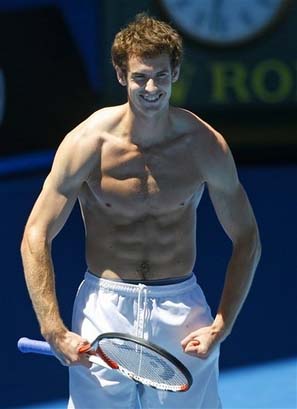
Gilles Simon (pictured here) took five sets to beat American, Wayne Odesnik, 3-6, 7-5, 6-2, 4-6, 6-4. Odesknik has actually made it further in the French than Simon has. In four prior attempts, Simon has never gotten past the 2nd round, and in 3 of the previous 4 years, Simon has lost in the 1st round. Odesnik, who was a wildcard last year, in a special deal between France and the US where France gave one American a wildcard (USTA picked Odesnik) for one wildcard given to a French player at the US Open.
Odesnik used the most of his wildcard and reached the third round where he lost to Novak Djokovic in straight sets.
This was a trap match for Simon. Simon has not played well this year and Roland Garros has not been kind to him. Odesnik was hitting his lefty forehands well. However, Simon came through with a key break in the fifth and rode it to victory. Perhaps this might be a good tournament for Simon to get back to the form he showed in the second half of last year.
Ivo Karlovic had a dubious distinction. He's acknowledged as the biggest server in the game. However, his huge serve doesn't always translate to wins. Today, Karlovic fired 55 aces against Lleyton Hewitt. Despite this, he lost in five sets to the tough Aussie: 6-7, 6-7, 7-6, 6-4, 6-3. Need less to say, tiebreaks and Karlovic are often synonymous.
Querrey had a tough opener, playing Ernests Gulbis. Gulbis hasn't really had that much of a year, but he's still a tough opponent. Querrey lost the opening set tiebreak and eventually lost in 4 sets. Querrey is having trouble breaking through to the next level. Right now, he seems relegated to the middling high ranks of 30 or 40. Ranked high enough to not have to qualify, but not high enough to get through a few rounds consistently.
Despite losses to Odesnik and Querrey, things weren't all bad for Americans. Robert Kendrick won a five setter over Daniel Brands of Germany, 6-3 in the fifth. Kendrick had to win a monster 3rd set tiebreak, 13-11, to keep the match going.
Sunday wasn't tough for everyone. The easy wins include: Cilic over Henrych (6-0, 6-4, 6-3), Golubev over Gremelmayr (6-3, 6-3, 6-2), Almagro over Callieri (6-4, 6-1, 6-3), Ferrer over Gil (6-2, 6-4, 6-4), and Verdasco over Serra (6-2, 6-1, 6-4).
Other than Montcourt, who had Yen-Tsun Lu retire after one set, the player that had the easiest opening round was Scot, Andy Murray. Although Murray is ranked 3, his play on clay leading up to the French has been spotty. His best performance was early on, with a semifinal loss to Rafael Nadal. He looked passive in his loss to del Potro in Madrid.
Today, Murray was matched against Juan Ignacio Chela. Chela was once in the top 20, ranked as high as 15. However, due to injury, he was out for a number of months. He is currently ranked 183.
You don't expect a player ranked so low to bother Andy Murray, even if he used to be much tougher. However, Chela's best surface is clay and Murray's worst surface is clay. Even so, this was one of Murray's better matches.
He played far more aggressive than he normally does, trying to set up for big forehands inside-out, trying to dictate play more than he had in previous clay events. Even when Chela was moving Murray around, Murray would often dig another shot out and elicit an error on Chela.
When Chela made the mistake of approaching the Murray forehand, Murray would flick a dipping crosscourt passing shot. He did this so often that commentator and former player and Murray coach, Brad Gilbert, pointed out that Murray always hits his forehand passes crosscourt.
Chris Fowler, whose actually a pretty good commentatory (does his homework, can watch the matches and say intelligent things), pointed out that it would be hard to cover that dipping shot.
Murray won handily, 6-2, 6-2, 6-1. This was a lopsided win, but bodes well for getting through a few more rounds. Gilbert feels Murray has the easiest quarter (I think Federer does, but partly because Federer is so comfortable playing Blake and Roddick, the highest seeds in his quarter) and should go deep in the tournament. I don't know if I agree, but certainly, he looked really sharp in his opening round. Like Fed and Djokovic, Murray is relying on his drop shot a great deal. We'll see how much he uses it in this year's tournament.
I think the danger player for Murray is Fernando Gonzalez of Chile. The two have played twice and split matches 1-1. However, the last time they faced each other was in 2006, before Murray made his big move up in 2008.
Tomorrow, Rafael Nadal will play Marcos Daniel of Brazil. Roger Federer will plays Spaniard, Alberto Martin. Andy Roddick and Fernando Gonzalez also play on Monday.
Enjoy the tennis!Labels: french open
posted by Charlzz at

The French Open draw was announced today. Sometimes you wonder if the draw is done at random or not.
The big question, first.
Who got Novak Djokovic?
Turns out Novak is in Roger's half of the draw. This means Andy Murray is in Nadal's half of the draw.
Nadal opens up playing a qualifier. In his quarter of the draw are: Karlovic, Soderling, Ferrer, Davydenko, Wawrinka, Almagro. and Verdasco. I'm sure Verdasco is wondering why he is always on Nadal's section of the draw. Nadal has the biggest group of tough players in his quarter.
In Murray's section is: Montanes, Lopez, Stepanek, Gonzalez, Granollers, Simon. He faces Juan Ignocio Chela, once 15 in the world, now mired in the 200s. All things considered, this isn't too horrible of a quarter for Murray. Still, he'll need some work to get out of this quarter.
In Djokovic's quarter is Andreev, Tsonga, Robredo, Fish, Ljubicic, and del Potro. This is a fairly tough section. Djokovic opens up with veteran Nicolas Lapentti. Ranked as high as 6 in the world, he's now around 100.
In Federer's quarter is Roddick, Blake, Monfils, Berdych. Roger seems to have the easiest quarter. Roger plays Alberto Martin. He's been as high as the mid 30s, has made it to the 4th round of the French (3 years ago), but is ranked about 100 now.
In order of tough players, Nadal appears to have the toughest quarter, then Djokovic, then Murray, then Federer. The good news for Nadal is that many of the tough players are in Verdasco's eighth of the draw, so only one player can come out of that section. Nadal's toughest rival might be David Ferrer, if he can get out of his part of the draw.
posted by Charlzz at
 The big clay court tournaments are done. There were three Masters 1000 tournaments: Monte Carlo, Rome, and Madrid (which replaced Hamburg). The big clay court tournaments are done. There were three Masters 1000 tournaments: Monte Carlo, Rome, and Madrid (which replaced Hamburg).
The top players are taking the week prior to the French to get ready for the second Grand Slam major of the year.
There are, of course, some minor clay court tournaments being played this week, one week prior to the French. Lower ranked players are using this time to get some extra play and pay in.
This is a good time to see how the top 10 players are looking, heading into the French.
First up is four time defending champion, Rafael Nadal. He won Monte Carlo and Rome, and was runner-up to Federer in Madrid. He's the class of the field, again. There are maybe two players that currently look like threats to Nadal. We'll get to them. He should be considered a strong favorite to repeat, although he looks a little more vulnerable than last year. Nadal did lose to Ferrero last year in Rome, but then played like a machine at the French, winning without dropping a set and demolishing Federer in the final. Expect Nadal to step it up.
Number 2 Roger Federer has followed up 2008 with a similarly spotty 2009. Roger had more success on clay in 2008. He played Rafa twice in Masters 1000 finals.
This year, Roger lost in the third round in Monte Carlo (to Wawrinka), the semis in Rome (to Djokovic), and won Madrid. At least, his results are trending in the right direction. The victory against Nadal was huge, but the way he won it and the circumstances he won it make people wonder if he can repeat in a best of 5 in Paris. Nadal isn't his only challenge. Djokovic is playing well on clay and has beaten Roger. Roger has to eliminate lapses in his game if he hopes to beat players like Djokovic.
Based on Novak's strong play, you have to consider him the second favorite behind Nadal. He finally seems comfortable with his racquet, and his finding good range. Furthermore, he doesn't yet look dejected despite three losses to Rafa, the last, a tantalizingly close loss in Madrid.
Number 3 Andy Murray lost in the semis in Monte Carlo (to Rafa), lost in the 2nd round (opening) in Rome (to Juan Monaco), and lost in the quarterfinals in Madrid (to del Potro). Right now, his record on clay looks spotty. Murray seems uncertain how he should play on clay. He mentioned how Rafa starts matches hitting from way back and works his way into matches (Murray likes hitting from way back) and tried to imitate that. Then he noted that the top players (Fed/Djokovic) don't change their play that much from hard courts to clay, so perhaps he plans to play clay more like a hardcourt. Murray hopes to play in the second week. That would be pretty good for Murray. If he doesn't play more aggressively, he's in for an early loss.
Number 4 Novak Djokovic was a finalist (to Nadal) in Monte Carlo and Rome. He beat Roger in Rome. He lost to Rafa in the semis at Madrid. If Rafa looks to be the favorite going into Paris, you have to, on record, pick Novak as second favorite. He's had the second best record, only losing to Rafa. He's beaten Roger. The one catch is Roger has beaten Rafa. Djokovic's best chance is to be on Roger's side of the draw. Roger's best chance is for Novak to be on Rafa's side of the draw.
Number 5 Juan Martin del Potro lost to Ljubicic, who has had a pretty good clay season, in the second (opening round) of Monte Carlo, lost to Djokovic in the semis in Rome, and lost to Federer in the semis to Federer. He's had a solid clay season, but the guys ahead of him (minus Murray) are still too good for him. Still, he should be good to the quarterfinals of the French.
Number 6 is Andy Roddick. Roddick got married and skipped Monte Carlo and Rome. He reached the quarters of Madrid (the only clay tournament he played), losing to Federer. Clay is not Roddick's best surface. However, Roddick does have a decently steady game. He doesn't have enough firepower to scare enough people, but I feel his game is a bit better suited to clay than, say, Murray mostly because he can hit a bit harder and his serve. Since he's played so little this clay season, it's really hard to say where his game is. Probably good for a quarterfinal appearance.
Number 7 Gilles Simon had a bad loss to Andreas Beck in the second round of Monte Carlo, lost to Zverev in the 3rd round in Rome, and lost to Ljubicic in the 3rd round at Rome. For a guy who looked awfully good on hard courts and indoors last year, Simon looks pretty shaky since he lost two Davis Cup matches against the Czech Republic (to Berdych and to Stepanek). Simon appears to be heading in the wrong direction in 2009. I think unless he shapes up, expect an early round loss for the steady Frenchman.
Number 8 Fernando Verdasco lost to Djokovic in the quarters of Monte Carlo, and to Rafa in the quarters of Rome and Madrid. I think he's hoping Rafa is not in his half of the draw. Verdasco has the kind of game that could take him pretty far. I think he should have a decent French Open. He's the big wildcard that could make life tough for whoever meets him. The main problem for Verdasco is errors and his mental toughness. His strength is his serve and huge forehand.
Number 9 Jo-Wilfried Tsonga didn't play Monte Carlo, lost to Gasquet in the first round of Rome, and to Ljubicic in the second round of Madrid. Tsonga's play has been worse than Gilles Simon. Doesn't look good heading into the French. The entire French contingent seems pretty bad (Gasquet is suspended, and I think Monfils is hurt).
Number 10 Nikolay Davydenko lost in the quarters of Monte Carlo to Murray, lost in the second round to Melzer at Rome, and didn't play his match against Roddick at Madrid. Again, a spotty record leading to the French. He was number 4 in the world last year, so things have not been that great for him in 2009. He was pretty much missing on the tour from mid February to mid April due to an injury and is likely not 100%.
Outside the top 10, I could see Blake or Fish going a few rounds. Stan Wawrinka and Tommy Robredo should be good for a few rounds too. Ivan Ljubicic, despite his relatively low ranking, has been playing pretty well as of late. Juan Monaco has also played pretty well.
Based on form, I'd put Nadal 1, Djokovic 2, Federer 3, del Potro 4, and maybe Verdasco 5.
Although Murray is ranked 3 and will be seeded 3rd, he's going to have to find some answers quick if he expects a successful French. His style is a bit too passive and he lets big hitters push him around. Short of injury, he's the likely top seed to fall first.
Rafa's biggest threats are Djokovic and Federer. Those appear to be the only two guys that can really hurt Rafa. He's played well against del Potro and Verdasco. It's hard to see anyone else who might bother Rafa as long as he stays healthy. He's still the prohibitive favorite, but Roger's recent win and Djokovic's near win make it interesting. Rafa may still have to go through them both to reclaim his title.
Any predictions?
posted by Charlzz at

Is Fed really back?
If you were Federer's coach--and he's had none in quite a while, despite overtures to Darren Cahill--what would you suggest Federer do?
You'd probably tell him to run around his backhand to counteract Nadal's constant barrage of serves to his backhand. You'd probably tell him to play long points and learn to be patient with Rafa. You'd tell him to look at Novak Djokovic's play and tell him to play like Djokovic.
But Roger, he's a stubborn one. He plays the way he plays, full of high risk. He wants to be in control of the matches, even when he's not full in control of his own play.
There are two ways to play Rafa. You play him like Djokovic. Play long rallies. Look for opportunities. Hit the big shot. Hope it goes in.
Then you play like Fed did. You take your chances. You go for big shots. Lower ranked players play this way. Gabashvili tried this, but made way too many errors. None of them are at Fed's level of play.
If Federer has someone to thank for his win, he can thank Djokovic. A long 4 hour match, the longest in Masters 1000 history, meant Rafa was less than fresh in a final. Rafa is often at his most vulnerable after playing a long match with no rest. It also helped that Djokovic was in Nadal's part of the draw, so he only had to play one of them, and not both. Fed would have had more trouble in the final playing Djokovic.
Unlike the Australian Open where Rafa got a day of rest, Rafa had to come back from his epic win over Novak Djokovic, less than 24 hours to face a fresh Roger Federer who had won handily over up-and-coming Argentine, Juan Martin del Potro.
Federer can also thank Madrid. The altitude means Rafa has had concerns about keeping the ball in play due to Madrid's high altitude. Witness his problems against Novak in the semis.
Despite the length of the semifinals, you can hardly pick against Rafa. Rafa is the king of clay and this was the first Masters 1000 for Fed this year. He hadn't beaten Rafa in over a year. His confidence was shot from Rafa's AO win. Everyone was wondering whether Fed could even compete against Rafa. Roger, despite the losses, still believed in himself.
The result you'd expect least was a easy Fed win over Nadal, but that was what happened. Fed picked the most bizarre strategy imaginable. He went Sampras. Key to beating Nadal was serving well. Fed could have tried to outlast Rafa (ha!), or to serve-and-volley like Edberg. Unlikely. His best chance was to serve better. Get more serves in. Dominate with big serves. Do it Sampras-style. And that was key to beating Nadal.
Beyond that, Fed just decided he was going for big shots as much as he could. He wasn't going to get into long rallies with Nadal. Who knew Rafa needed high shot count to feel comfortable with a match? Fed was not going to get into 20 shot rallies. If a rally went 10 shots or less, perfect. Quick points, quick points, quick points.
Fed opened up with a style I can only call serve-and-strike. Hit a big serve, take the short return, and power to the corners. That combined with a big serve, and Fed was actually holding serves. Despite a few hiccups where he missed shots, Fed managed to get enough in, often clipping the line, that Rafa had troubles.
On Rafa's serve, Fed simply took chances. For most games, this meant Rafa managed to hold easily because Fed was giving him errors. But Fed got a break in each set, Sampras-style, and held his serve, despite close calls.
Just when you thought Fed had no answers to Rafa, he puts his high-risk style in overdrive.
And what does it mean for the French? It means wait and see. The tournament is two weeks long. Fed is probably fervently wishing that Djokovic is in Rafa's half of the draw, like he was at the French. He's hoping for a gruelling 5-set win for Rafa or perhaps for Noval. The French surface will be friendlier than Madrid, so it will again favor Nadal.
Until then, Roger can be happy that he won a big tournament, his first in quite a long time.
Welcome back.
posted by Charlzz at
 The clay season leading to the French Open is nearly over. The third of the Masters 1000 clay events will have its final tomorrow. The three tournaments in 2009 are: Monte Carlo, Rome, and Madrid. Madrid was an indoors event but was recently changed to clay, held at the new Magic Box arena, replacing Hamburg which was demoted to an ATP 500 event. The clay season leading to the French Open is nearly over. The third of the Masters 1000 clay events will have its final tomorrow. The three tournaments in 2009 are: Monte Carlo, Rome, and Madrid. Madrid was an indoors event but was recently changed to clay, held at the new Magic Box arena, replacing Hamburg which was demoted to an ATP 500 event.
The story of these three tournaments have boiled down to these two guys: Rafael Nadal, world number 1, and Novak Djokovic, world number 4. Djokovic recently slipped to 4th when he was unable to defend Rome, behind Andy Murray.
Although Andy Murray is number 3, clay is Murray's weakest surface. His style of play, while effective on faster surfaces, is a bit too passive for clay. Murray plays an odd style of tennis. If Nadal has been criticized for waiting for the unforced error, he's not in the same league as Murray. Nadal can hit amazing shots in neutral to precarious situations. Murray meanwhile hits neutral shots. Strong clay courters have pushed Murray around, making Murray look like a deer lost in headlights.
And Roger Federer? Although he's been the world number 2, aarguably the second best clay courter in the world, his clay court season in 2009 has been spotty. He lost to countryman, Stan Wawrinka, in the third round of Monte Carlo. In Rome, Federer lost to Djokovic in three sets in the semifinals. Because he's still number 2, he's always on the opposite half of the draw, and thus hasn't met Nadal no clay. Madrid will be the first match Federer has played Nadal since January.
Based on tournament results, he two best players on clay this year has been Novak Djokovic and Rafael Nadal.
To say the competition has been close, well, it's been close for a set and a little more. It's quite telling when people feel Djokovic is the best guy to beat Nadal and still has lost 6-1 and 6-2 sets
against him.
Djokovic took a set off Nadal in the finals of Monte Carlo, quite a feat as Nadal had not dropped a set in Monte Carlo in years. Although Djokovic played strongly in the third set, having opportunities to break Nadal and hold his own serve, Nadal won every critical point, and finally ran away with the set, 6-1.
They met again in the finals of Rome where Djokovic struggled on serve in the first set, but managed to break Rafa and force a tiebreak. The tiebreak went easily to Nadal. And much like a repeat of Monte Carlo, Djokovic had chances to keep the second set close, but ultimately, Nadal ran away with the second set, 6-2.
This clay court rivalry has been a kind of redemption for Djokovic, at least for the tennis savvy fan. Djokovic has been criticized for his health issues, having retired several times. It's been joked that he might complete a Grand Slam in retirements having dropped out 3 of 4 Grand Slams. Recently, he's working with a trainer to try to improve his fitness, so he doesn't retire nearly as much as he does. Fitness was also a problem that plagued Murray, one he rectified when he began seriously dealing with fitness and training in late 2007.
Djokovic's reputation as a likable player took a serious hit, at least among Americans, due to an incident at the US Open. Prior to this match, Djokovic won a five-set thriller against Spain's Tommy Robredo. Robredo was none too happy with Djokovic's numerous call to trainers, insinuating Djokovic wasn't really ill, but simply unfit. When asked about it Roddick started making jokes claiming Djokovic must have a laundry list of illnesses, like SARS.
Djokovic was none too happy about his comments, which he likely heard second-hand, and made a point of it after beating Roddick. Not surprisingly, the largely American audience turned against Djokovic booing him for making such critical remarks, and this seems to have surprised Djokovic. It may have played a small role in his loss to Federer in the semifinals. When he should have been concentrating on beating Roger, he was fighting off negative press fallout.
If Djokovic is going to rehabilitate his image, beating Nadal might be the way to do it. Djokovic has been taking tests that Nadal has admistered. Each time, Djokovic has done well, but not passed the test.
To Djokovic's credit, he knows he has the kind of game that can beat Nadal. He knows that, unlike Verdasco, he's mentally tough enough to at hang in with Nadal most of the times. Despite a lopsided head-to-head record, Djokovic keeps working at getting his game to the point where he can beat Nadal.
Their rivalry isn't Andy Roddick vs. Roger Federer, where Roddick just hopes things align so he can beat Roger. Roddick knows he doesn't have enough game to bother Federer, and the only way to beat him is for Roger to have a bad day. On the other hand, Djokovic knows if he is having a pretty good day, he can challenge Nadal.
Madrid is the third test of Djokovic vs Nadal. And this time, Djokovic had his best chance ever. Unlike his previous two meetings, Djokovic faced Nadal in the semifinals.
Several things helped Djokovic keep this match tantalizingly close. First, Nadal started off poorly. Nadal is stingy on errors, but he was tossing lots of errors off his forehand in the first set. Second, Madrid is played in altitude. That, combined with court conditions make Madrid as close to a hardcourt as one gets for a clay court. And Djokovic plays pretty good on hardcourts.
Djokovic started the match off well with an immediate break. He held the break lead and won the first set, 6-4. Nadal called for a trainer who massaged his leg and wrapped it up.
The second set was tighter. Neither player lost serve. Djokovic played as well as he did due to superior serving. Nadal took the second set in a tiebreak rather easily.
Unlike the previous matches, Djokovic did not crumble early in the third set. Indeed, he broke early, but then gave the break back. Djokovic continued to pressure Nadal in the third set, and even had a 15-40 game on Nadal, one that Nadal came back and won.
Nadal is most dangerous when he's down. If he needs a point, his level of aggression goes up. You can classify Nadal's strokes into neutral, near winner, and winners. Nadal hits more near-winners than any other player. These are shots where the opponent gets the ball back, but often barely gets the shot back, leading Nadal to an easy shot that he pounces on. He does this so well that players have to train to deal with this shot and have a reasonable reply.
Djokovic handles these shots as well as anyone on tour. It helps that he has a two-handed backhand and can do more with shots to his backhand than, say, Roger Federer.
In the third set, Djokovic faced break points. Taking a page out of Nadal's book, Djokovic played very aggressive, taking the game to Nadal and winning these games. Playing aggressive against Nadal is a risky proposition. If you are too aggressive, you make errors, and hand games to Nadal. Djokovic has just enough consistency that he can hit hard aggressive shots and not make too many errors. He's not in the same league as Nadal, but for that style of play, he's probably Nadal's closest rival.
Djokovic pushed Nadal to a third set tiebreak. Could Novak finally beat Nadal?
Here's an interesting stat. Djokovic has never won a tiebreak against Nadal. To be fair, in their 18 meetings, they've only ever played 5 tiebreakers, and 2 of them were in the Madrid semifinals.
This tiebreak was tantalizingly close with Djokovic had several opportunities to win the match. If anything, Nadal's superior serving at break points helped keep Nadal in the tiebreak. When Djokovic had opportunities, Nadal became the aggressor and hit amazing shots.
What Nadal does better than anyone in the world is to play huge shots at huge moments. This is the sign of a great champion. Obviously, if he wilted in such situations, he wouldn't be number 1, but it's a testament to Nadal's skill as a player, both mental and physical, that he wills himself to win crucial points.
The 11-9 win in the tiebreak is as good a tiebreak as you'll see, and Djokovic had the match on his racquet several times. This defeat has to be hugely discouraging, and yet, Djokovic needs to realize he's close, he's close, he's close, and keep working at his game.
Many would say this incredible match should have been the final.
Except.
Except that Roger Federer finally beat the players he should have beaten and made it to the finals. Federer hasn't played Nadal since the Australian Open. The prior two meetings were at the French Open final and Wimbledon final. And it's mostly been Federer who has been unable to make finals to meet Nadal.
If Federer is going to win, and the likelihood seems remote, he'll do it through big serves, and taking his game to Nadal. He can't slip mentally and start spraying shots as he's done against nearly all his top rivals. Nadal may have to help out by playing subpar.
One can only hope the intrigue to this final is matched by the actual play. Alas, it's going to be very hard to top the semifinal match, and that odds are, it will be far less than exciting. I can only hope that I'm wrong, and the finals top the semis.
posted by Charlzz at

Madrid is the third and final Masters 1000 clay court tournament leading up to the French Open. Monte Carlo was the first and Rome was the second.
Madrid was an indoors event last year, but it was moved to a clay tournament this year. Meanwhile, Hamburg was dropped from the Masters series. The official name is ATP World Tour Masters 1000 which is a bit of a mouthful.
Shanghai was added to the Masters 1000 tour to replace Madrid. Hamburg was demoted to an ATP 500 tournament.
Let's start off with seeds:
- Rafael NADAL
- Roger FEDERER
- Novak DJOKOVIC
- Andy MURRAY
- Juan Martin DEL POTRO
- Andy RODDICK
- Fernando VERDASCO
- Gilles SIMON
- Jo-Wilfried TSONGA
- Nikolay DAVYDENKO
- Stanislas WAWRINKA
- David FERRER
- Marin CILIC
- James BLAKE
- Radek STEPANEK
- Tommy ROBREDO
Andy Murray is the defending champion. This was due to Madrid being moved from an indoors event, one that favors Murray, to a clay event. Although Madrid "replaces" Hamburg, the points from Hamburg in 2008 drop off this week. Hamburg 2009 will be played July 20. That is an ATP 500 event.
The points from Madrid 2008, the one where Murray is defending champion, don't drop off until the Shanghai Masters is played in October (Shanghai "replaces" Madrid as the Masters 1000 indoors event). So Murray will still keep his Madrid 2008 points and effectively only need to defend his Hamburg points from last year.
Think of Hamburg 2009 as just another ATP 500 tournament. Effectively, players defend Hamburg 2008 points with Madrid 2009 points. Obviously, Hamburg organizers are not happy.
Although Murray has improved to a career high #3, the seedings were determined prior to that change, so he is seeded 4th at Madrid. Murray has yet to show that he is a huge threat on clay. On Tuesday, he won a tight match against Italian, Simone Bolleli, 7-6(9), 6-4. In interviews, he said he played very well, crediting Bolleli with playing well. Others would argue that he should make easy work of Bolleli because he'll have to deal with tougher players.
Murray has a lot of work to do to reach the semifinals, or for that matter, the next round, as he faces Tommy Robredo next.
Of the upcoming matches, I'm curious how David Ferrer will do against Juan Monaco. Ferrer had been declining in the rankings, but he's been playing better on clay lately, most recently reaching the Barcelona final, an ATP 500 event, losing to Rafael Nadal. Monaco did well in the Rome, losing to Fernando Gonzalez in the quarterfinals. I have to believe Ferrer is playing much better recently, and should be favored to win.
Verdasco is in the same quarter as Nadal and the two are expected to meet each other. Verdasco had an easy win over former number 1, Juan Carlos Ferrero, 6-3, 6-3.
Djokovic is in a fairly easy eighth. He plays wildcard, Oscar Hernandez, next, and the winner of Querrey and Seppi, after that.
Robredo-Murray should be a tough match for Murray. Although Jason has picked Robredo as his man during the clay court season, he lost to Juan Monaco in Monte Carlo in the round of 32, lost to David Ferrer in the quarters of Barcelona, and to Novak Djokovic in the round of 16. A win by Murray against a tough clay-courter like Robredo would show he's making progress on clay.
A tough eighth is the one with del Potro, Berdych, Chardy, and Wawrinka. del Potro hasn't had a great clay season so far, so it could be any of these four.
Andy Roddick returns back to play after his marriage. Unlike Federer, Roddick didn't return to tour right away. He skipped Monte Carlo and Rome. This is his first clay event. He plays veteran Tommy Haas. Although Roddick was showing proficiency on clay last year until he got injured, no one knows how Roddick will fare this year. He's in the same section as Davydenko, who has performed well in the smaller clay events in Estoril and Barcelona, reaching the semis of both.
Federer will take on the winner of Blake and Karlovic. Blake reached the finals at Estoril, so his confidence on clay is probably quite high. His high risk play and Karlovic's big serve mean it's a toss-up who wins that match. Federer has confidence playing both, so should get through that eighth.
Of the four quarters, Nadal and Djokovic are in the best form and should get through their quarters. Federer has a friendly enough section and should make it through as well. Murray is going to have to play well to get out of his quarter. That quarter seems the most up in the air.
I'd bet Federer-Nadal and Nadal to win. The question is whether Federer wants to meet Nadal before the French or not, but at this point, it would be a huge boost to his confidence to win Madrid. I would find it hard to believe Federer is intentionally trying to duck Nadal.
posted by Charlzz at
 2008 was a big year for a number of players on the men's tour. 2008 was a big year for a number of players on the men's tour.
Juan-Martin del Potro came from nowhere to land in the top 10. Jo-Wilfried Tsonga used an Australian Open finals appearance and a solid indoor season to move there too. Countryman, Gilles Simon, played remarkably steady during the hard-court and indoor season to move into the top 10 as well.
Perhaps the most interesting change in ranking, despite the small bump in ranking from 6 to 4, Andy Murray's leap may be the most significant. It's hard to break into the top 10, but to break into the top 3 is even harder.
Most people make that jump early in their career. It's a rare player to be in the top 3 whose talent nobody saw when they were 17 or 18 years old. Federer is a bit of an anomaly who didn't start to make a huge impact until he was 21.
Andy Murray's rise to number 3 in the world started with the hiring of Team Murray. Team Murray includes Miles Maclagan, his coach, Matty Little and Jez Green, his conditioning/fitness coaches, and Andy Ireland, his physiotherapist. Prior to this, Murray worked with Brad Gilbert. This change reflected a dissatisfaction with Brad Gilbert as his coach. Murray felt he was always having arguments with Gilbert, since Gilbert is strongly opinionated. He wanted someone that thought about the game like he did and someone he could discuss his game rationally with.
Murray started with his new team in late 2007 during the one month tennis off-season, December. His plan was to work training and fitness year-round, bringing his trainers to tournaments.
Things started off well in 2008. Murray won at Doha and Marseilles early in 2008 (on hard courts). But it took a while to get used to his new fitness routine. Murray wouldn't win another title until Cincinnati in August. His Grand Slam record prior to Wimbledon was spotty. He lost in the first round of the Australian Open. A bad loss, it probably helped that Murray lost to eventual finalist, Jo-Wilfried Tsonga. In the French Open, he lost to Almagro in the third round. Despite his training, he didn't get past the third round of any clay event in 2008.
Wimbledon was a big breakthrough for Murray. Often criticized for not fighting his way out of tough matches, he pulled out a 5-setter against Richard Gasquet. Gasquet was up 2 sets to none and serving for the match. Although Murray would end up losing in straight sets to eventual winner, Rafael Nadal, this win, on a surface that isn't his best, was key, showing that he was heading in the right direction.
Despite his success at Wimbledon, Murray's best surfaces are indoors and hard courts. His preference for hard courts goes back to the juniors. In the year that Monfils won 3 of 4 Grand Slam junior events, Murray won the 4th, which was the US Open.
Murray's fitness program began to yield big results in the 2008 hardcourt season. He reached the semifinals in Toronto and won in Cincinatti, both Masters series events. Murray beat Djokovic twice both tournaments, a player he had had trouble with before. He would follow that with his biggest win, taking out Rafael Nadal in 4 sets in the US Open semifinals.
The real test of Murray's preparation is how he fares on clay, his worst surface. Andy relies on the speed of the court to play aggressive when he needs to. The slow pace of clay means the prototypical clay grinder can stay even with Murray and not be fazed by his change of pace. On faster surfaces, Murray's serve is more effective, and this makes it easier for him to hold serve.
Murray is a longshot to win the French or even reach the finals. Only a few weeks away, almost everyone thinks Nadal will win the French again. For Murray to win, he'd most likely have to beat Nadal, and lately, no one has made a huge impression on Nadal.
Let's quickly review Nadal's top rivals to win the French. Federer has been in the last 3 French finals against Nadal and has come second each time. Fed looked less than invincible in 2008, which was mostly blamed on mono that he got late in 2007. Despite uncharacteristic losses, Federer still had an amazing year in the Slams, reaching the AO semis, the French and Wimbledon finals, and winning the US Open. Still, most people felt Federer had slipped a notch, and he ceded number 1 to longtime rival, Rafa Nadal.
At the end of 2008, Federer injured his back. He's mentioned in interviews that his back took longer to heal than expected which may contribute to his funk in 2009. People used to blame his losses to Nadal to Rafa's mental edge. Fed could beat everyone else, but not Nadal.
However, by the end of 2008 and throughout 2009, Federer has now become vulnerable to Novak Djokovic and Andy Murray. He hasn't beaten either one since the US Open, where he bat them both. People are no longer asking whether Federer will reach number 1 again, but whether he can stay at number 2. Djokovic and Murray are competing heavily to get that number 2 slot.
Despite these losses, Federer is unusually optimistic. He argues that his losses to Murray and Djokovic have been 3-setters and not blowouts. He feels that he is still the one who determines who wins or loses, not his opponent. Still, it would require a big effort for Federer to reach the finals of the French Open given he's yet to reach a clay court final in 2009. It's almost as if he's avoiding Nadal until the French (in which case, one would expect Federer not to reach the finals of Madrid).
Based on current form, Novak Djokovic is Nadal's closest rival. Close is, of course, relative. It's like saying Serena is the closest woman to beating a male pro. It may be true, but Serena isn't likely to beat any male pro soon.
In the 2009 clay court events, Djokovic has looked good for a set or a set and a half against Nadal, but Nadal manages to win the games when it matters most. Djokovic has to balance being aggressive against Nadal with making too many unforced errors, and right now, unforced errors have been his downfall.
In Monte Carlo, Novak took a set off Nadal, quite an accomplishment since Nadal hadn't dropped a set since 2006. However, Novak lost the third set 6-1. Despite the blowout score, Novak had numerous chances to win games but nearly everyone went to Nadal.
In Rome, Djokovic managed to push Nadal to a tiebreak after being broken twice and then breaking back twice. However, Nadal won the tiebreak. Although Djokovic looked good in the early parts of the second set, Nadal again came through, and won the set 6-2. This is what happens when you play the king of clay. Close isn't good enough.
There are some dark horses that might bother Nadal. Verdasco gave Nadal fits at the Australian, but has posed little challenge on clay. del Potro finally beat Nadal, but that was on the hard courts. Ferrer has looked more solid lately. James Blake(!) just won a clay event in Portugal and Tomas Berdych won one in Germany. These are smaller events with weaker fields, but an ATP win is still a confidence builder.
And where does Murray fit in all this? Murray knows clay is his worst surface. He gave Nadal a fight in Monte Carlo. On clay, Federer or Djokovic is probably favored over Murray. You'd give Murray the slight edge against these two on a faster surface.
Rather than play a lot of clay court events, a strategy that probaby wouldn't help, Murray has only entered 3 clay court tournaments, all of them Masters series tournaments. He has entered Monte Carlo, Rome, and Madrid.
How has Murray fared? In 2008, he didn't get past the third round of any clay event. He was hoping for a late round appearance in one of these events. In Monte Carlo, he reached the semis beating Davydenko en route (Davydenko had just returned to the tour). There, Murray predictably lost to Nadal, but pushed him to a tiebreak. That was a good result for Murray and gave him points on clay which he lacked from 2008.
In Rome, Murray lost in the second round to Juan Monaco of Argentina in 3 sets, a player he had beaten once on hard courts earlier in 2009, but not played since he was a junior training in Spain. He lost in the second round the previous year too, so he lost no points. Despite this early loss, Murray moved to number 3 because Djokovic failed to defend his title at Rome, losing (not surprisingly) to Nadal.
Murray's has used the off weeks between Monte Carlo, Rome, and Madrid to work on his fitness and adjust his strategy to play on clay. He primarily trains in London with his team, working on both fitness and strategy, which he has tuned for the clay court season.
Murray stays loose during these practice sessions due to a variety of silly games his team plays.
Losers of these games must do silly things like wear women's clothing, hose down the clay court, or get in an ice bath, post training, sans shorts. These are so-called forfeits.
How do I know these details? Am I chummy with Andy? Not at all. Unlike many of the top players, Andy Murray has been pretty open about his training. Like a few other celebrity athletes (most notably Shaquille O'Neal), Andy Murray uses Twitter. Twitter is considered a microblogging service. You are limited to 140 character updates. Murray often details the forfeits of the day via tweets giving his fans a peek at the life of a pro.
Andy Murray's webpage details his training. Photos of Murray working in the gym, running on tracks, as well as some of the lighter moments. It's surprising to see a top player this open about his training.
Can you imagine the reserved Roger Federer revealing how he trains? Federer protects his image zealously. You know there are things he wants to blurt out to the press, but he maintains an aura of diplomacy, much like Michael Jordan. This means, he says nice things rather than really say what's on his mind. It's hard to imagine Fed being as silly as Murray on his website. It's just not in his nature.
It's also hard to imagine Nadal, under the tutelage of Uncle Toni, revealing his training secrets. Nadal delegates a lot of his training to Uncle Toni who probably doesn't want to say what he does to make Rafa so good.
Prior to 2008, Murray has been perceived as a whiner, a guy who gives up, a guy who wasn't serious about his game. Murray had plenty of detractors prior to his rise in the rankings in 2008. His website and tweets may be part of a concerted effort to rehabilitate Murray's image showing Andy is not only a good guy, but someone working really hard to move up the rankings. In the meanwhile, we, the public, get to see what goes behind the scenes of a top pro.
Will this training yield good results? Murray is playing in Madrid, where is defending champion. Unfortunately, it was an indoors event last year, and was converted to a clay event this year. With Nadal in the field, he's unlikely to defend.
And his chances at the French? Murray would probably consider a semifinal appearance at the French as a huge success. Even a quarterfinal result would be pretty good. It will be interesting to see if his preparation leads to better results on clay. I can't wait til the French to see if anyone is ready to take it to Rafa.
posted by Charlzz at
 Commentators recently pointed out that Andy Murray plays "classic defense". This is far from the truth. Commentators recently pointed out that Andy Murray plays "classic defense". This is far from the truth.
Classic defense was predicated on getting the ball back one more time. Arantxa Sanchez-Vicario was a superb classic defender.
She didn't beat her rival, Steffi Graf, often, but when she did, it was due to her speed and ability to get every ball back. She forced Steffi to hit one more shot. Everyone knew Steffi hit much harder than Arantxa.
Arantxa was a rabid retriever, but she couldn't dictate play with power. If Graf hit a powerful forehand, Arantxa might moonball in return, or hit a forehand slice. Anything to stretch the point to another shot. That was classic defense, and Arantxa played it during the shift to power tennis in the women's game.
In the men's game, watch some classic matches, like the Pepsi Grand Slam Challenge on Tennis Channel or at the website. Watch as Borg plays Connors. Borg wasn't interested (or entirely capable) of hitting winners. The racquets were too tiny to make it a reliable way to win matches. Borg's defense was predicated on high topspin shots and his uncanny ability to hit them one more time than his opponents.
Oddly enough, the forbear of the modern defense might be Pete Sampras. Recall his classic matches against Andre Agassi. Agassi would strike his power forehand wide to Sampras's forehand. Against most players, a weak return would surely follow, one that Agassi would pounce on. Sampras, however, had mastered the reverse forehand, the forehand where you follow-through above your head. Sampras would track the ball as he moved to his right, and buggy whip an angle even bigger than the one he received, leaving Agassi dumbfounded staring at the ball that just went by him.
It wasn't long that other players began to imitate Sampras, realizing the importance of hitting a wide angle shot well. Nadal, of course, is the king of the reverse forehands. It's so hard to rush Nadal because he can buy a split second more time with the reverse forehand.
The key aspect of today's defense is the passing shot. Today's players, many with two-handed backhands, can flick a shot either up the line or sharp crosscourt, even when severely pressed. As good a striker of the ball as Nadal is, when he comes to net, a good passer has a decent chance of getting a ball by him. Nadal's success at net usually comes from the sneak approach when a player is struggling to get to a ball and Nadal swoops in for the volley.
Indeed, the decline of serve and volley can be attributed to the improvement in today's players ability to pass. As good a serve and volleyer as Federer was, he had to abandon this strategy because players were making it too difficult to approach. When was the last time you saw Nadal really struggle returning serve? Sampras's opponents routinely whiffed returns, unable to handle his pace. Perhaps the next great player will be one that both serves well and hits off the ground well, but these days, you don't need a fantastic serve to play at the top, at least, not a Sampras-like serve.
The key to a great defensive pass is a short flick of the wrist that favors positioning the ball accurately over sheer pace. It helps to have two hands on the backhand to hit this shot, but one-handers like Federer have mastered a one-handed backhand flick as well. Today's players have learned to deal with an incredible number of scenarios, no matter how unlikely, and much of that is learning the modern defense.
Next time you watch a pro match, pay attention to how well players play when they are pushed in difficult spots. This is where today's top pros really excel.
posted by Charlzz at
Estoril, Portugal ATP 250
1. Simon
2. Davydenko
3. Ferrer
4. Blake
5. Nalbandian
6. Fish
7. Montanes
8. Serra
My Pick: David Ferrer
Underdog Pick: JC Ferrero (great draw)
As with most ATP 250's, it's weak. These are the sort of events that in the past Nalbandian and Davydenko have picked up their points, as there is only a handful of elite level players. I don't think that's going to happen here however, as both of them are on the steady decline in their careers.
Interesting potential matchups:
Simon vs. Montanes: They would meet in the quarter finals. On red clay it's very likely that these are the two best players in the draw.
Ferrero vs. Davydenko: Potential quarter final meeting. Ferrero needs to win this match if he wants to keep playing tennis, and I think he will. We all know Davy can find a way to lose, and after getting past Davy, JC would face Fish on red clay. This SHOULD be a relatively easy pass into the semi's of an ATP 250, which Ferrero desperately needs.
Ferrer = Free ride to the semi's. Sure he may play against Nalbandian, but thats IF Nalbandian gets there, and it's a 95% win for Ferrer anyway.
Some decent matches... but they start in a couple days, check back for the real stuff!
For the main draw singles, click here
posted by Jason C at
|
 |

|